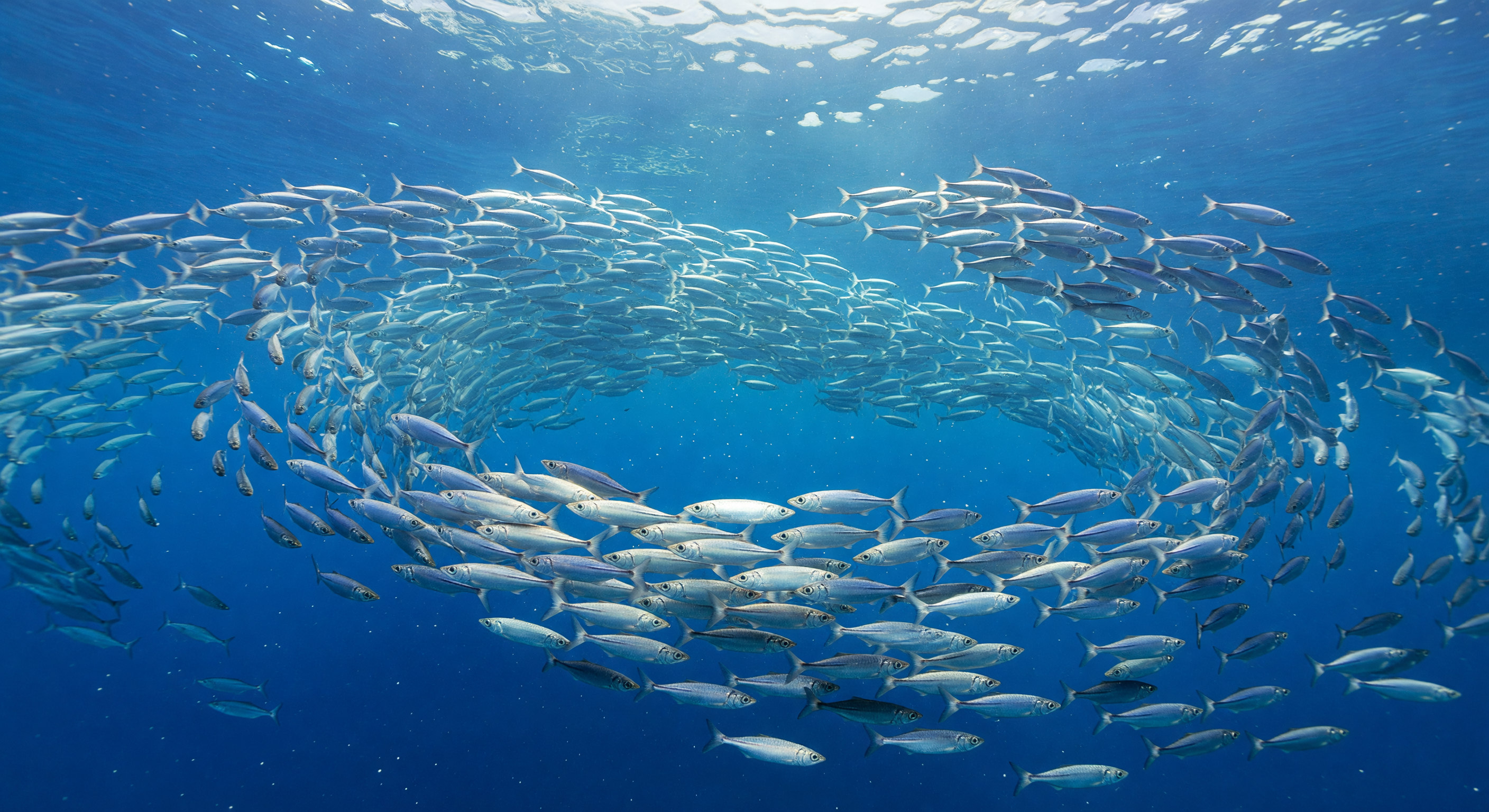
In the sunlit upper ocean, where pressure barely doubles even at depth and sunlight still reaches far enough to fuel the base of all marine life, a vast shoal of European pilchards — *Sardina pilchardus* or their Pacific kin — wheels through open water in one of the sea's most spectacular collective behaviors. Thousands upon thousands of individuals compress into sweeping arcs and then open into darker corridors of cobalt, the whole formation bending like a living vortex governed by hydrodynamic pressure waves and split-second lateral-line sensing rather than any leader or signal. Each synchronized turn presents a broadside of reflective guanine-crystal scales to the sun, converting the shoal momentarily into a shimmering mosaic of silver and white-gold against deep sapphire — a behavior known as the flash expansion, thought to confuse predators by overwhelming their ability to isolate a single target. Fine marine snow and suspended phytoplankton drift freely through the water column, catching fragments of light between the bodies, while god rays descend from the wind-rippled surface overhead, fanning outward through the euphotic zone where net photosynthesis still exceeds respiration and the entire pelagic food web begins. This is the ocean's most productive layer — a place of relentless biological momentum, radiant, indifferent, and complete without witness.
Other languages
- Français: Rotation de nuage de sardines
- Español: Rotación de nube de sardinas
- Português: Rotação de nuvem de sardinha
- Deutsch: Sardinenwolken Rotation
- العربية: دوامة سرب السردين
- हिन्दी: सार्डिन बादल घुमाव
- 日本語: イワシ雲の回転
- 한국어: 정어리 구름 회전
- Italiano: Rotazione nube di sardine
- Nederlands: Sardine wolk rotatie