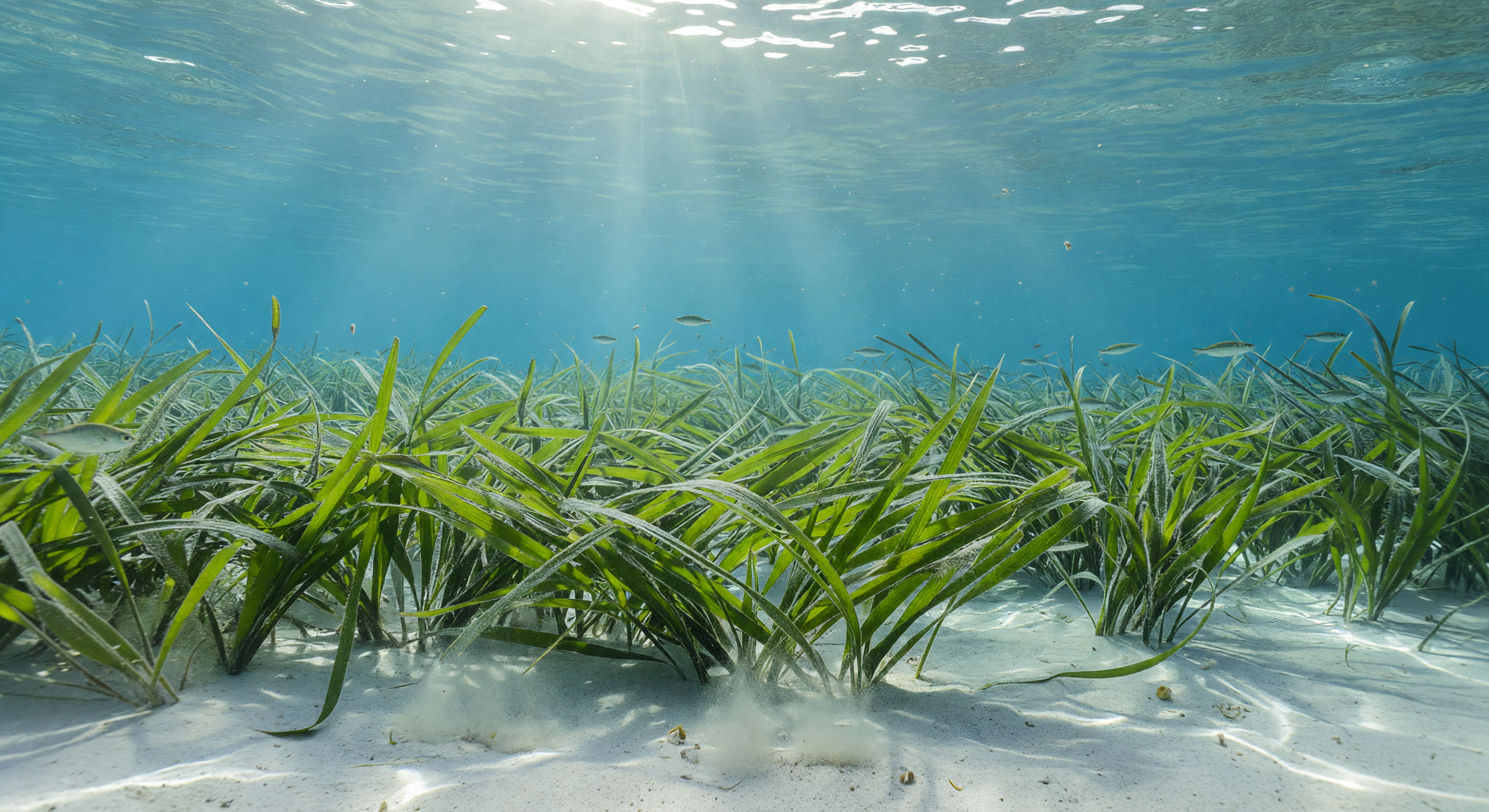
Sunlight pours through the rippled surface in broad, shifting curtains of gold and turquoise, refracting into crisp caustic ribbons that stripe the pale carbonate sediment and the swaying blades of turtle grass — *Thalassia testudinum* — whose ribbon-like leaves form a living lattice across the seafloor a few meters below the air-sea interface. This is the epipelagic realm at its shallowest and most luminous, where pressure is barely above one atmosphere, dissolved oxygen is saturated, and photosynthesis runs at full intensity, sustaining an entire trophic architecture built on light. The seagrass meadow itself is an ecosystem engineer: its root-and-rhizome matrix stabilizes the carbonate sediment, its blades host a dense film of epiphytic algae and microinvertebrates, and its canopy provides refuge for the loose aggregations of juvenile mojarras and translucent grunt fry drifting just above the tips, their silvery flanks catching and scattering the ambient light. Near the bottom, micro-disturbances lift fine detritus — fragments of shell, decomposing leaf material, foraminifera tests — into slow-spiraling suspension, tracing the subtle tidal current that bends the grass in long synchronized waves. The scene exists entirely on its own terms: a shallow tropical coastal habitat running its ancient, intricate metabolism in full sunlight, indifferent and complete.
Sunlit surface waters