Scientific confidence: Very High
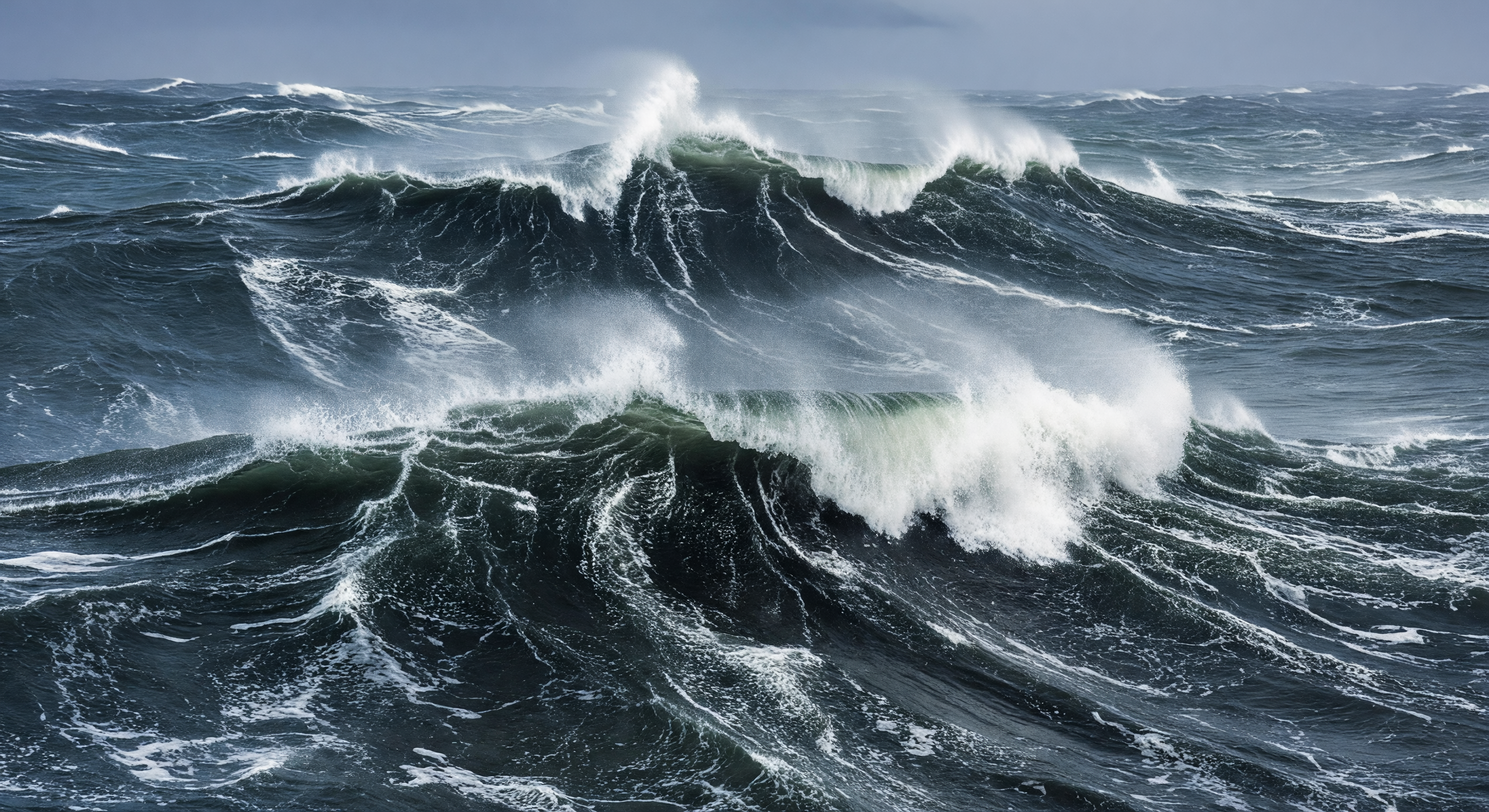
At the very threshold where atmosphere and ocean become indistinguishable, the sea surface under storm-force winds is one of the most energetically violent environments on the planet, a place where momentum, heat, and mass transfer between two fluids at rates that shape climate itself. Long swell trains generated by distant pressure systems propagate beneath shorter, steeper wind waves, their superimposition producing the characteristic cross-hatched chaos of open ocean gale conditions, while breaking crests inject billions of microscopic bubbles into the upper meter, briefly supersaturating the water with oxygen and generating the sea-salt aerosols that seed clouds far inland. The sea-surface microlayer — that biochemically extraordinary film spanning barely a millimeter — is perpetually destroyed and reformed here, its concentrated organic molecules, bacteria, and lipids shredded by each breaking wave and redistributed as spindrift racing low across the water in pale, fast-moving veils. Langmuir circulation organizes the subsurface turbulence into paired helical cells aligned with the wind, collecting foam and biological material into the long windrows visible as combed streaks across the troughs, while the mixed layer deepens with every hour of sustained gale, entraining cooler, denser water from below and erasing the seasonal thermocline. This is the ocean at its most exposed and most consequential — a raw coupling of sky and sea that has operated without interruption across billions of years, indifferent and immense.
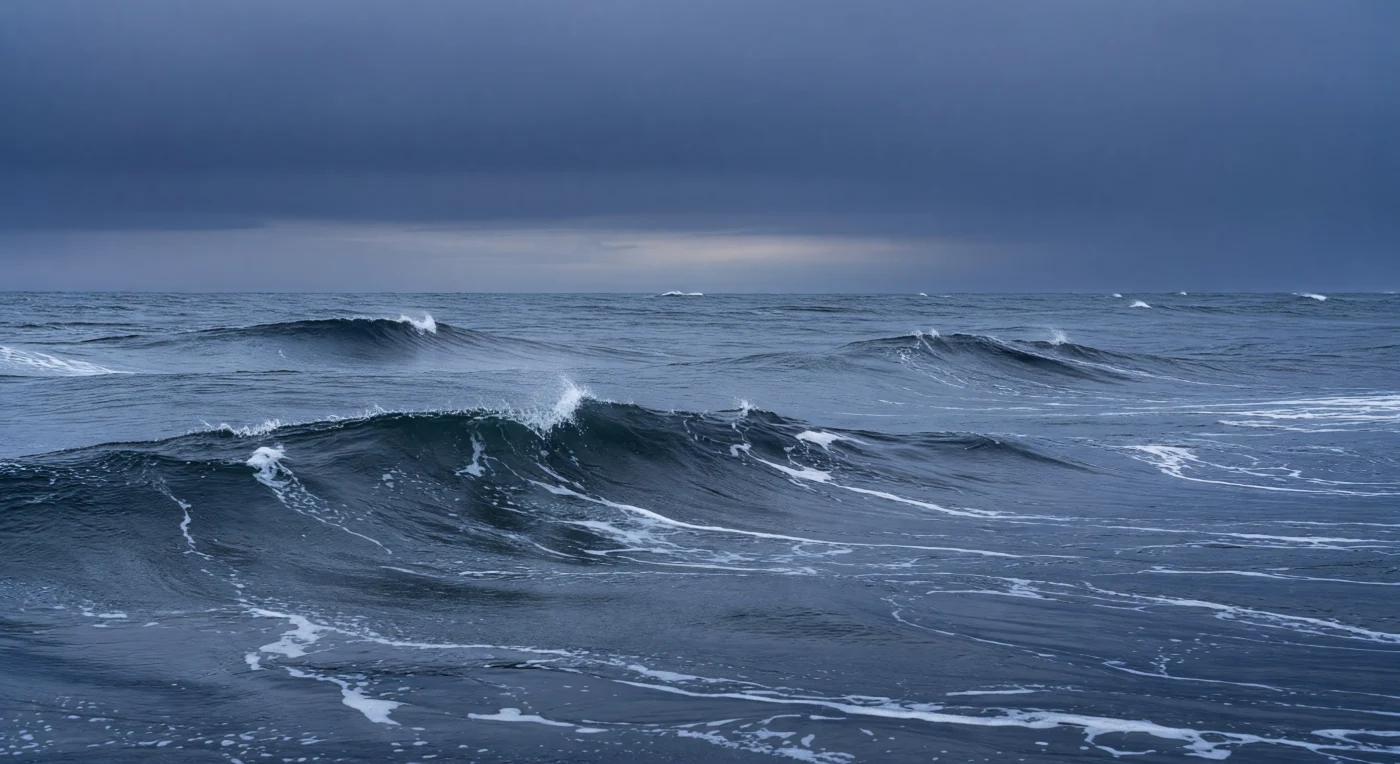
At the very boundary where ocean becomes atmosphere, gale-force winds exceeding seventeen metres per second drag the sea surface into a landscape of ordered chaos, sculpting Langmuir circulation cells that manifest as those long parallel foam windrows — convergence zones where wind-driven surface drift and counter-rotating vortex pairs trap buoyant bubbles and froth into braided ivory lanes stretching downwind for hundreds of metres. Each collapsing crest is a factory of aerosol production, with bursting bubble films ejecting billions of brine droplets and sea-salt particles into the lower atmosphere while simultaneously pumping atmospheric gases — oxygen, carbon dioxide — deep into the wave-mixed layer through plumes of entrained microbubbles that render the upper centimetres milky and supersaturated. The bottle-green colouration betrays optically deep, nutrient-bearing water where dissolved organic matter and suspended particulates absorb the red end of the spectrum, leaving this cold, heavy, iron-grey-lit palette, while the translucent olive flash at a crest's thin lip lasts only the fraction of a second before the wave overturns and shatters into shredded froth. Here pressure is barely above one atmosphere, yet the mechanical energy concentrated in this vanishingly thin interface layer drives heat flux, momentum transfer, and gas exchange at rates that regulate climate on planetary timescales — an immense, self-sustaining engine running without pause, indifferent and complete.
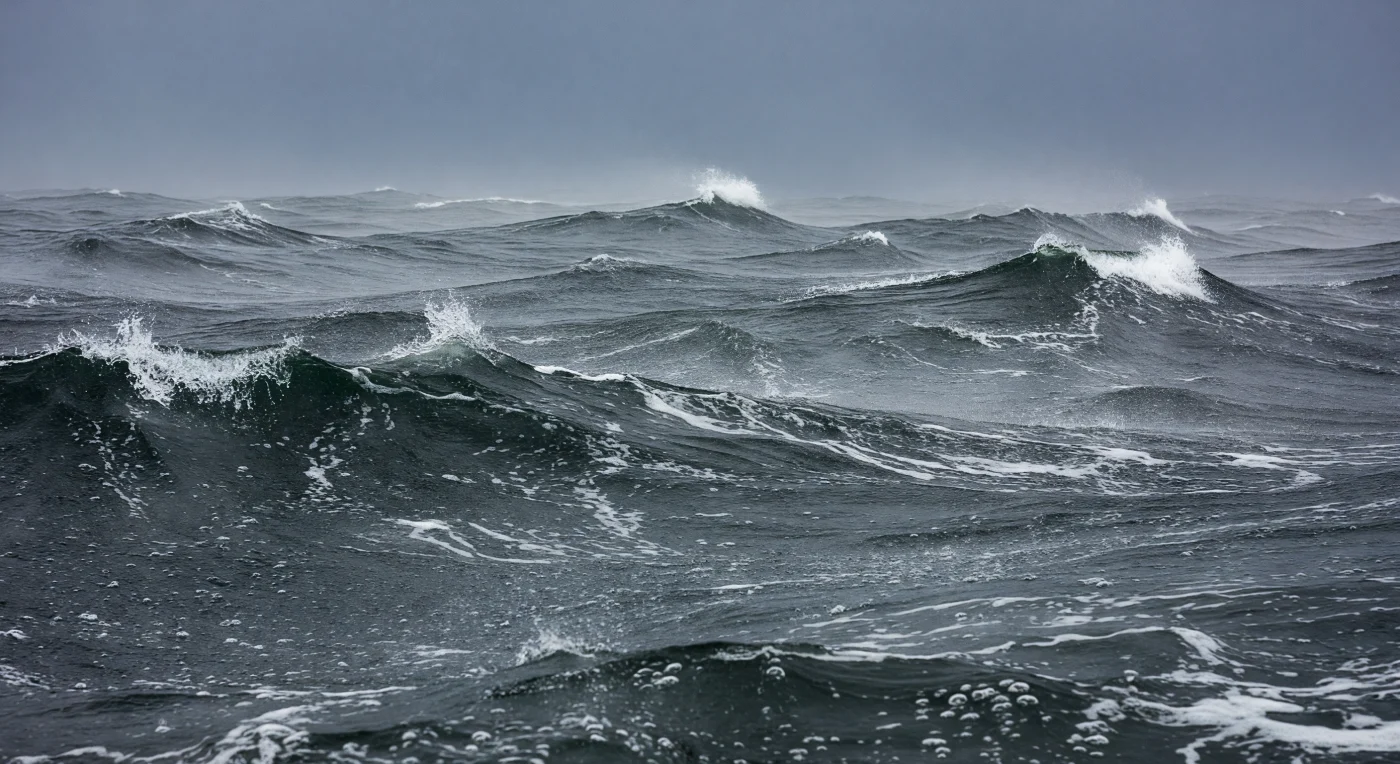
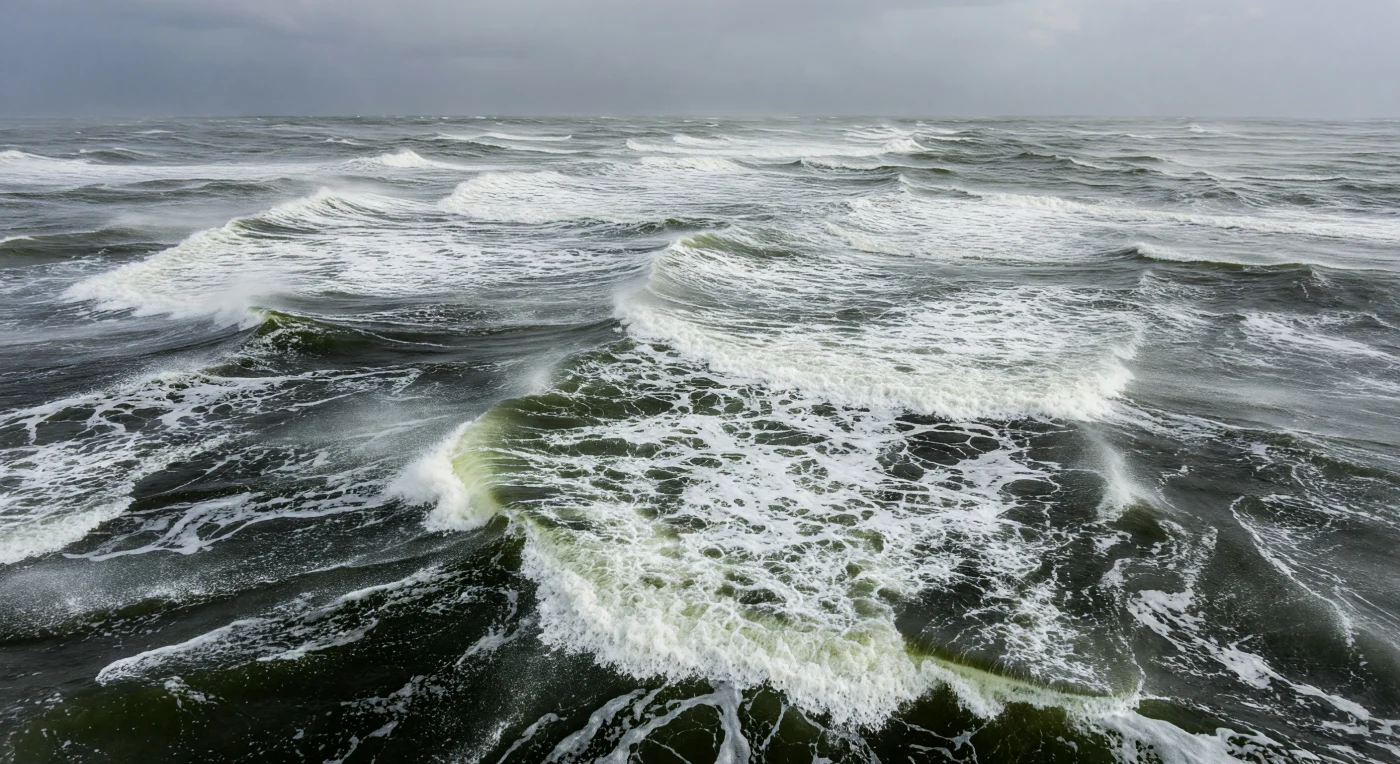
At the ocean's outermost boundary, where atmosphere and sea wage open war, a Beaufort 9–10 squall transforms the water's surface into a heaving, pewter-grey architecture of collapsing crests and rain-hammered troughs, with wind velocities exceeding 24 metres per second ripping spindrift horizontally and flattening foam into pale downwind streaks. Every breaking whitecap drives a cascade of air bubbles deep into the upper metre of the water column, creating transient plumes of oxygen-bright, aerated water where gas exchange between ocean and atmosphere accelerates dramatically — a process responsible for a significant fraction of global CO₂ absorption and marine oxygen cycling. Raindrop crowns stipple every exposed surface in their thousands, each impact momentarily disrupting the sea-surface microlayer — that biologically and chemically critical film spanning just microns to millimetres — while simultaneously contributing freshwater lenses that are almost instantly homogenised by the turbulent mixing beneath. The cold diffuse daylight, filtered through layered storm cloud and curtains of rain, catches translucent wave faces in fleeting blue-green and slate tones before each crest tears apart into white chaos, the horizon wholly dissolved into grey-white spray haze. Here, at this roiling boundary that has never needed a witness, the ocean conducts its most energetic exchange with the sky — violent, indifferent, and complete in itself.
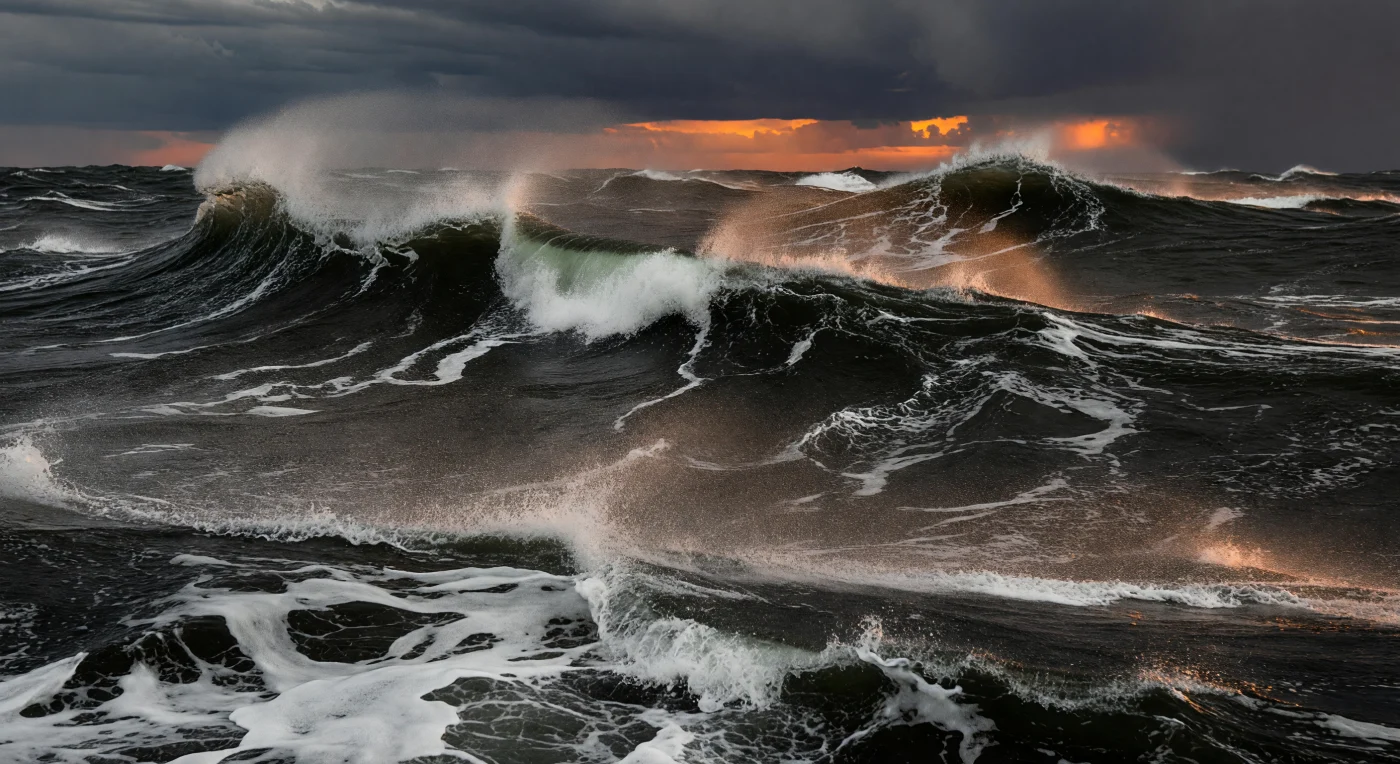
At the ocean's surface, where atmosphere and sea are violently indistinguishable, Beaufort force 10–11 winds shear the tops from asymmetric wave crests and hurl the water skyward as spindrift, scattering the last copper light of a storm sunset into suspended curtains of bronze and amber aerosol. The air–sea boundary here is not a surface but a churning, pressure-fluctuating zone several meters deep, where collapsing breakers inject dense plumes of microbubbles into the upper water column, driving oxygen exchange and seawater outgassing at rates orders of magnitude above calm-sea conditions. Wave faces steep enough to overhang trap pockets of air against green-black water before releasing them as subsurface bubble clouds, briefly rendering the upper meter translucent with froth before the next crest swallows the evidence. Langmuir circulation organizes the downwelling foam into parallel windrow streaks torn flat across the troughs, while salt aerosols ripped from bursting bubble films seed the storm atmosphere with cloud condensation nuclei, completing an invisible but critical loop in planetary climate regulation. This outermost skin of the ocean — storm-torn, copper-lit, perpetually unmade and remade — exists in full indifference, a self-regulating boundary that has governed heat, gas, and momentum transfer between ocean and atmosphere for billions of years.
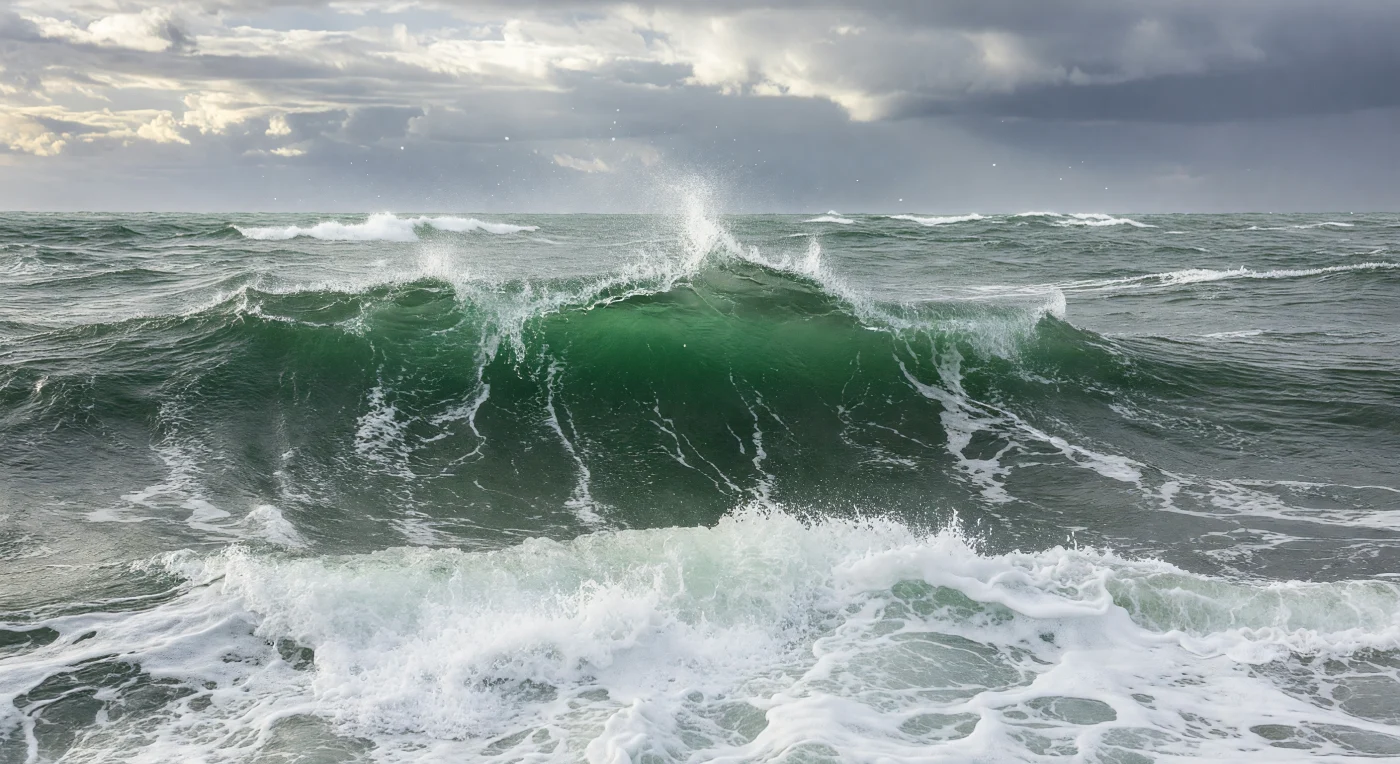
At the ocean's surface, where atmosphere and sea collide with maximum violence, gale-force winds exceeding seventeen metres per second tear the crests from advancing swells and fling them downwind as luminous spindrift, reducing visibility to a shifting lattice of salt haze and granular spray. Each breaking crest initiates a cascade of physical processes critical to planetary regulation: the collapsing wall entrains vast quantities of air, driving bubble plumes metres deep into the water column, dramatically accelerating the exchange of carbon dioxide and oxygen between ocean and atmosphere, and generating the sea-salt aerosols that seed distant clouds. The wave face itself — perhaps four to six metres of dense, storm-charged seawater — glows jade and bottle-green as diffuse storm daylight, filtered through a sky layered with turbulent cumulonimbus, penetrates the semi-translucent body of water before scattering against entrained microbubbles and suspended particulates. Beneath the collapsing crest, Langmuir circulation cells organise the turbulence into parallel counter-rotating vortices, mixing heat, gases, and biological material through the upper mixed layer with an efficiency impossible in calmer conditions. This is the ocean at its most mechanically powerful — a boundary layer governing global climate, operating in perpetual, indifferent motion, wholly sufficient unto itself.
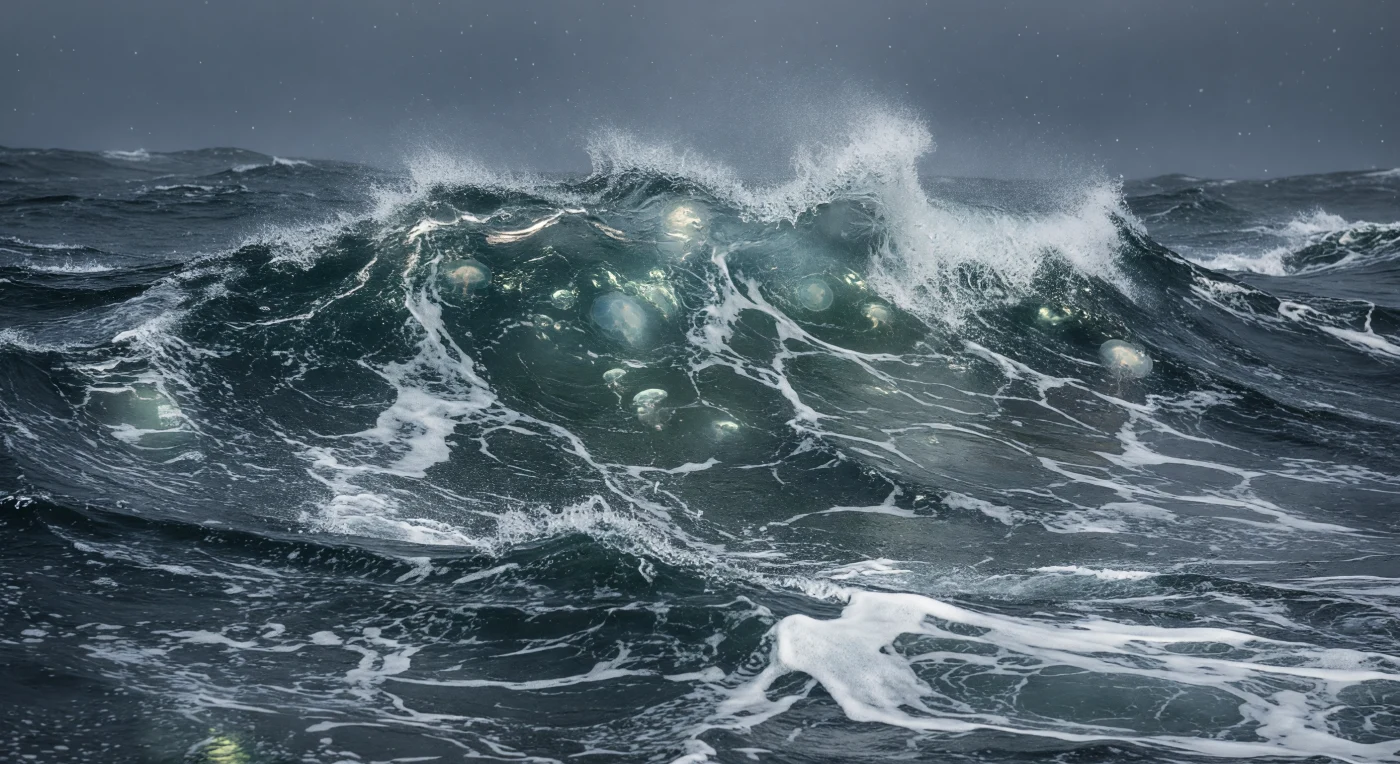
At the ocean's very skin, where atmosphere and sea wage open war, the boundary dissolves into a roiling architecture of collapsing crests, torn spindrift, and cascading bubble curtains driven downward by each breaking wave. Storm-force winds transfer momentum directly into the water column through Langmuir circulation cells and intense surface shear, supersaturating the upper meter with oxygen as billions of entrained bubbles dissolve under the brief elevated pressure of each breaker. Through the chaotic but occasionally transparent forward face of passing swells, pale moon jellies — *Aurelia aurita* — hang suspended just beneath the rain-struck skin, their translucent bells and faint radial canal systems diffusing cold storm light into soft, milky silhouettes against the churn; these gelatinous medusae exploit the surface layer's zooplankton concentrations while their mesoglea, being nearly neutrally buoyant and largely water themselves, renders them indifferent to the violent pressure fluctuations cycling around them. The only illumination here arrives as flat, diffuse daylight pressed through dense overcast and fractured again through the moving water surface, producing fleeting green-turquoise luminosity inside wave crests and cold caustic flickers that trace the undersides of foam rafts before the water closes back to steel. This is one of the most physically energetic and biogeochemically consequential environments on the planet — governing global gas exchange, aerosol production, and heat transfer — yet it persists in complete indifference, a world of perpetual violent renewal that has no memory of calm.
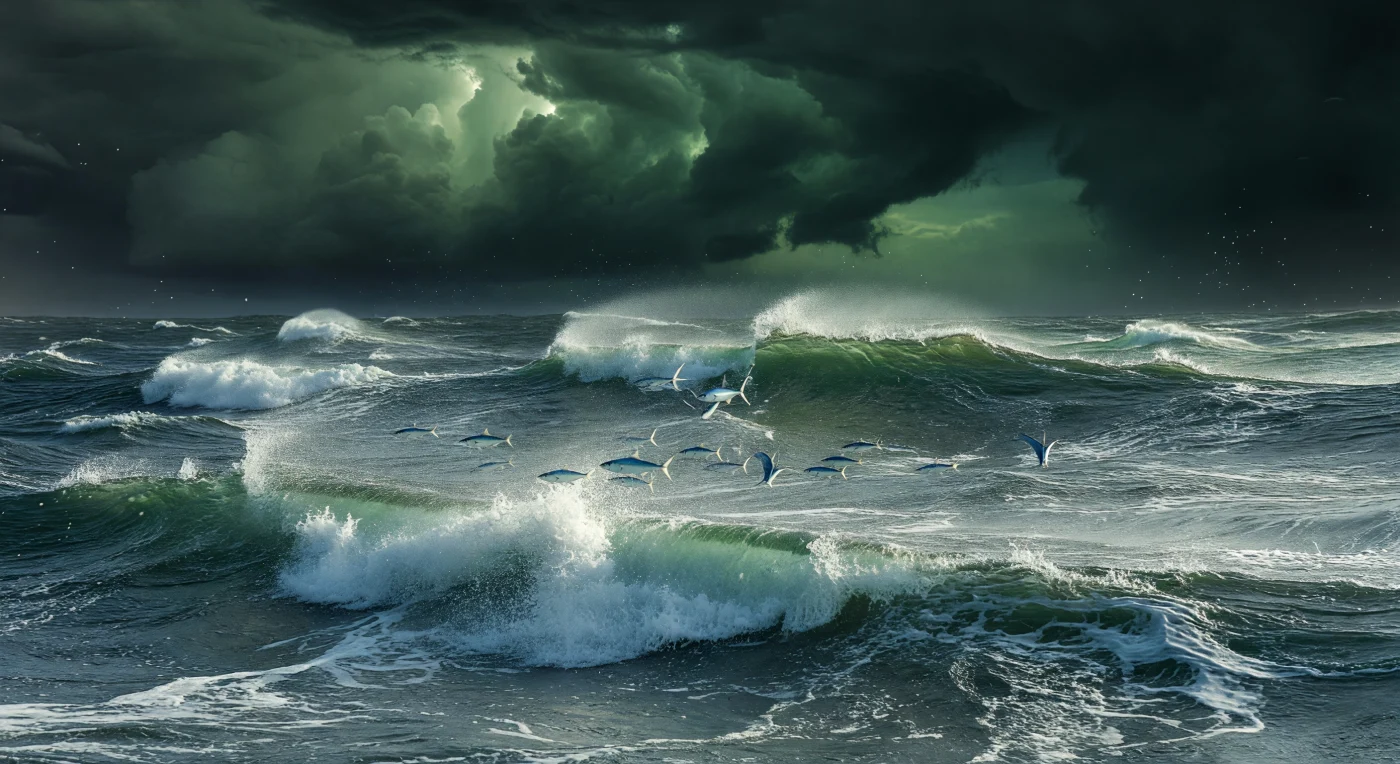
At the ocean's outermost boundary, where atmosphere and sea collide in their most elemental argument, a violent tropical squall has erased every trace of calm. Storm-filtered sunlight pressing through cumulonimbus tens of kilometers deep transforms the water into fractured planes of bottle-green and cold cobalt, while wind exceeding gale force strips whitecaps flat and drags foam into long downwind streaks, a process that dramatically accelerates air–sea gas exchange and pumps the upper layer toward oxygen supersaturation. Into this shattered airspace a burst of flying fish — exocoetids whose enlarged pectoral fins generate genuine aerodynamic lift — launches itself clear of the breaking crests, each individual riding ground-effect compression between body and wave face to extend glides of thirty meters or more, a behavior thought to reduce predation risk in precisely the kind of high-turbulence conditions that confuse pelagic hunters below. The wave faces themselves are geological documents in motion: every crest is a momentary structure shaped by fetch, wind duration, and the nonlinear interaction of crossing swell trains, their translucent lips refracting what little coherent light survives the cloud layer into an eerie green luminescence before collapsing into dense white aeration and subsurface bubble plumes that scatter sound and briefly whiten the near-surface column. Here, at the thinnest seam between ocean and sky, the biosphere and atmosphere exchange heat, carbon, aerosols, and life itself in a transaction that has continued, unwitnessed and indifferent to observation, across every ocean on Earth.
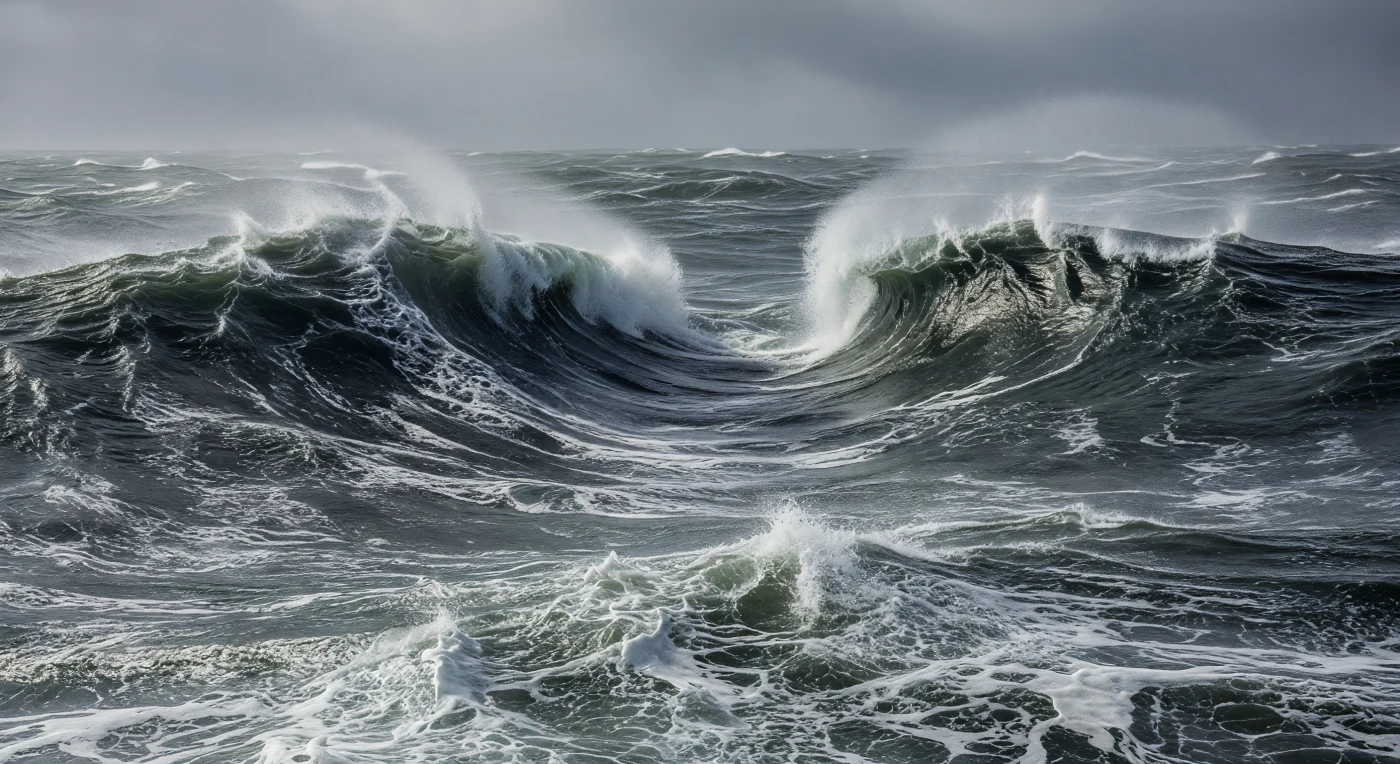
At the very boundary where atmosphere meets ocean, gale-force winds exceeding 20 metres per second drive towering walls of slate-green water into steep, heaving corridors, their forward faces glassy and dark beneath a uniformly overcast sky that diffuses cold daylight into a featureless silver-gray radiance. Each crest tears apart under wind shear, shedding curtains of spindrift and flinging aerosol droplets into a salt-heavy atmosphere where visibility dissolves into spray haze at the horizon; the sea-surface microlayer — that upper fraction of a millimetre governing gas exchange between ocean and atmosphere — is shattered and continuously remade thousands of times per second across every breaking wave. Beneath the collapsing whitecaps, bubble plumes carry entrained air meters deep, supersaturating the upper water column with oxygen and driving intense atmosphere-ocean coupling that transfers heat, moisture, and momentum on scales critical to global climate systems. Langmuir circulation cells align foam streaks into parallel downwind lanes, while the breaker-mixed surface layer churns temperature and salinity into near-homogeneity across the uppermost tens of metres, erasing any calm stratification that calmer days might have established. This is the ocean at its most mechanically violent and most atmospherically consequential — a self-contained engine of physical exchange that has operated across every storm-track on Earth for hundreds of millions of years, entirely indifferent to witness.
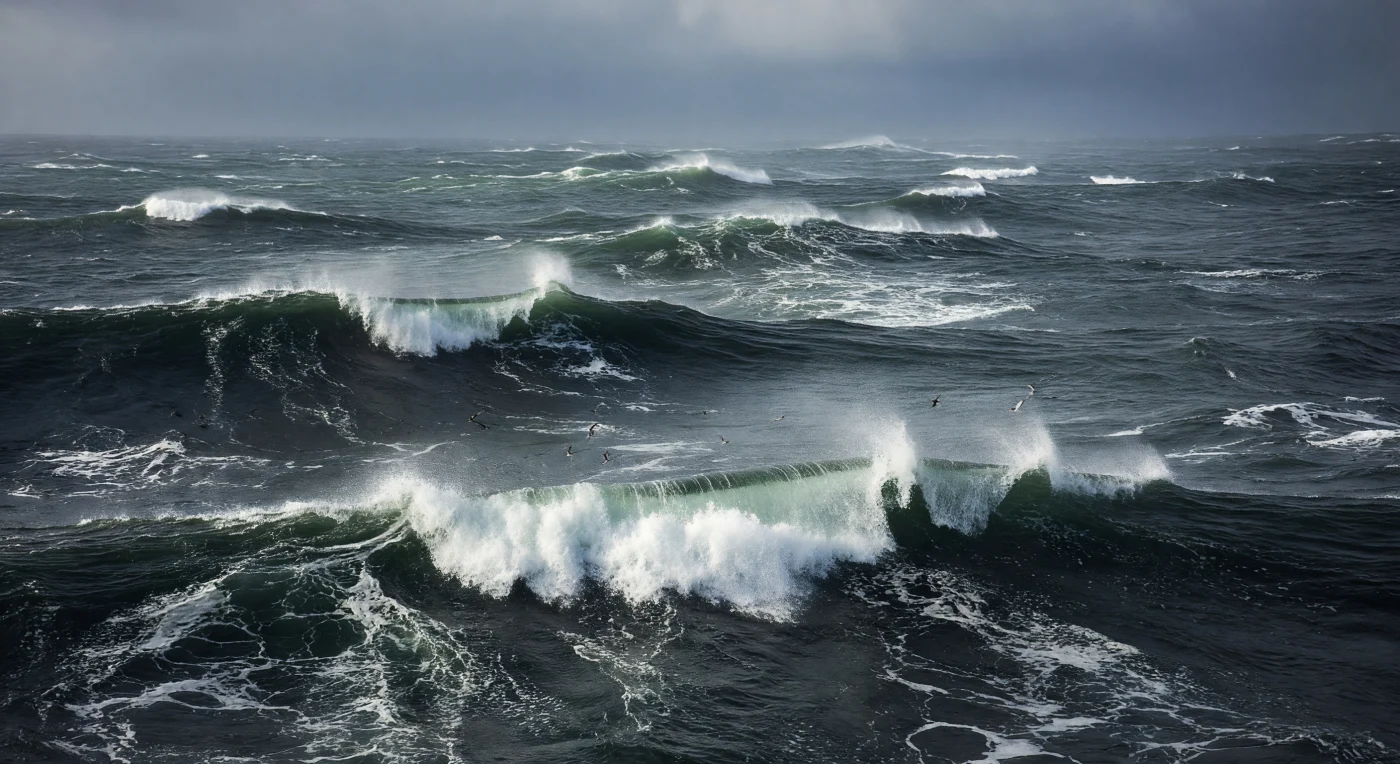
At the ocean's surface, where atmosphere and sea wage their most violent negotiation, gale-force winds sculpt steep, asymmetrical walls of slate-blue and iron-gray water into collapsing architecture — crests sheering into spindrift the instant they form, foam streaks wheeling in convergence lines dictated by Langmuir circulation cells driven by wind-wave coupling. Storm petrels, *Hydrobates* and *Oceanodroma* species among the most accomplished of all seabirds, exploit the pressure gradients above each trough in dynamic soaring, their metabolic efficiency in these conditions among the highest recorded for any flying vertebrate, their dark bodies stitched low and purposeful through the spray haze. Where each crest collapses, the water turns briefly milky with microbubble plumes injected centimeters to meters deep, dramatically accelerating the flux of atmospheric gases — oxygen, carbon dioxide, dimethyl sulfide — across the air-sea boundary, a process that makes storm-season surface ocean among the most biogeochemically active environments on the planet. The diffuse cold light filtering through thick overcast illuminates every suspended droplet and aerated plume without shadow or hierarchy, revealing the sea-surface microlayer in its raw condition: a chemically and biologically distinct film mere micrometers thick, continuously shattered and reconstituted, governing heat exchange, aerosol production, and the slow breath between ocean and sky.
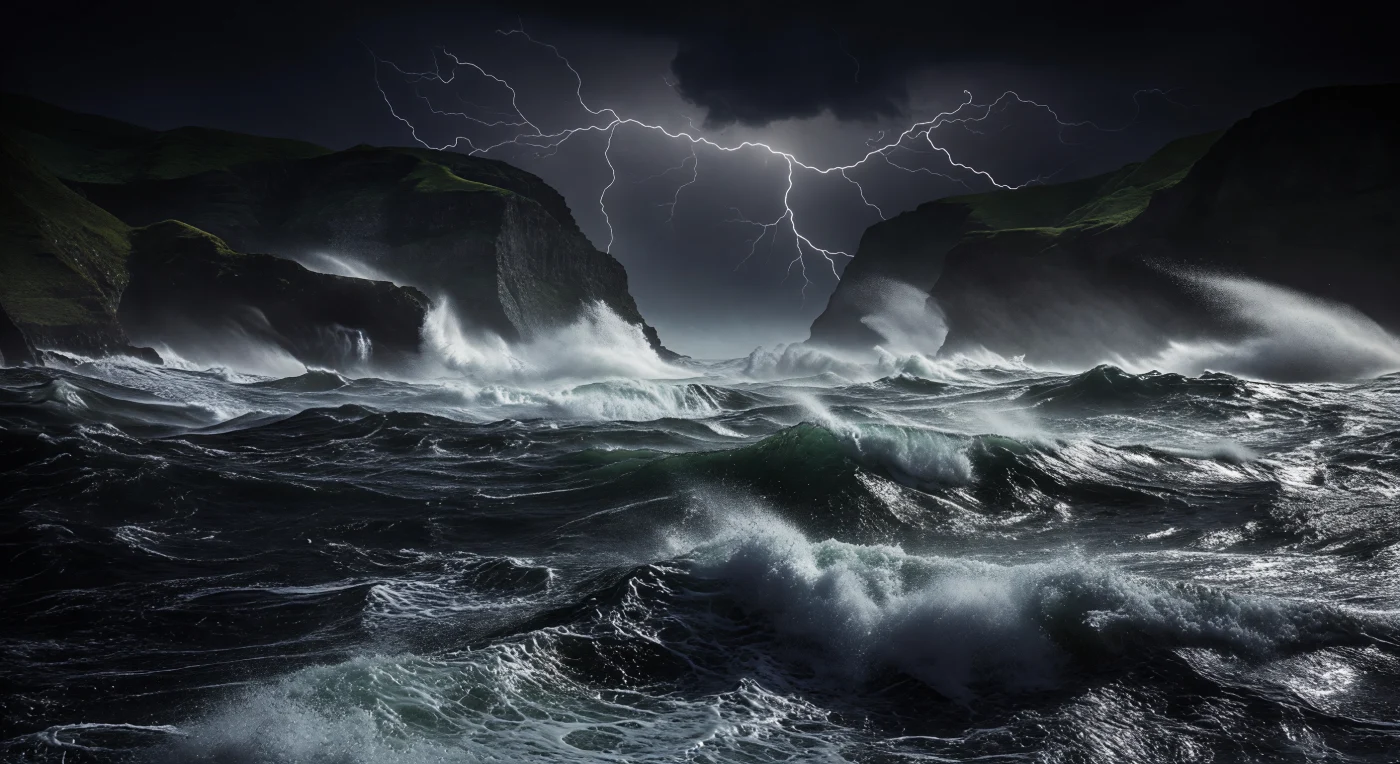
At the very boundary where atmosphere and ocean collide with maximum violence, wind speeds exceeding 40 knots tear the surface into a chaos of steep-walled wave mountains and collapsing troughs, with crests blown flat and spindrift streaking horizontally in dense curtains of atomized seawater. Each breaking wave drives compressed air into the water column, generating vast clouds of microbubbles that briefly turn the uppermost centimeters into a white, turbulent froth — a process that dramatically accelerates gas exchange between ocean and atmosphere, transferring heat, carbon dioxide, and oxygen at rates impossible under calm conditions. The lightning-illuminated sea surface is not a passive boundary but an intensely active engine: Langmuir circulation cells align foam streaks into convergent windrows, Stokes drift carries surface water downwind faster than the deeper mass, and the entire upper layer is mechanically churned into thermal homogeneity within hours of sustained gale force. Salt aerosols, born from the bursting of billions of film-cap bubbles at each breaking crest, are flung into the storm clouds above, seeding droplets and feeding a feedback between the ocean and the very weather system that created this fury. Here, at nominal zero depth and one atmosphere of pressure, the ocean exerts its greatest influence on planetary climate — raw, unmeasured, and utterly indifferent to any witness.
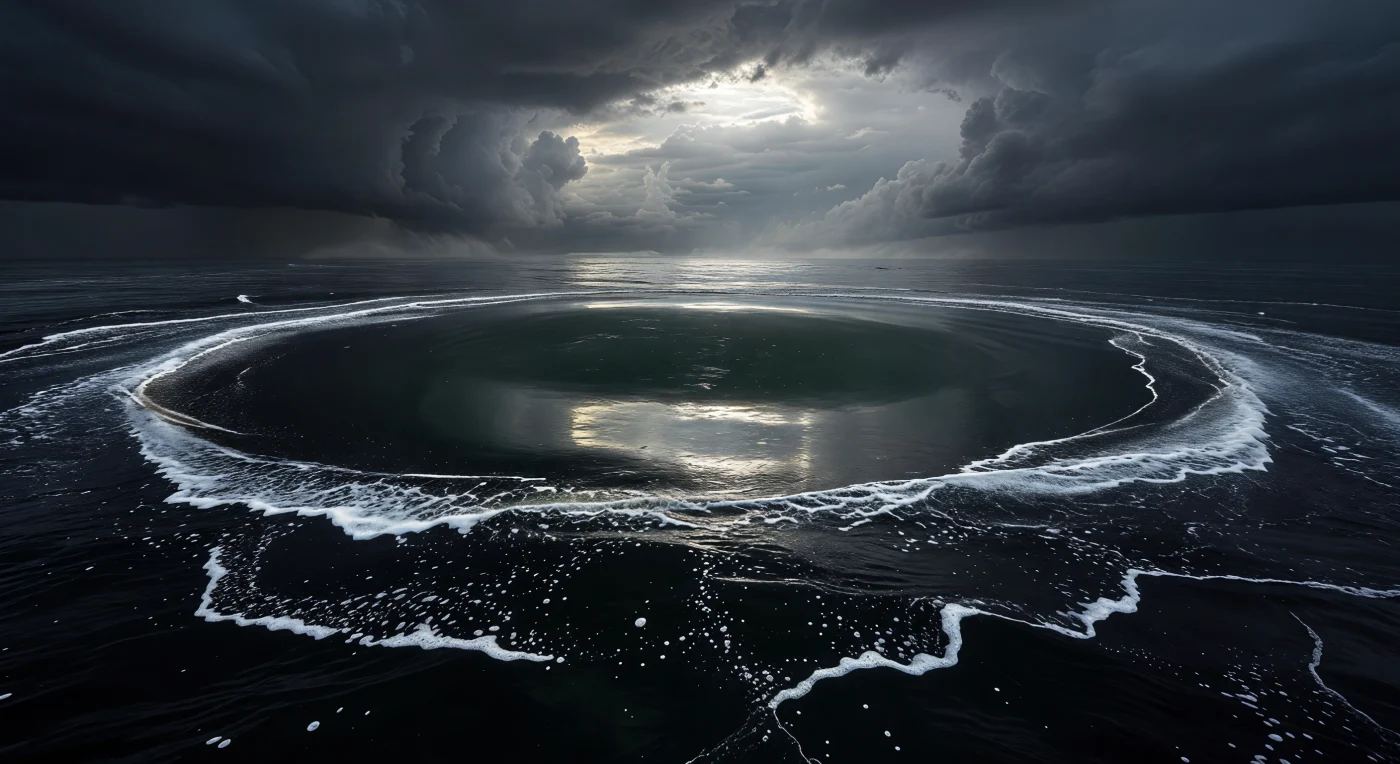
At the ocean's uppermost boundary, where atmosphere and abyss first meet, the air-sea interface becomes a zone of extraordinary thermodynamic violence — yet within the eye of a mature tropical cyclone, an uncanny stillness briefly reigns. Here, where atmospheric pressure hovers near one standard atmosphere and sea surface temperatures exceed 28–30°C, the warm water has already surrendered enormous latent heat to feed the surrounding convective towers, leaving behind a skin of black, glassy swells that still carry the long memory of the surrounding hurricane's wave field, their broad domes rising and falling in slow, crossed patterns called swell interference — the lingering signature of wind that is no longer present. The sea-surface microlayer, just micrometers thick, forms a chemical boundary of concentrated organics, lipids, and dissolved gases, its integrity momentarily restored after hours of violent bubble injection and whitecap destruction; collapsed foam arcs and microbubble lace drift across the slick, each bubble membrane a remnant of the breaking crests that, minutes before, were injecting oxygen and sea-salt aerosols into the marine boundary layer at extraordinary rates. A silver fracture in the cumulonimbus wall pours cold, diffuse light onto the curved shoulders of each swell, the metallic sheen tracing the geometry of water that holds no reflections of land, vessel, or shore — only sky, storm, and the vast, lightless column of ocean descending beneath, indifferent to the atmospheric fury encircling this brief, impossible calm.
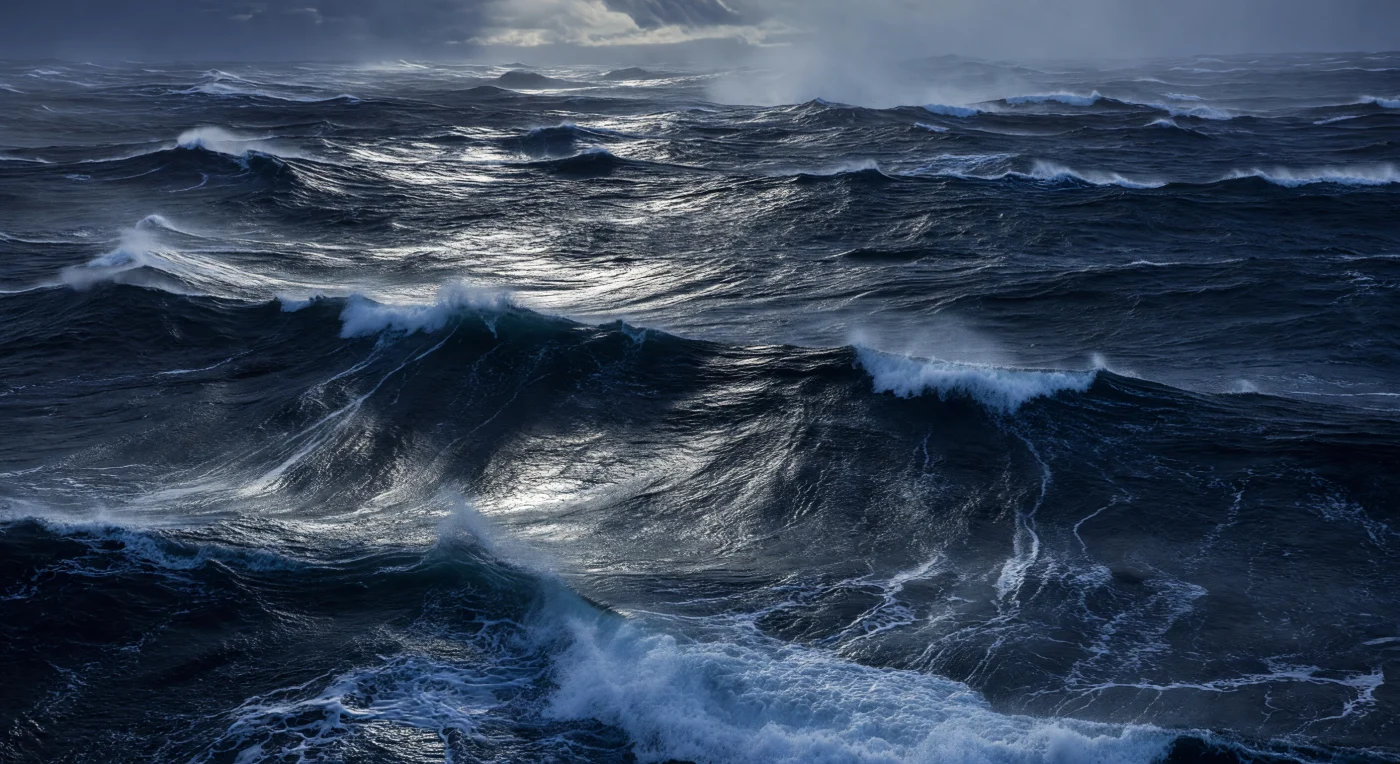
At the very boundary where ocean ends and atmosphere begins, a gale-force wind tears the crests from steep asymmetric swells, combing them into long silver lanes of spindrift that stream downwind across a cobalt-black sea. This is the air–sea interface under storm conditions — a zone of violent momentum transfer where breaking waves inject cascades of microbubbles into the upper meter, briefly turning freshly shattered sections milky white before turbulent shear disperses them back into the dark water column. Intermittent moonlight, filtered through racing cloud gaps, glazes the highest crest tops in cold metallic silver while the troughs sink into near-total shadow, creating a chaotic geometry of shattered reflections and translucent steel-blue crest edges that exist for only fractions of a second before the next breaker collapses them. At this interface, the ocean is performing one of its most consequential planetary functions: the mechanical churning of each whitecap drives intense gas exchange — injecting oxygen, expelling carbon dioxide — and generates the salt aerosols that will eventually seed clouds far inland. Nothing witnesses this but the storm itself, the sea it has built, and the cold light of a moon that neither knows nor cares what moves beneath it.