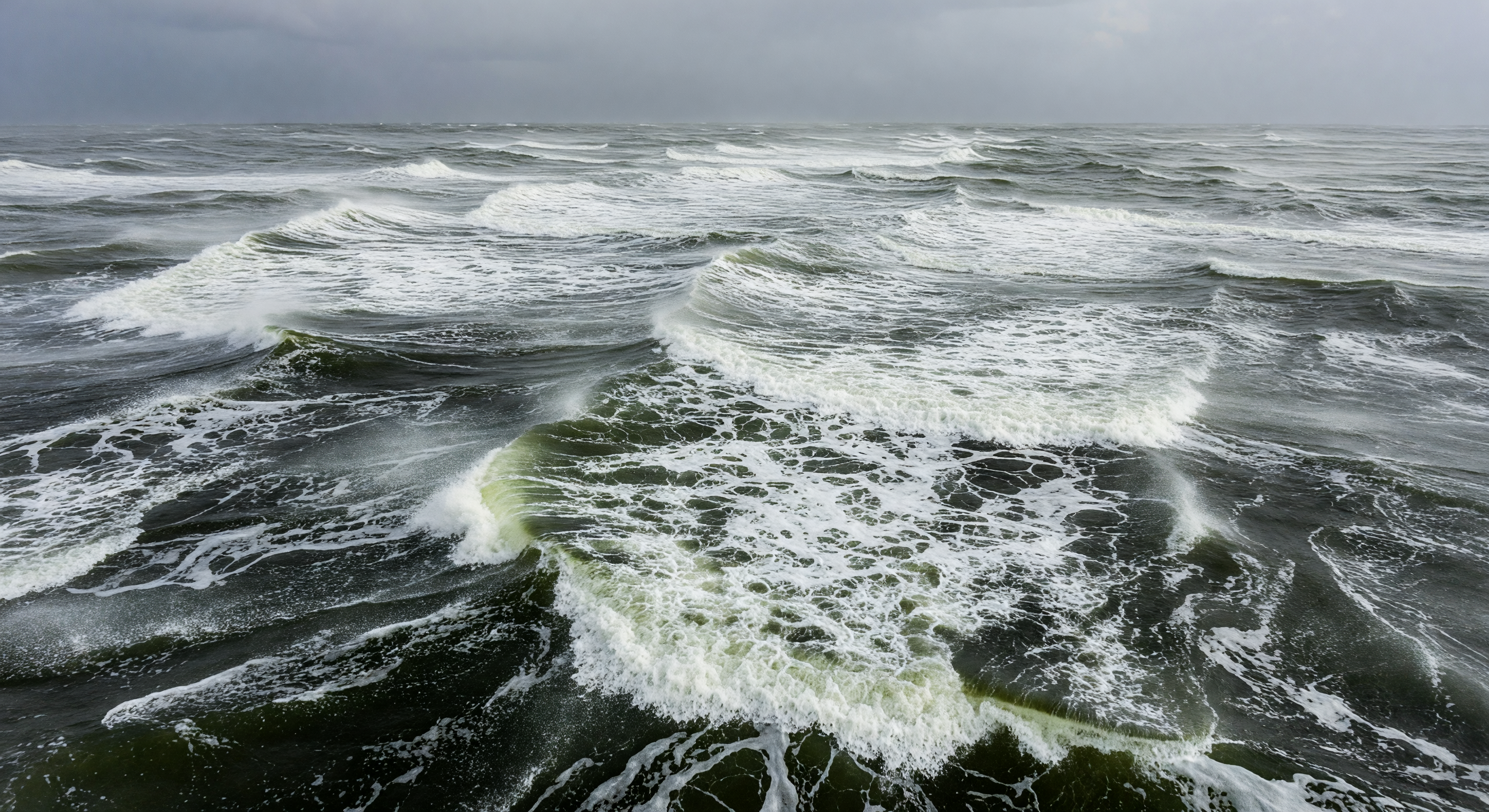
At the very boundary where ocean becomes atmosphere, gale-force winds exceeding seventeen metres per second drag the sea surface into a landscape of ordered chaos, sculpting Langmuir circulation cells that manifest as those long parallel foam windrows — convergence zones where wind-driven surface drift and counter-rotating vortex pairs trap buoyant bubbles and froth into braided ivory lanes stretching downwind for hundreds of metres. Each collapsing crest is a factory of aerosol production, with bursting bubble films ejecting billions of brine droplets and sea-salt particles into the lower atmosphere while simultaneously pumping atmospheric gases — oxygen, carbon dioxide — deep into the wave-mixed layer through plumes of entrained microbubbles that render the upper centimetres milky and supersaturated. The bottle-green colouration betrays optically deep, nutrient-bearing water where dissolved organic matter and suspended particulates absorb the red end of the spectrum, leaving this cold, heavy, iron-grey-lit palette, while the translucent olive flash at a crest's thin lip lasts only the fraction of a second before the wave overturns and shatters into shredded froth. Here pressure is barely above one atmosphere, yet the mechanical energy concentrated in this vanishingly thin interface layer drives heat flux, momentum transfer, and gas exchange at rates that regulate climate on planetary timescales — an immense, self-sustaining engine running without pause, indifferent and complete.
Other languages
- Français: Andains d'écume en tempête
- Español: Hileras de espuma en vendaval
- Português: Fileiras de espuma na ventania
- Deutsch: Schaumstreifen im Sturm
- العربية: خطوط الرغوة في العاصفة
- हिन्दी: तूफान में झाग की लकीरें
- 日本語: 嵐の泡の筋
- 한국어: 폭풍 속 거품 줄기
- Italiano: Strisce di schiuma nel vento
- Nederlands: Schuimrijen in de storm