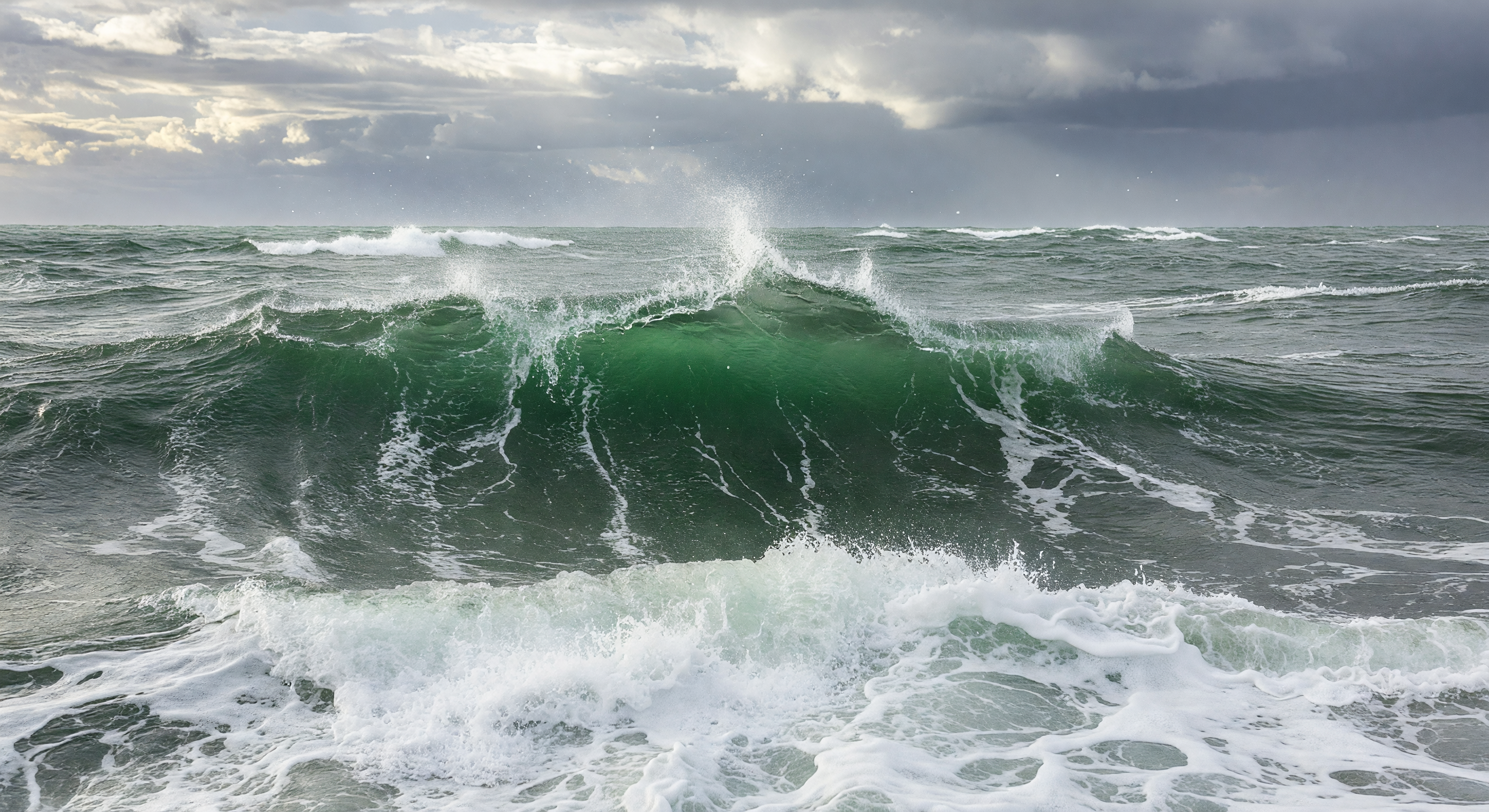
At the ocean's surface, where atmosphere and sea collide with maximum violence, gale-force winds exceeding seventeen metres per second tear the crests from advancing swells and fling them downwind as luminous spindrift, reducing visibility to a shifting lattice of salt haze and granular spray. Each breaking crest initiates a cascade of physical processes critical to planetary regulation: the collapsing wall entrains vast quantities of air, driving bubble plumes metres deep into the water column, dramatically accelerating the exchange of carbon dioxide and oxygen between ocean and atmosphere, and generating the sea-salt aerosols that seed distant clouds. The wave face itself — perhaps four to six metres of dense, storm-charged seawater — glows jade and bottle-green as diffuse storm daylight, filtered through a sky layered with turbulent cumulonimbus, penetrates the semi-translucent body of water before scattering against entrained microbubbles and suspended particulates. Beneath the collapsing crest, Langmuir circulation cells organise the turbulence into parallel counter-rotating vortices, mixing heat, gases, and biological material through the upper mixed layer with an efficiency impossible in calmer conditions. This is the ocean at its most mechanically powerful — a boundary layer governing global climate, operating in perpetual, indifferent motion, wholly sufficient unto itself.
Stormy surface