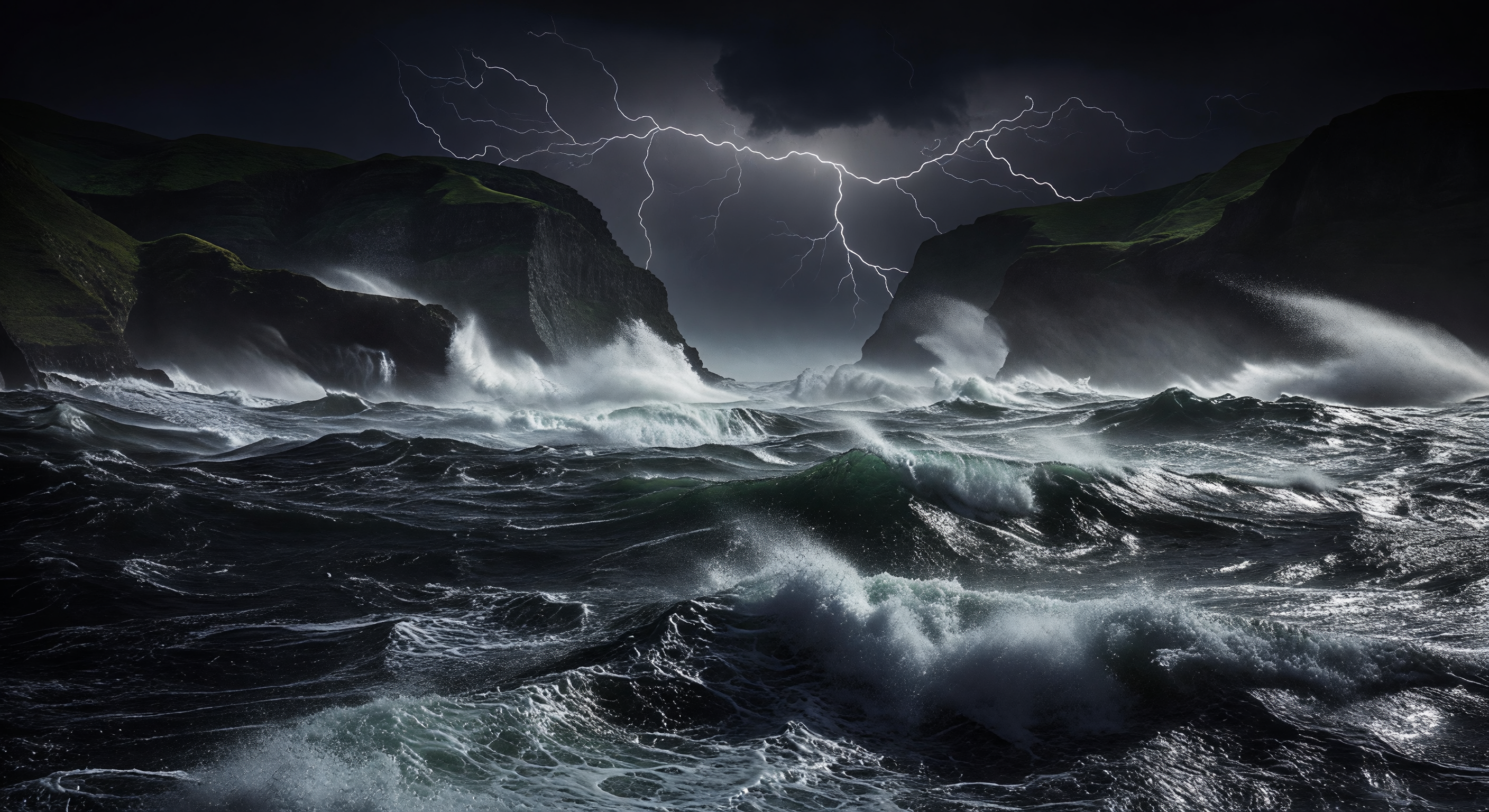
At the very boundary where atmosphere and ocean collide with maximum violence, wind speeds exceeding 40 knots tear the surface into a chaos of steep-walled wave mountains and collapsing troughs, with crests blown flat and spindrift streaking horizontally in dense curtains of atomized seawater. Each breaking wave drives compressed air into the water column, generating vast clouds of microbubbles that briefly turn the uppermost centimeters into a white, turbulent froth — a process that dramatically accelerates gas exchange between ocean and atmosphere, transferring heat, carbon dioxide, and oxygen at rates impossible under calm conditions. The lightning-illuminated sea surface is not a passive boundary but an intensely active engine: Langmuir circulation cells align foam streaks into convergent windrows, Stokes drift carries surface water downwind faster than the deeper mass, and the entire upper layer is mechanically churned into thermal homogeneity within hours of sustained gale force. Salt aerosols, born from the bursting of billions of film-cap bubbles at each breaking crest, are flung into the storm clouds above, seeding droplets and feeding a feedback between the ocean and the very weather system that created this fury. Here, at nominal zero depth and one atmosphere of pressure, the ocean exerts its greatest influence on planetary climate — raw, unmeasured, and utterly indifferent to any witness.
Other languages
- Français: Horizon Brisé par la Foudre
- Español: Horizonte Roto por Rayos
- Português: Horizonte Partido pelo Relâmpago
- Deutsch: Blitz Zerschmetterter Horizont
- العربية: أفق محطم بالبرق
- हिन्दी: बिजली से टूटा क्षितिज
- 日本語: 稲妻が砕く水平線
- 한국어: 번개 부서진 지평선
- Italiano: Orizzonte Spezzato dal Fulmine
- Nederlands: Bliksem Verbrijzelde Horizon