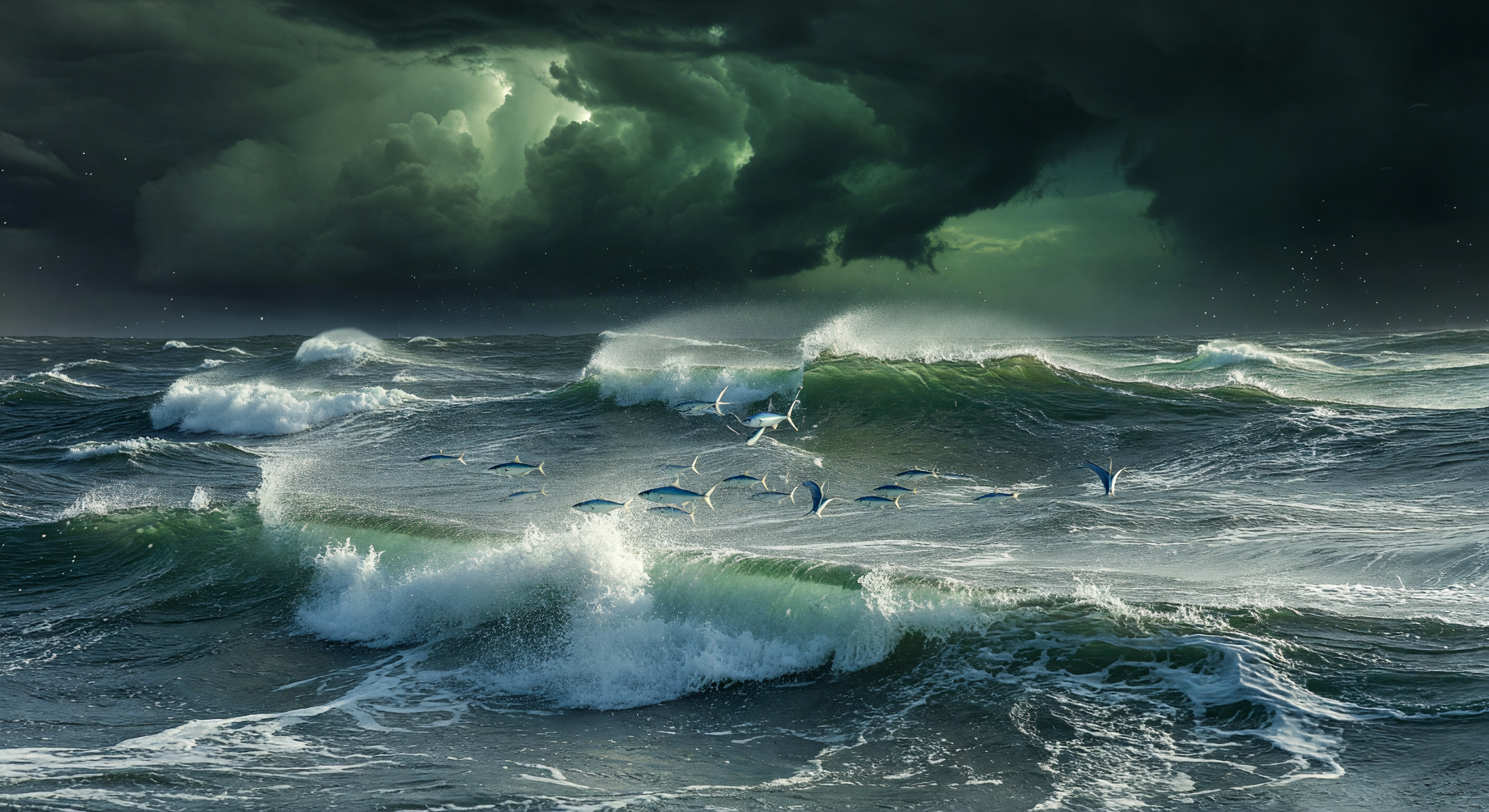
At the ocean's outermost boundary, where atmosphere and sea collide in their most elemental argument, a violent tropical squall has erased every trace of calm. Storm-filtered sunlight pressing through cumulonimbus tens of kilometers deep transforms the water into fractured planes of bottle-green and cold cobalt, while wind exceeding gale force strips whitecaps flat and drags foam into long downwind streaks, a process that dramatically accelerates air–sea gas exchange and pumps the upper layer toward oxygen supersaturation. Into this shattered airspace a burst of flying fish — exocoetids whose enlarged pectoral fins generate genuine aerodynamic lift — launches itself clear of the breaking crests, each individual riding ground-effect compression between body and wave face to extend glides of thirty meters or more, a behavior thought to reduce predation risk in precisely the kind of high-turbulence conditions that confuse pelagic hunters below. The wave faces themselves are geological documents in motion: every crest is a momentary structure shaped by fetch, wind duration, and the nonlinear interaction of crossing swell trains, their translucent lips refracting what little coherent light survives the cloud layer into an eerie green luminescence before collapsing into dense white aeration and subsurface bubble plumes that scatter sound and briefly whiten the near-surface column. Here, at the thinnest seam between ocean and sky, the biosphere and atmosphere exchange heat, carbon, aerosols, and life itself in a transaction that has continued, unwitnessed and indifferent to observation, across every ocean on Earth.
Other languages
- Français: Poissons Volants sous Grain
- Español: Peces Voladores en Turbión
- Português: Peixes Voadores na Tempestade
- Deutsch: Fliegende Fische im Sturm
- العربية: سمك طائر في عاصفة
- हिन्दी: तूफान में उड़ती मछलियाँ
- 日本語: スコールの飛び魚
- 한국어: 돌풍 속 날치
- Italiano: Pesci Volanti nella Burrasca
- Nederlands: Vliegende Vissen in Bui