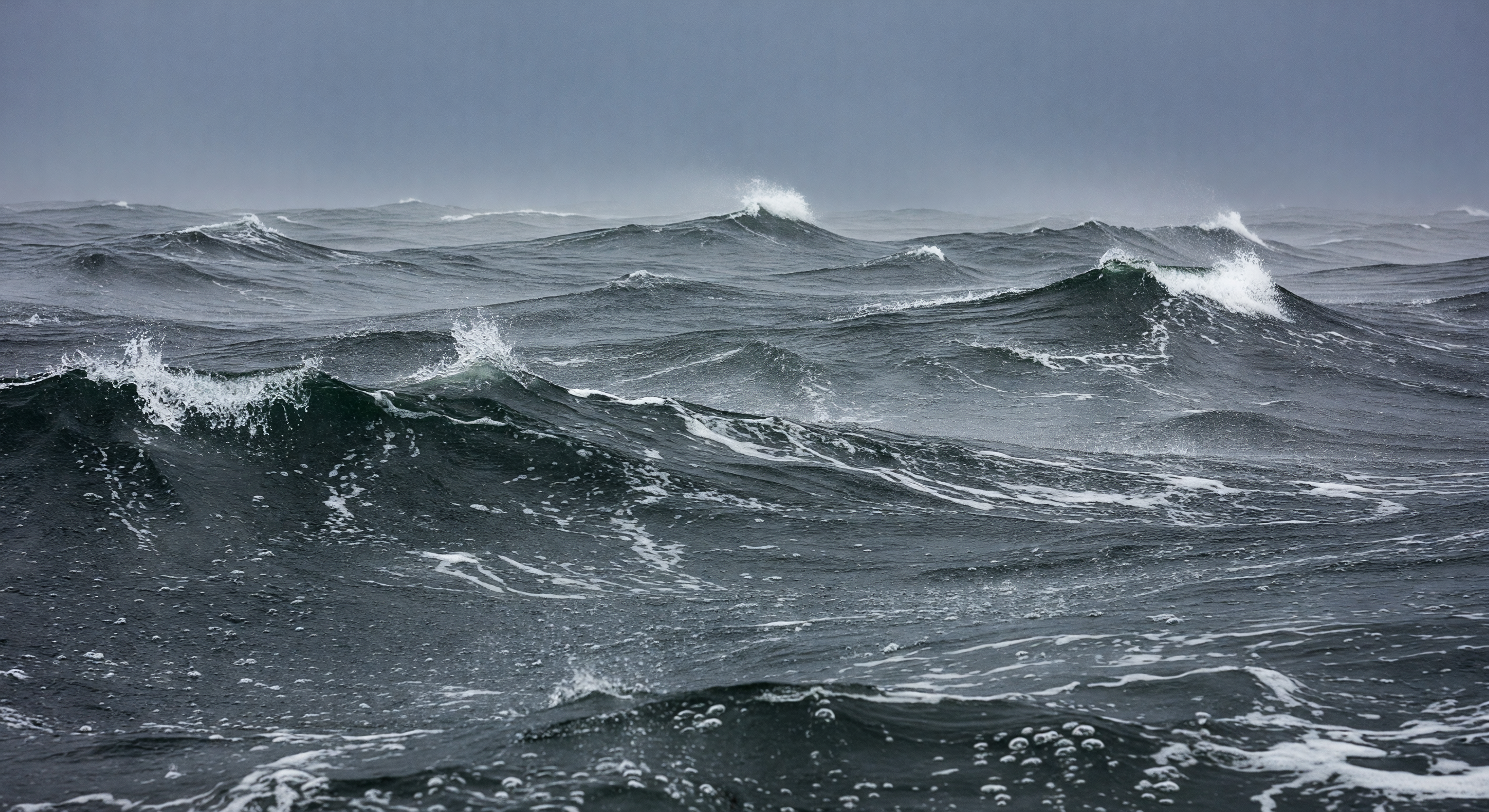
At the ocean's outermost boundary, where atmosphere and sea wage open war, a Beaufort 9–10 squall transforms the water's surface into a heaving, pewter-grey architecture of collapsing crests and rain-hammered troughs, with wind velocities exceeding 24 metres per second ripping spindrift horizontally and flattening foam into pale downwind streaks. Every breaking whitecap drives a cascade of air bubbles deep into the upper metre of the water column, creating transient plumes of oxygen-bright, aerated water where gas exchange between ocean and atmosphere accelerates dramatically — a process responsible for a significant fraction of global CO₂ absorption and marine oxygen cycling. Raindrop crowns stipple every exposed surface in their thousands, each impact momentarily disrupting the sea-surface microlayer — that biologically and chemically critical film spanning just microns to millimetres — while simultaneously contributing freshwater lenses that are almost instantly homogenised by the turbulent mixing beneath. The cold diffuse daylight, filtered through layered storm cloud and curtains of rain, catches translucent wave faces in fleeting blue-green and slate tones before each crest tears apart into white chaos, the horizon wholly dissolved into grey-white spray haze. Here, at this roiling boundary that has never needed a witness, the ocean conducts its most energetic exchange with the sky — violent, indifferent, and complete in itself.
Stormy surface