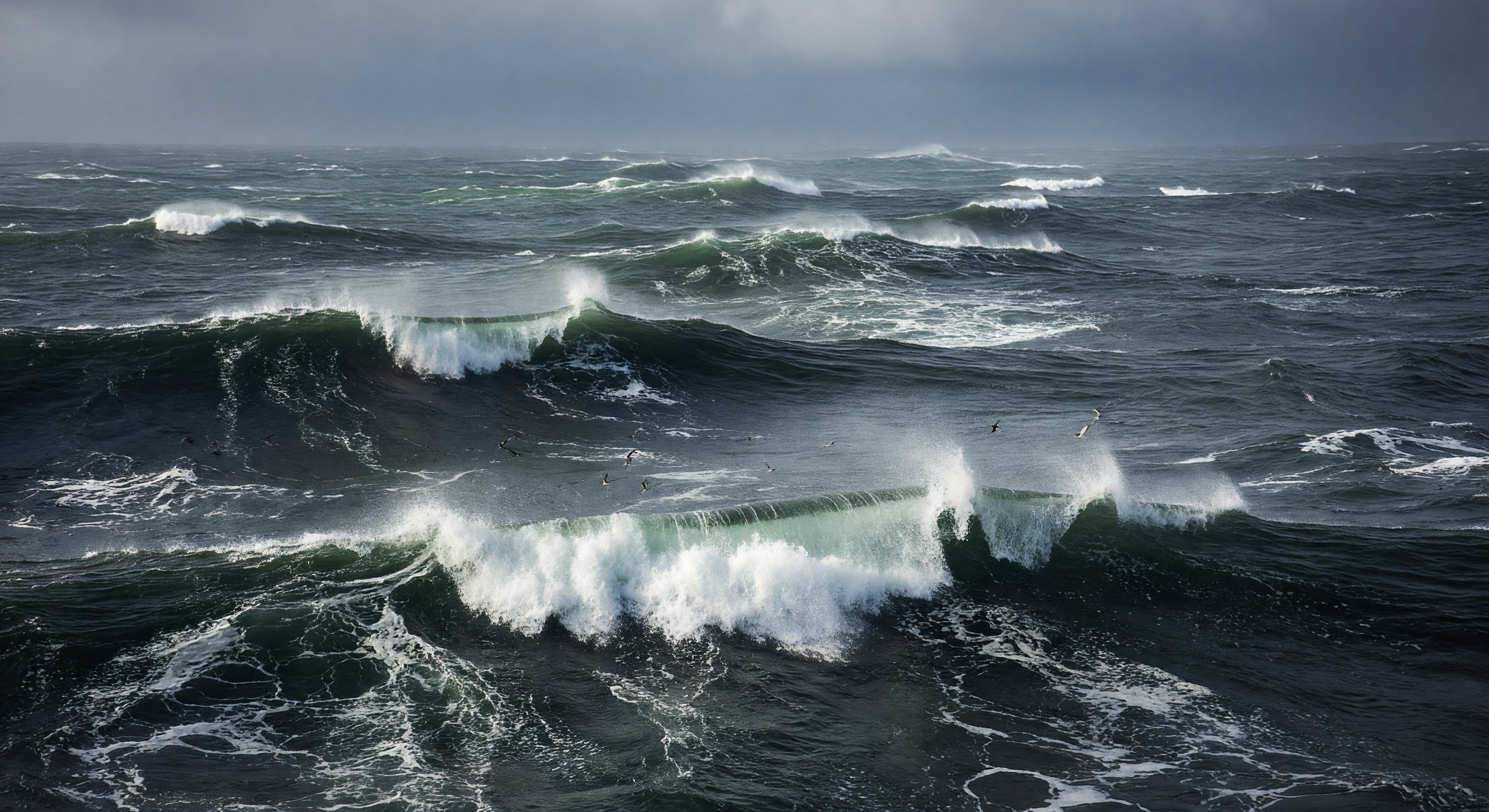
At the ocean's surface, where atmosphere and sea wage their most violent negotiation, gale-force winds sculpt steep, asymmetrical walls of slate-blue and iron-gray water into collapsing architecture — crests sheering into spindrift the instant they form, foam streaks wheeling in convergence lines dictated by Langmuir circulation cells driven by wind-wave coupling. Storm petrels, *Hydrobates* and *Oceanodroma* species among the most accomplished of all seabirds, exploit the pressure gradients above each trough in dynamic soaring, their metabolic efficiency in these conditions among the highest recorded for any flying vertebrate, their dark bodies stitched low and purposeful through the spray haze. Where each crest collapses, the water turns briefly milky with microbubble plumes injected centimeters to meters deep, dramatically accelerating the flux of atmospheric gases — oxygen, carbon dioxide, dimethyl sulfide — across the air-sea boundary, a process that makes storm-season surface ocean among the most biogeochemically active environments on the planet. The diffuse cold light filtering through thick overcast illuminates every suspended droplet and aerated plume without shadow or hierarchy, revealing the sea-surface microlayer in its raw condition: a chemically and biologically distinct film mere micrometers thick, continuously shattered and reconstituted, governing heat exchange, aerosol production, and the slow breath between ocean and sky.
Other languages
- Français: Pétrels sur écume blanche
- Español: Petreles sobre espuma
- Português: Petréis sobre estrias de espuma
- Deutsch: Sturmvögel über Schaumstreifen
- العربية: طيور العاصفة فوق الزبد
- हिन्दी: झाग पर उड़ते पेट्रेल
- 日本語: 波頭を舞うウミツバメ
- 한국어: 거품 위를 나는 바다제비
- Italiano: Procellarie su scie di schiuma
- Nederlands: Stormvogels boven schuimstrepen