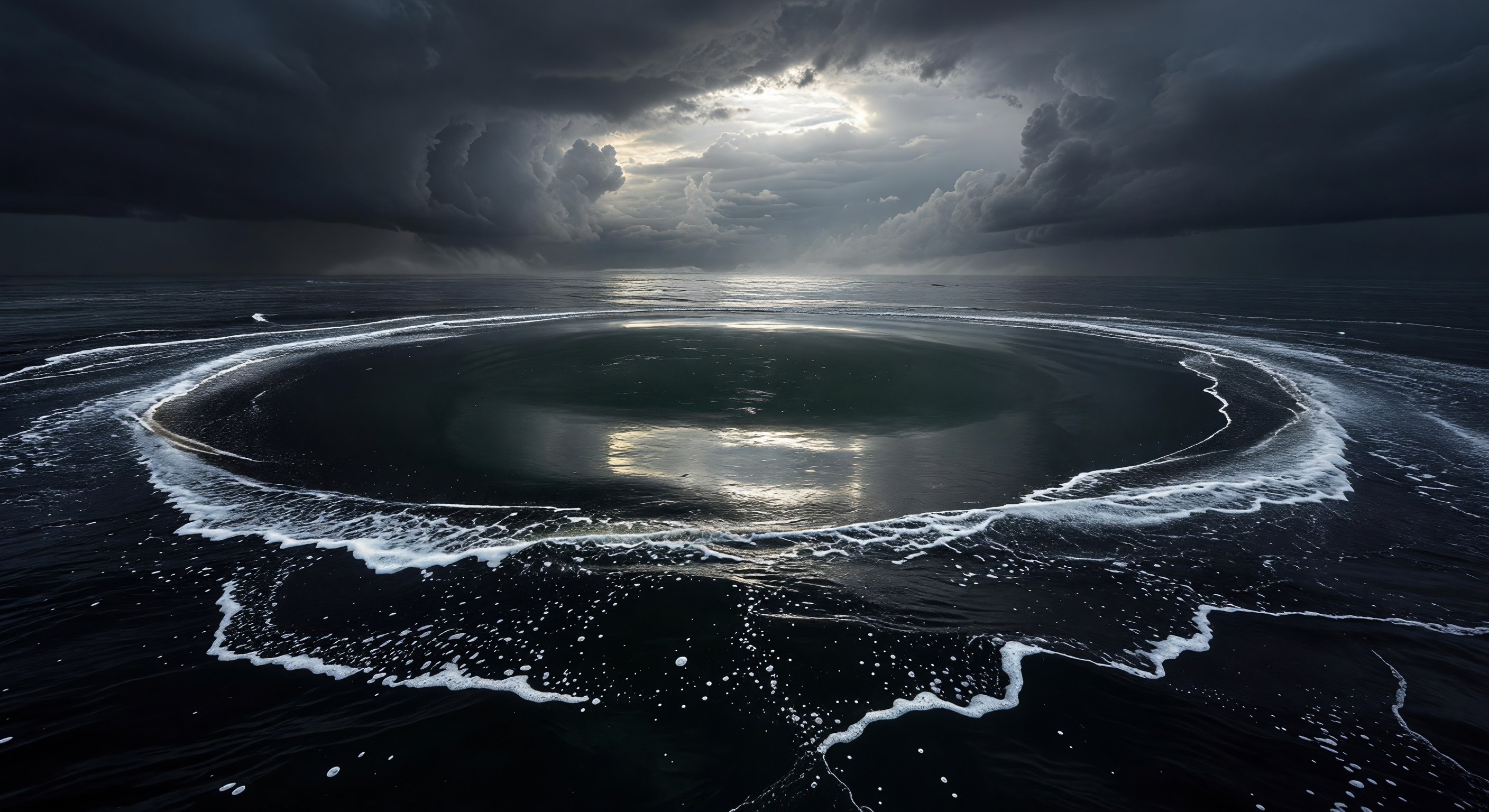
At the ocean's uppermost boundary, where atmosphere and abyss first meet, the air-sea interface becomes a zone of extraordinary thermodynamic violence — yet within the eye of a mature tropical cyclone, an uncanny stillness briefly reigns. Here, where atmospheric pressure hovers near one standard atmosphere and sea surface temperatures exceed 28–30°C, the warm water has already surrendered enormous latent heat to feed the surrounding convective towers, leaving behind a skin of black, glassy swells that still carry the long memory of the surrounding hurricane's wave field, their broad domes rising and falling in slow, crossed patterns called swell interference — the lingering signature of wind that is no longer present. The sea-surface microlayer, just micrometers thick, forms a chemical boundary of concentrated organics, lipids, and dissolved gases, its integrity momentarily restored after hours of violent bubble injection and whitecap destruction; collapsed foam arcs and microbubble lace drift across the slick, each bubble membrane a remnant of the breaking crests that, minutes before, were injecting oxygen and sea-salt aerosols into the marine boundary layer at extraordinary rates. A silver fracture in the cumulonimbus wall pours cold, diffuse light onto the curved shoulders of each swell, the metallic sheen tracing the geometry of water that holds no reflections of land, vessel, or shore — only sky, storm, and the vast, lightless column of ocean descending beneath, indifferent to the atmospheric fury encircling this brief, impossible calm.
Stormy surface