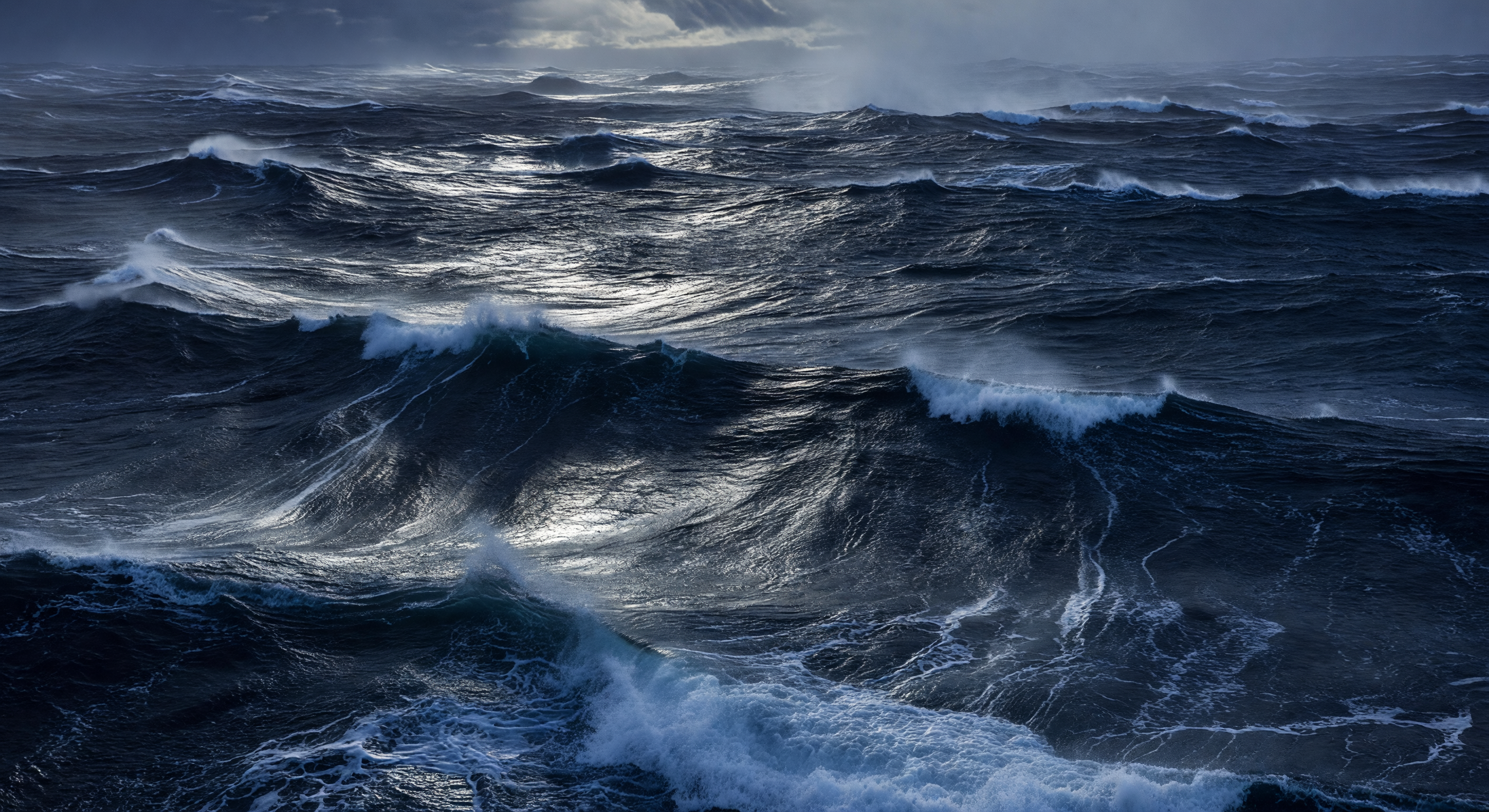
At the very boundary where ocean ends and atmosphere begins, a gale-force wind tears the crests from steep asymmetric swells, combing them into long silver lanes of spindrift that stream downwind across a cobalt-black sea. This is the air–sea interface under storm conditions — a zone of violent momentum transfer where breaking waves inject cascades of microbubbles into the upper meter, briefly turning freshly shattered sections milky white before turbulent shear disperses them back into the dark water column. Intermittent moonlight, filtered through racing cloud gaps, glazes the highest crest tops in cold metallic silver while the troughs sink into near-total shadow, creating a chaotic geometry of shattered reflections and translucent steel-blue crest edges that exist for only fractions of a second before the next breaker collapses them. At this interface, the ocean is performing one of its most consequential planetary functions: the mechanical churning of each whitecap drives intense gas exchange — injecting oxygen, expelling carbon dioxide — and generates the salt aerosols that will eventually seed clouds far inland. Nothing witnesses this but the storm itself, the sea it has built, and the cold light of a moon that neither knows nor cares what moves beneath it.
Stormy surface