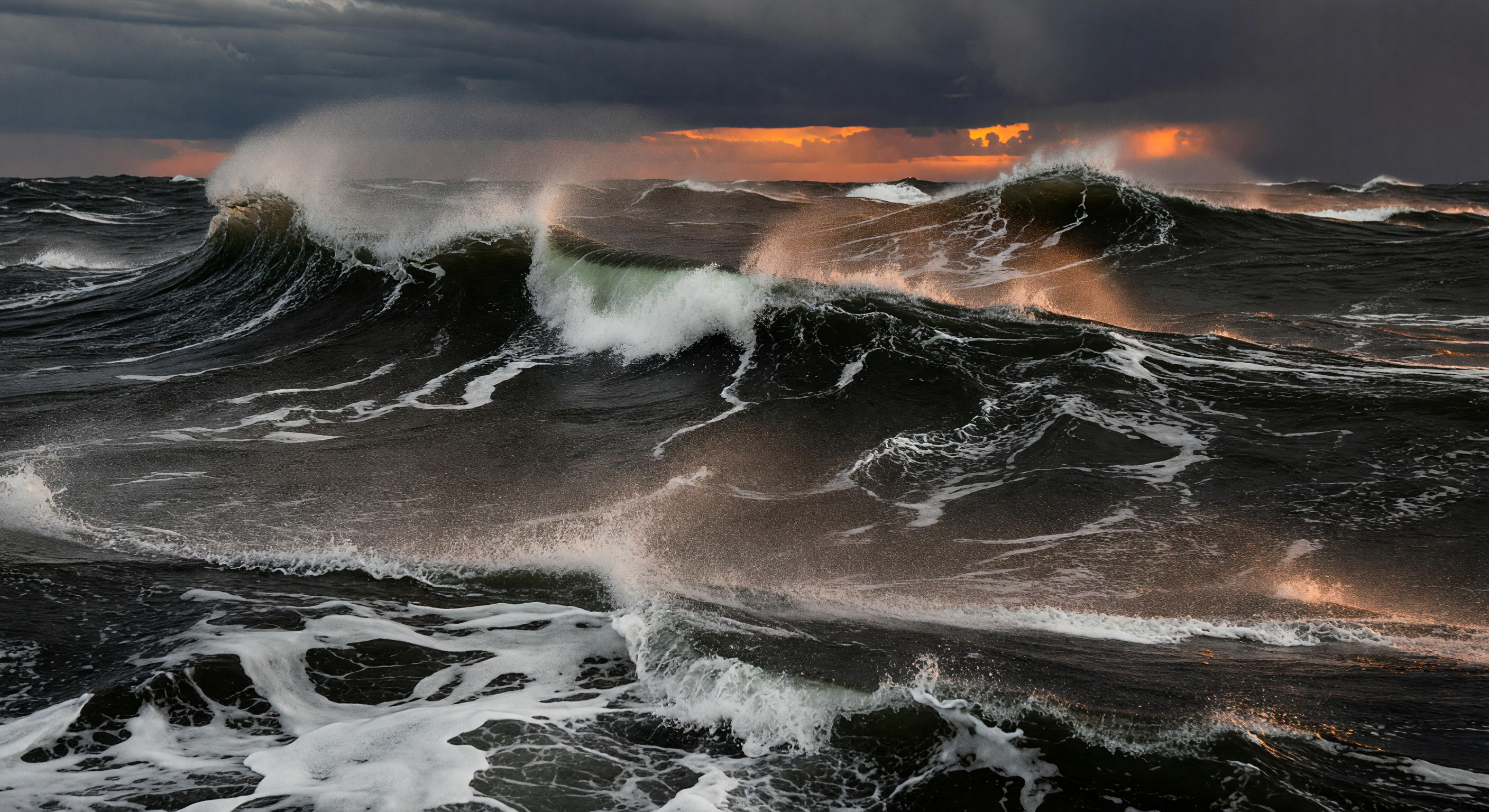
At the ocean's surface, where atmosphere and sea are violently indistinguishable, Beaufort force 10–11 winds shear the tops from asymmetric wave crests and hurl the water skyward as spindrift, scattering the last copper light of a storm sunset into suspended curtains of bronze and amber aerosol. The air–sea boundary here is not a surface but a churning, pressure-fluctuating zone several meters deep, where collapsing breakers inject dense plumes of microbubbles into the upper water column, driving oxygen exchange and seawater outgassing at rates orders of magnitude above calm-sea conditions. Wave faces steep enough to overhang trap pockets of air against green-black water before releasing them as subsurface bubble clouds, briefly rendering the upper meter translucent with froth before the next crest swallows the evidence. Langmuir circulation organizes the downwelling foam into parallel windrow streaks torn flat across the troughs, while salt aerosols ripped from bursting bubble films seed the storm atmosphere with cloud condensation nuclei, completing an invisible but critical loop in planetary climate regulation. This outermost skin of the ocean — storm-torn, copper-lit, perpetually unmade and remade — exists in full indifference, a self-regulating boundary that has governed heat, gas, and momentum transfer between ocean and atmosphere for billions of years.
Other languages
- Français: Embruns cuivrés au crépuscule
- Español: Espuma cobriza al atardecer
- Português: Névoa de cobre ao pôr do sol
- Deutsch: Kupfergischt im Abendrot
- العربية: رذاذ نحاسي عند الغروب
- हिन्दी: सूर्यास्त में तांबई फुहार
- 日本語: 夕暮れの銅色の波しぶき
- 한국어: 석양의 구리빛 물보라
- Italiano: Spruzzi ramati al tramonto
- Nederlands: Koperen nevel bij zonsondergang