Scientific confidence: Very High
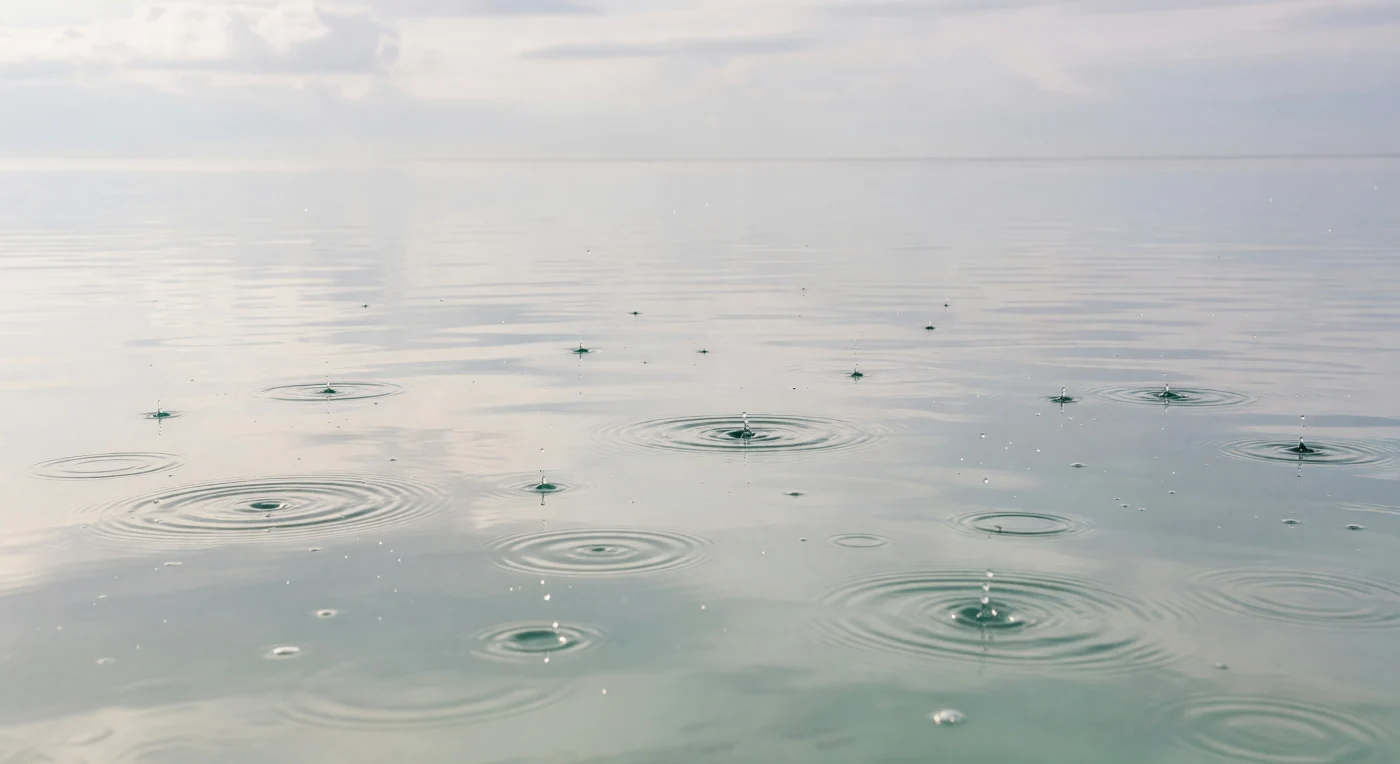
At the very skin of the sea, where atmosphere and ocean negotiate their endless exchange, the first scattered raindrops of an approaching tropical system are rewriting the surface one micro-impact at a time. Each falling drop carries enough momentum to punch a transient millimeter-scale crater into the water's elastic membrane, ejecting a delicate crown of displaced fluid before surface tension reclaims it, while concentric capillary waves radiate outward across the near-glass calm — physics playing out at the scale of milliseconds and micrometers. Beneath each impact, a column of entrained air fractures into oscillating microbubbles that ring with a characteristic acoustic frequency near 14–15 kHz, meaning that rain does not merely mark the ocean visually but writes itself into the underwater soundscape as a broadband hiss detectable by marine mammals and passive hydrophone arrays kilometers away. The soft overcast sky above diffuses solar radiation uniformly across the pale silver surface, eliminating shadows and reducing the air–sea interface to a luminous mirror interrupted only by these sparse percussion points, while just below the surface microlayer — that biogeochemically active film only micrometers thick, enriched in lipids, bacteria, and dissolved organics — the first freshwater lenses are forming, marginally cooler and less saline than the tropical water beneath, creating transient haline stratification that will vanish with the first gust of wind. Here the ocean is not scenery but a dynamic boundary where mass, heat, momentum, and sound transfer between two fluid worlds, indifferent and continuous, long before any eye existed to observe it.
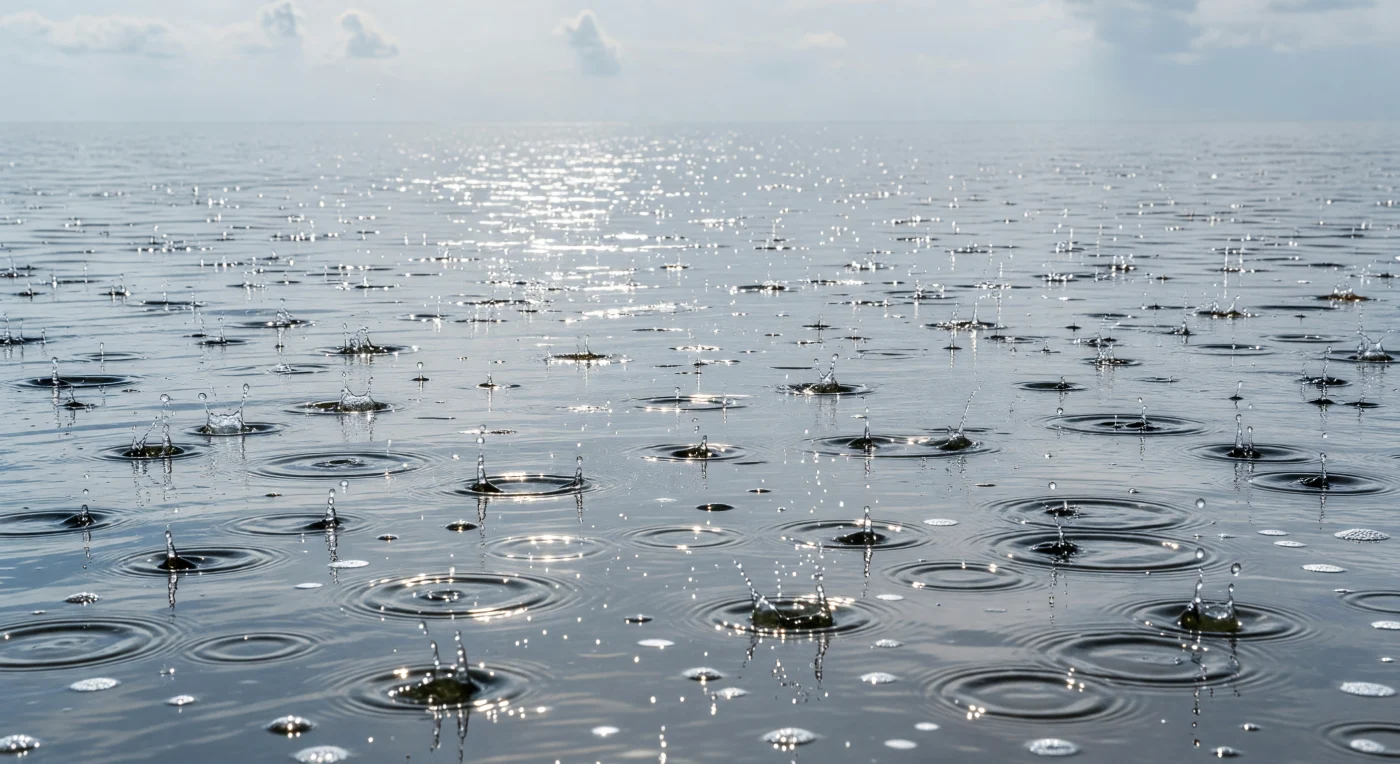
At the very skin of the world's ocean, where atmosphere and sea meet in a plane measured in fractions of a millimeter, a dense tropical downpour transforms the surface into a continuously detonating mosaic of hydraulic sculptures — each raindrop excavating a transient micro-crater whose serrated crown of water flings thin Worthington jets skyward before collapsing back into the expanding rings that collide with a hundred identical neighbors. The energy of each impact, modest in isolation, is collectively immense: rain at this intensity transfers momentum deep enough to shear the diurnal warm layer, freshens the upper centimeters into a haline anomaly measurably distinct from the saline water beneath, and generates a broadband acoustic field — a hissing, crackling sound halo audible to hydrophones tens of meters below — dominated by the resonant oscillation of entrained air bubbles trapped at roughly 1–2 millimeters diameter. Under overcast skies that diffuse photons into a flat silver illumination, the sea surface reads not as a plane but as a living topology of impact bowls, foam flecks, and transient subsurface bubble clouds that scatter light into faint halos visible through the glassy interstices between strikes. Here, the ocean is neither calm nor stormy in any classical meteorological sense, but occupies its own liminal physics — a realm of micrometeorology, capillary hydrodynamics, and acoustic ecology that existed for billions of years before any mind existed to witness it, and continues now, indifferent and intricate, in every rainstorm over every open sea on Earth.
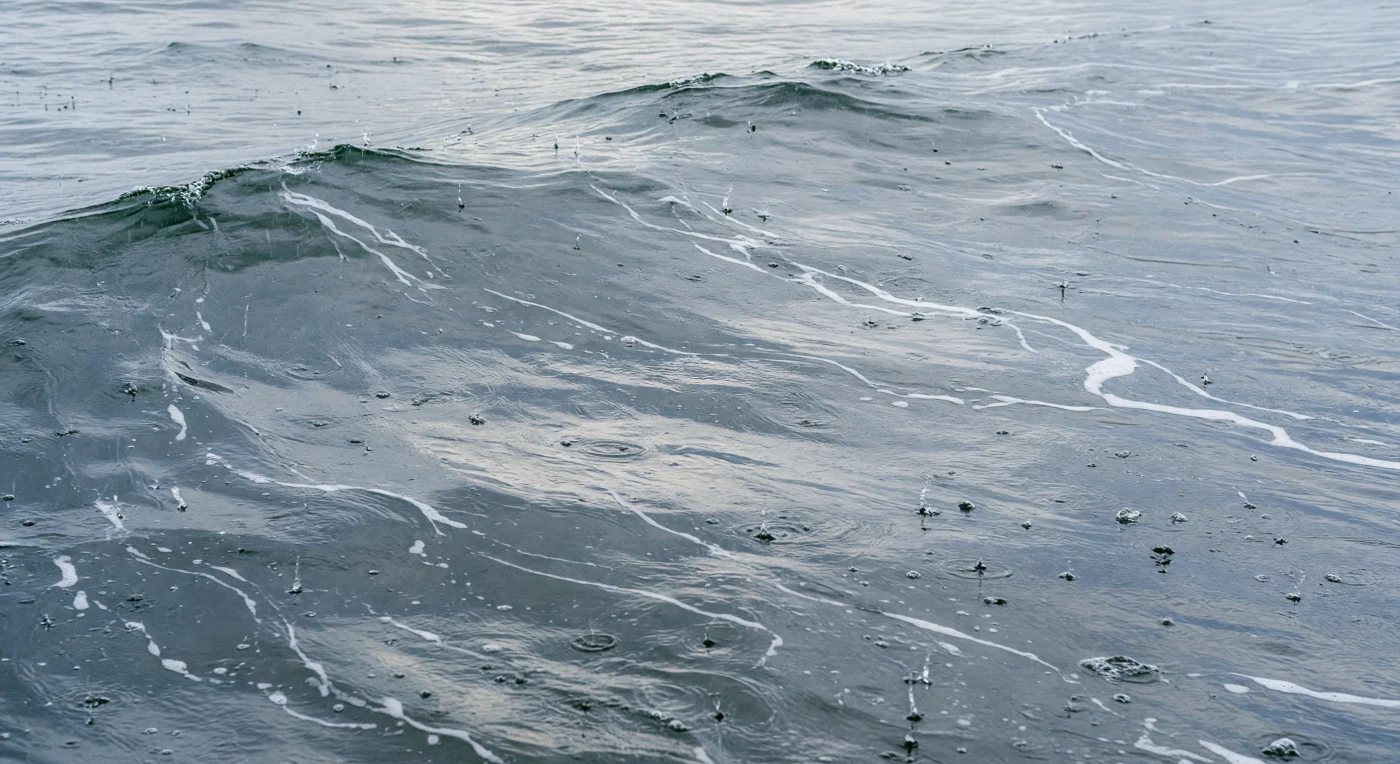
At the skin of the sea, where atmosphere and ocean negotiate their boundary in a language of kinetic energy and surface tension, countless falling drops arrive at oblique angles across the rolling slate-blue wave faces, each impact detonating into a brief asymmetric crown — a microsecond sculpture of stretched stalks, satellite droplets, and concentric ringlets instantly sheared apart by wind and wave motion. The air–sea interface is one of the most physically active layers on the planet: a zone of continuous gas exchange, latent-heat flux, and mechanical coupling where even a moderate rainfall measurably freshens the upper centimeters, depresses local salinity, and imposes a shallow haline stratification that can suppress turbulent mixing and trap heat anomalies in a lens only decimeters thick. Each impact also entrains a microscopic bubble that collapses and re-radiates sound, so that a rain event transforms the upper ocean into an acoustic landscape — a dense, spatially structured field of underwater noise that marine mammals and hydrophone arrays can detect across great distances. Foam streaks and bubble flecks drift between the darker troughs, tracing the surface convergence lines carved by wind and swell, while broken reflections of layered gray cloud slide across wet wave facets in cold overcast light that carries no shadow and casts no beam. The sea exists here entirely on its own terms: stippled, freshened, acoustically alive, and utterly indifferent to any observer.
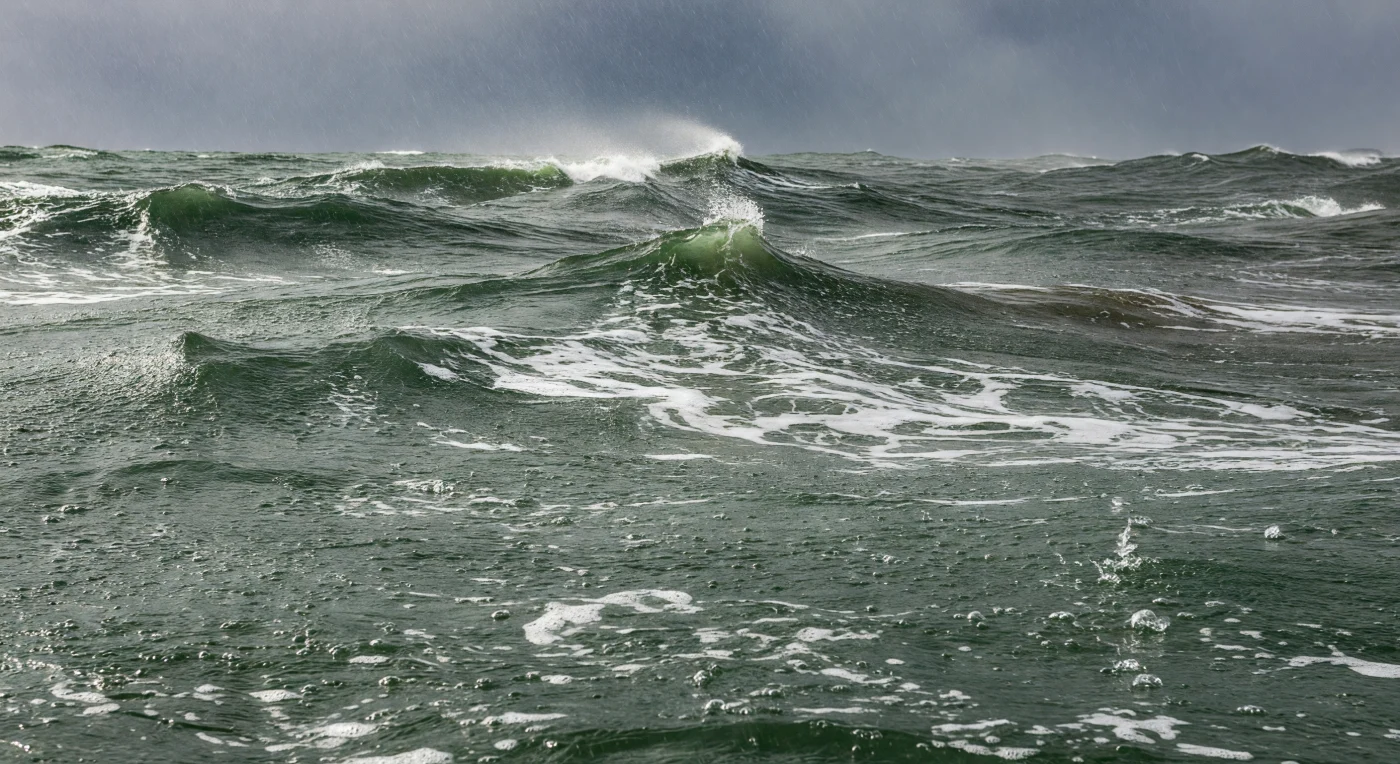
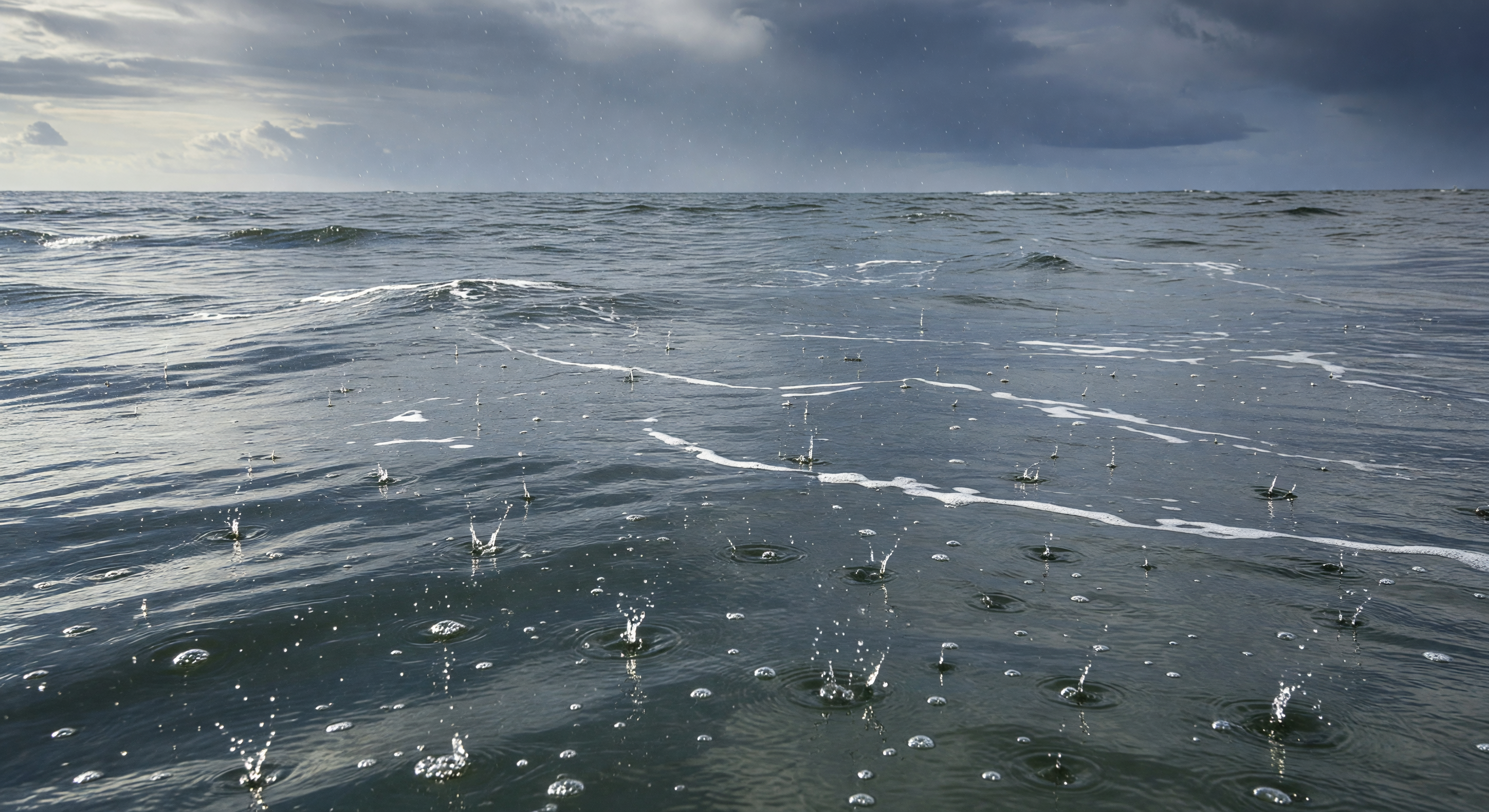
At the ocean's surface, the boundary between sea and sky dissolves entirely during a violent squall, becoming a third medium of its own — neither water nor air but a chaotic, aerated skin of colliding phases. Each raindrop strikes with enough momentum to punch a sharp microcrater, ejecting a transient crown of droplets before collapsing into overlapping ringlets that spread outward across foam-covered, bottle-green swells; at high rain rates, thousands of such impacts per square meter per second generate a continuous acoustic halo detectable well below the surface, as entrained air bubbles oscillate and radiate sound in a characteristic broadband signature that oceanographers use to remotely measure precipitation intensity from underwater hydrophones. The sea-surface microlayer — that biologically and chemically distinct skin only micrometers to fractions of a millimeter thick, enriched in organic surfactants, bacteria, and lipids — is repeatedly disrupted and reformed, while rain-freshened lenses of lower salinity and slightly cooler water spread in thin, unstable caps across the uppermost centimeters, creating transient haline stratification that suppresses vertical mixing until wind-driven shear overwhelms it. Beneath the foam mats and shredded spindrift, bubbles injected by breaking crests and raindrop entry scatter ambient light into a milky, scattering layer, giving the upper water column its opaque, aerated translucence even on this diffuse, overcast day when no direct solar radiation penetrates the storm canopy. This is the ocean as energetic interface — thermodynamically open, acoustically loud, chemically active — a world of perpetual, self-organizing violence that requires no witness to proceed.
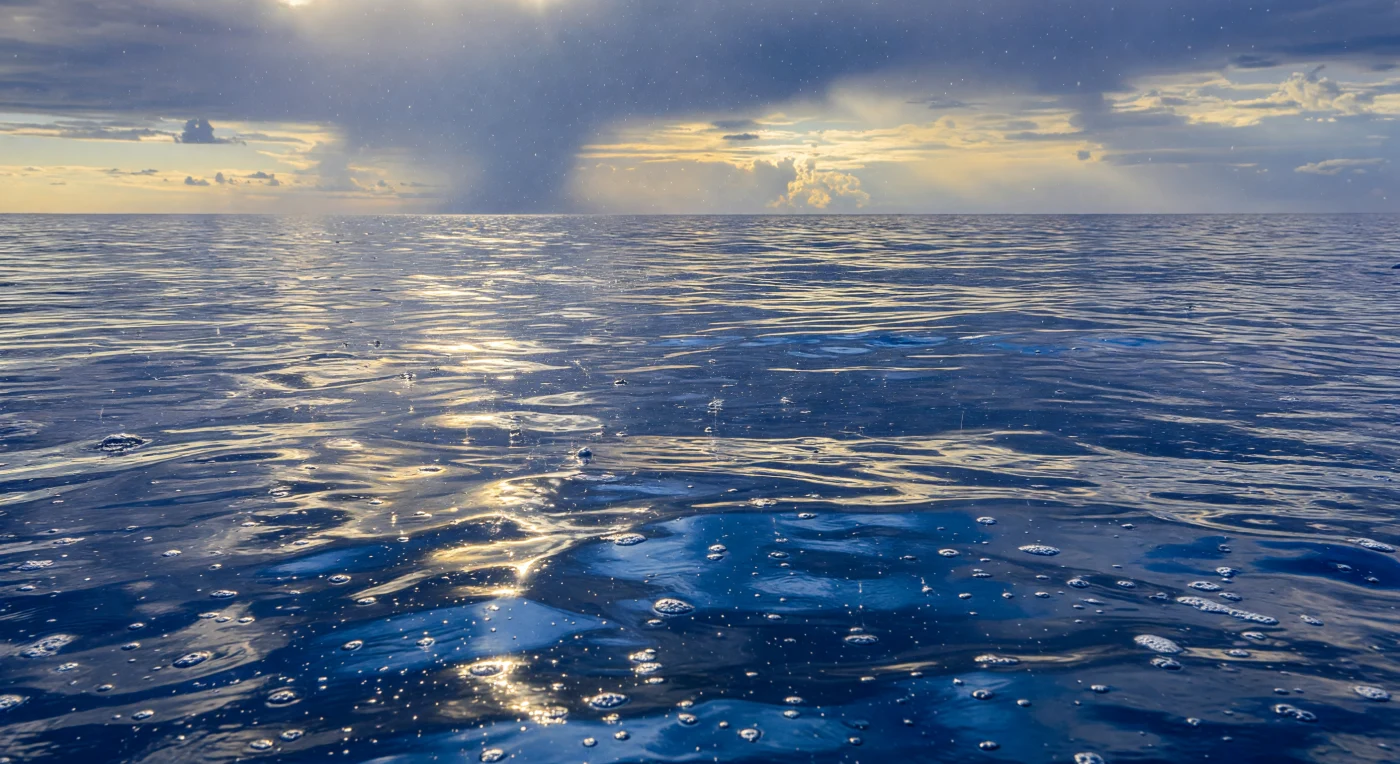
At the sea's uppermost skin — the few millimetres where atmosphere surrenders to ocean — a passing rain shower rewrites the surface in real time. Each raindrop arrives carrying kinetic energy sufficient to punch a concave crater several times its own diameter, eject a thin Worthington jet, and collapse back into a ring of capillary wavelets within fractions of a second; multiplied across millions of simultaneous impacts, this generates a continuous broadband acoustic field that propagates downward through the upper mixed layer as an invisible percussive halo, detectable by cetaceans and fish far below. The freshwater delivered by rainfall creates a transient haline lens only centimetres thick yet measurably lighter than the saline water beneath it, briefly stratifying the surface microlayer and suppressing turbulent exchange of heat and gas between ocean and atmosphere until wind stress eventually erases the anomaly. Low-angle sunlight breaking beneath the retreating cloud mass catches the roughened capillary texture at oblique incidence, fracturing into irregular caustic ribbons that tremble and split just centimetres below the interface, their geometry encoding the surface's constantly renegotiated topography of impact craters, ringlets, wind-driven capillary waves, and ephemeral foam streaks. This is the ocean at its most dynamically alive and least witnessed — a self-organizing boundary where rainwater mixes into seawater, acoustic energy dissipates into depth, and sunlight is scattered back toward a sky that holds no observer.
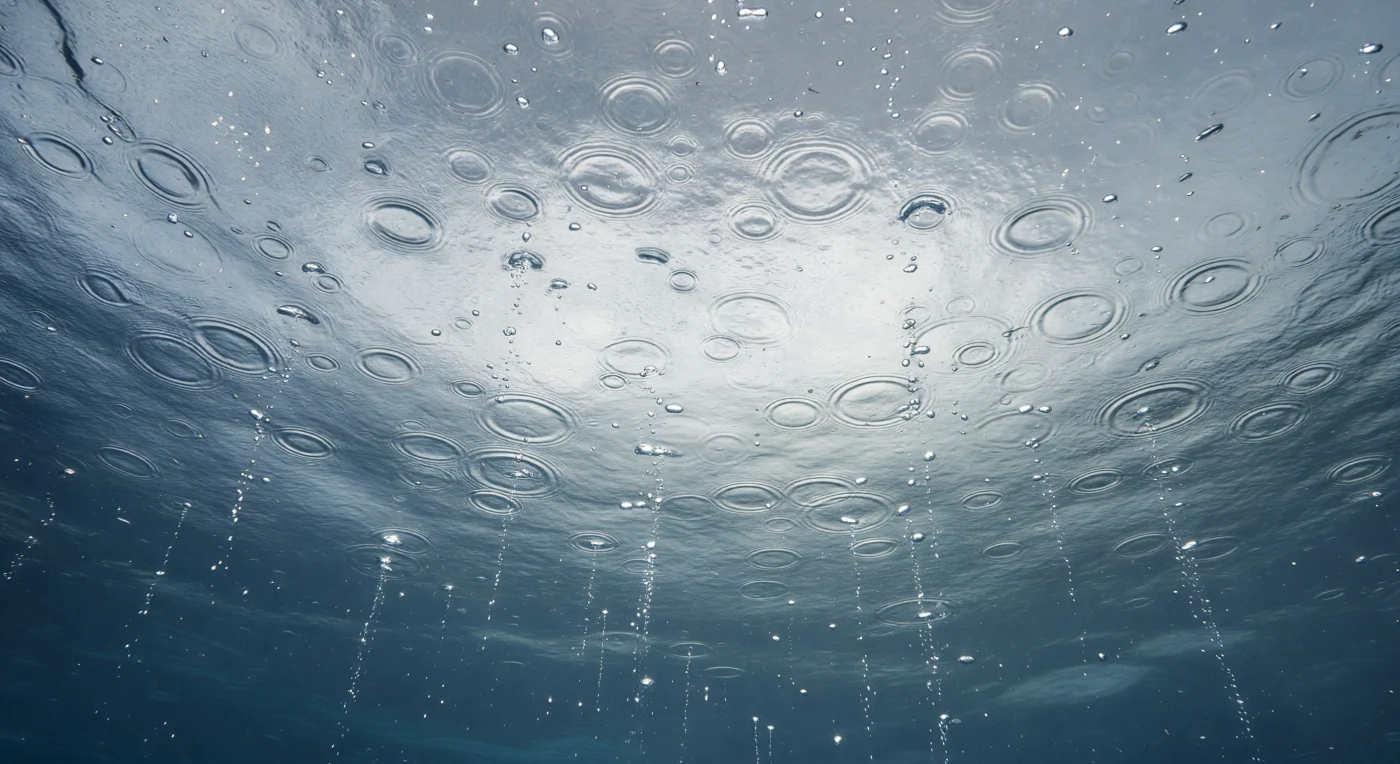
Just beneath the open ocean surface, moderate rainfall transforms the air–sea interface into a living percussion membrane: each descending drop punches a downward dimple, throws a momentary micro-crater crown, and vanishes into a collapsing cup, while entrained air bubbles cling in pearly clusters just below impact points and drift upward in brief vertical traces. Looking upward through this hammered skin, refracted overcast daylight gathers by total internal reflection into a trembling white-silver oval at the center of Snell's window — the entire compressed sky visible within a cone of roughly 97 degrees — grading outward through cool cyan and deep steel-blue into the darker periphery where no skylight penetrates. The sea-surface microlayer, normally a film only micrometers thick and chemically distinct from the water below, is here ceaselessly shredded and renewed, its organic surfactants broken into fragments as rainfall energy cascades through the uppermost centimeters, generating turbulence, transient salinity lenses, and the characteristic broadband underwater acoustic signature of rain — a hiss rich in frequencies between 1 and 50 kHz produced partly by the oscillation of entrapped resonant bubbles. Caustic coherence is shattered by the roughened interface, leaving only faint fragmented flashes and soft wavering highlights, while fine suspended particulates and organic specks drift freely through water of essentially atmospheric pressure — a world of astonishing physical intensity compressed into the thinnest, most energetically charged boundary the ocean possesses.
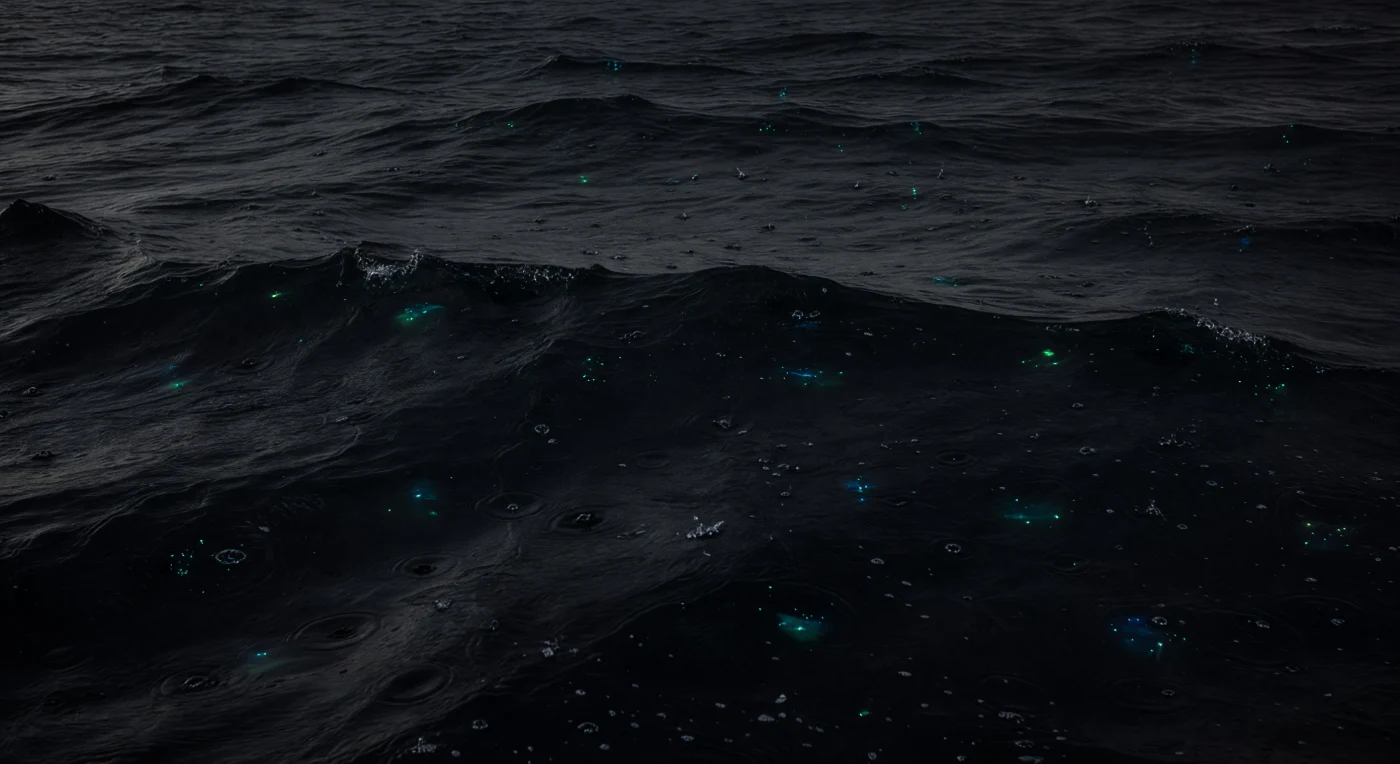
Where the open ocean breathes against a moonless sky, rain falls without witness onto three hundred million square kilometers of living water. Each droplet strikes with enough force to punch a momentary crater a few millimeters across, ejecting a symmetrical crown of displaced seawater that collapses back within milliseconds — a choreography of hydraulic mechanics repeated millions of times per second across the storm's footprint. The true spectacle belongs to the organisms just beneath the skin: dinoflagellates, those single-celled, bioluminescent plankton that respond to mechanical disturbance with bursts of cold blue-green light produced through the oxidation of luciferin, fire in isolated sparks and smears wherever a raindrop impact sends pressure waves radiating downward through the first centimeters of seawater. Acoustically, each raindrop also entrains a microscopic air bubble as it penetrates the surface microlayer, and these bubbles oscillate at frequencies between roughly 1 and 20 kilohertz, generating a broadband underwater sound field that marine bioacousticians can use to estimate rainfall rates remotely — the ocean is, in this sense, listening to itself. Here at the surface, salinity drops fractionally in a thin lens of fresher water, temperature shifts by tenths of a degree, and the sea-surface microlayer — that chemically distinct film only micrometers thick that mediates the exchange of gases including carbon dioxide and oxygen between ocean and atmosphere — is continuously disrupted and reformed, the planet's largest breathing surface endlessly renewing itself in the dark.
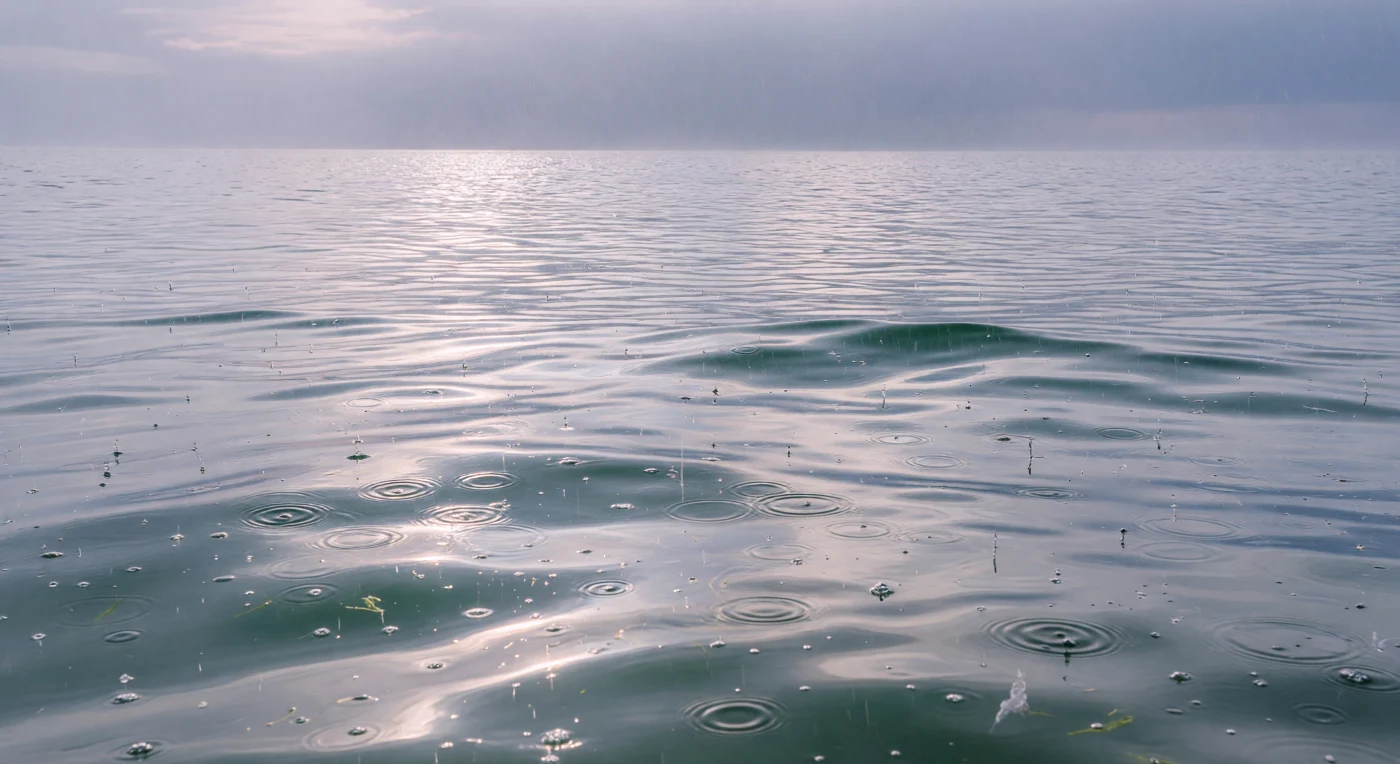
At the ocean's uppermost skin — a boundary measured in millimeters yet governing exchanges between atmosphere and sea — fine rain dismantles the surface microlayer one drop at a time, each impact excavating a momentary crater, flinging a crown of tiny droplets, and releasing a trapped air bubble that descends as a resonating sphere, producing the characteristic broadband hiss that propagates downward through the water column as a dense acoustic field. The sea-surface microlayer itself, that gossamer film enriched with dissolved organics, lipids, and gelatinous neuston — organisms that spend their entire lives at this precise boundary — is rhythmically disrupted and reconstituted between impacts, its translucent residents rocking on the interference rings crossing the broader swell geometry beneath a pre-dawn sky diffusing cool silver-lilac light. Where clusters of drops strike together, bubble plumes carry freshened, slightly cooler water downward, creating transient haline lenses only centimeters thick that float above the saltier ocean below, a microstratification that will persist only until wind or breaking waves erase it. This is where the hydrological cycle closes its loop, where evaporated ocean water returns as precipitation to locally freshen the surface, cool the skin, seed acoustic turbulence, and nourish the invisible community of organisms riding the interface — a world of extraordinary physical complexity existing at the thinnest possible margin between sky and sea.
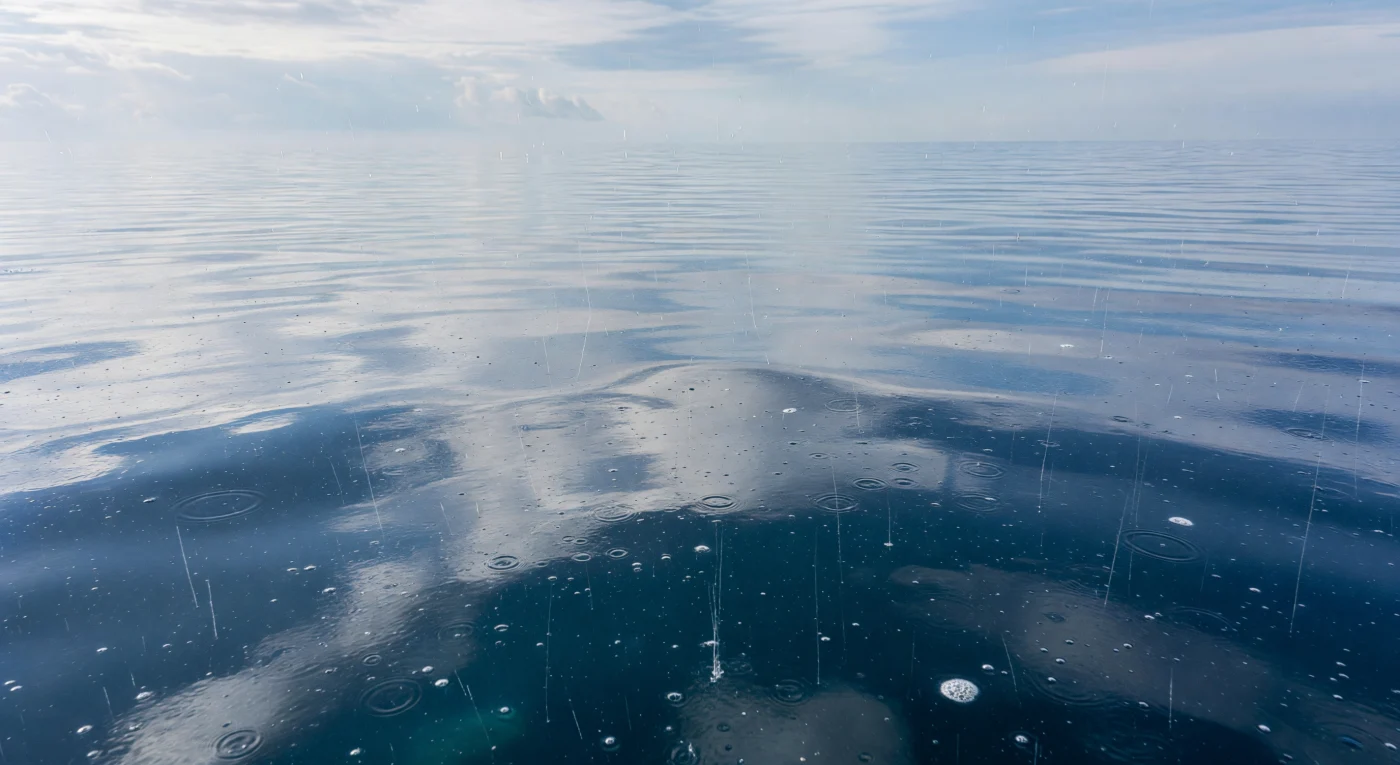
Where the sky releases its weight upon the sea, the ocean surface becomes a living mosaic of competing physics — broad glassy patches of rain-freshened water lie in silent contrast beside actively stippled zones where each falling drop punches a microscopic crater, flings a momentary crown of spray, and seeds a brief bubble before the surface heals itself in milliseconds. These falling drops deliver not only fresh water but kinetic energy that propagates downward as sound, generating a dense acoustic halo of broadband noise radiating through the upper meters — a hidden resonance invisible from above yet measurable far beneath the surface. The thin lens of freshened, slightly cooler water forming in the uppermost decimeters creates a subtle haline stratification, its lower boundary bending transmitted light into soft wavering caustics that shift cyan in the shallows to deep cobalt below, as refractive index gradients trace the boundary between diluted surface water and the saltier, denser ocean beneath. Convergence lines accumulating at salinity and surface-tension boundaries gather films of organic material — transparent exopolymers, lipid monolayers, and minute plankton — the sea-surface microlayer concentrating life and chemistry at this thinnest of interfaces. The overcast sky diffuses tropical sunlight evenly across the whole scene, and the ocean exists entirely in its own terms: a self-organizing system of thermodynamics, acoustics, fluid instability, and biology, continuously renewed by rain it has evaporated into clouds that have only now returned it home.
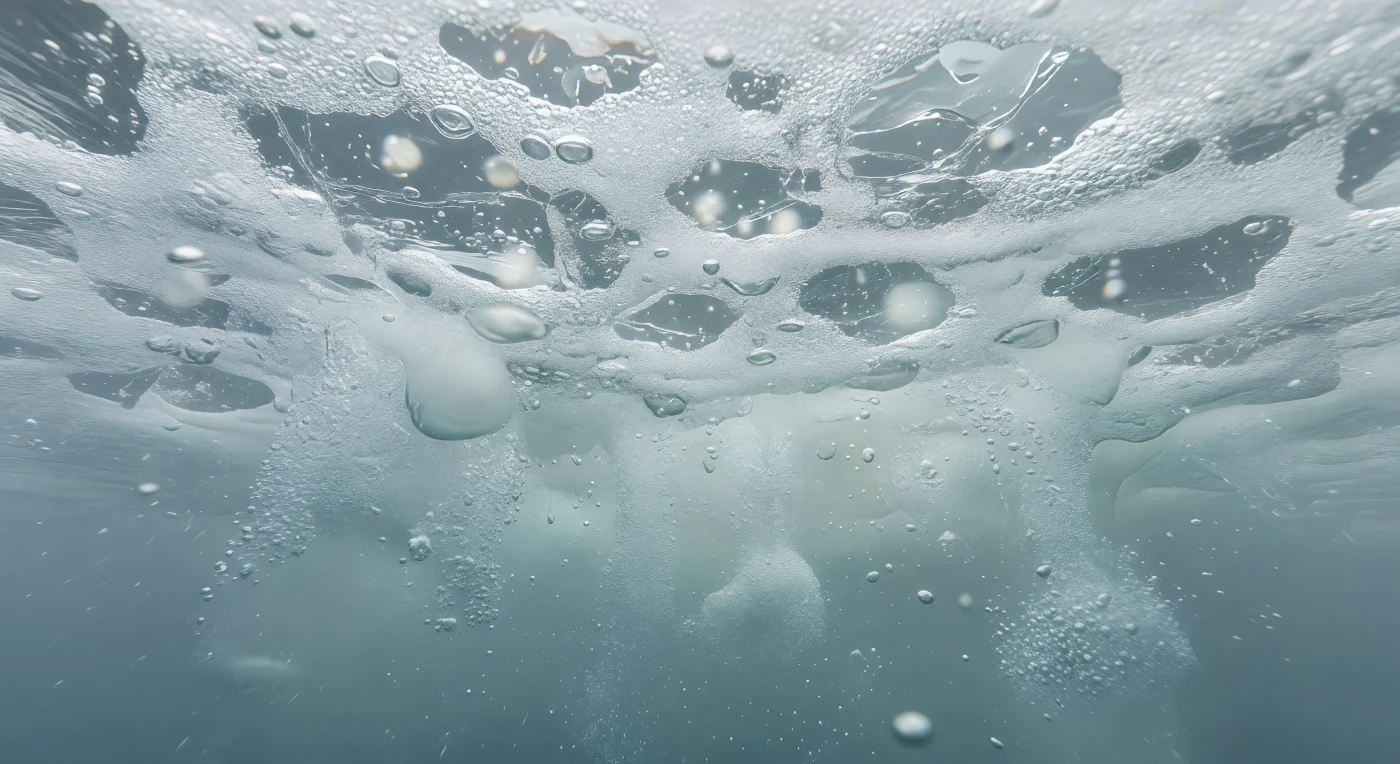
Just beneath the rain-struck surface, the ocean and atmosphere are locked in violent, continuous negotiation — each raindrop punching a fleeting micro-crater through the foam canopy, collapsing inward and sealing itself in a ring of entrained air that immediately fragments into pearl-white bubble veils drifting downward through cold gray-blue water. This uppermost boundary, barely centimeters thick, belongs to the sea-surface microlayer: the thinnest and most chemically distinct skin of the ocean, perpetually remade by wind shear, thermal flux, and the mechanical assault of precipitation, its salinity diluted into transient freshened lenses that float for minutes before turbulence dissolves them. Diffuse overcast daylight filters through the fractured foam raft overhead, scattered and milky rather than focused, robbed of directionality by countless bubble membranes so that the water below glows with a sourceless, pearlescent luminosity reaching only a short distance before the optically noisy column of suspended microbubbles and particulate swallows it entirely. Acoustically, each raindrop impact generates a characteristic double-frequency sound pulse audible for hundreds of meters in all directions — a continuous broadband hiss that pervades the upper ocean during squalls and that marine biologists and oceanographers exploit to measure rainfall rates remotely from hydrophones. Here, in this pressureless, turbulent, perpetually renewed skin, the boundary between two fluid worlds is not a line but a trembling, porous, self-erasing threshold that the ocean continuously reclaims.