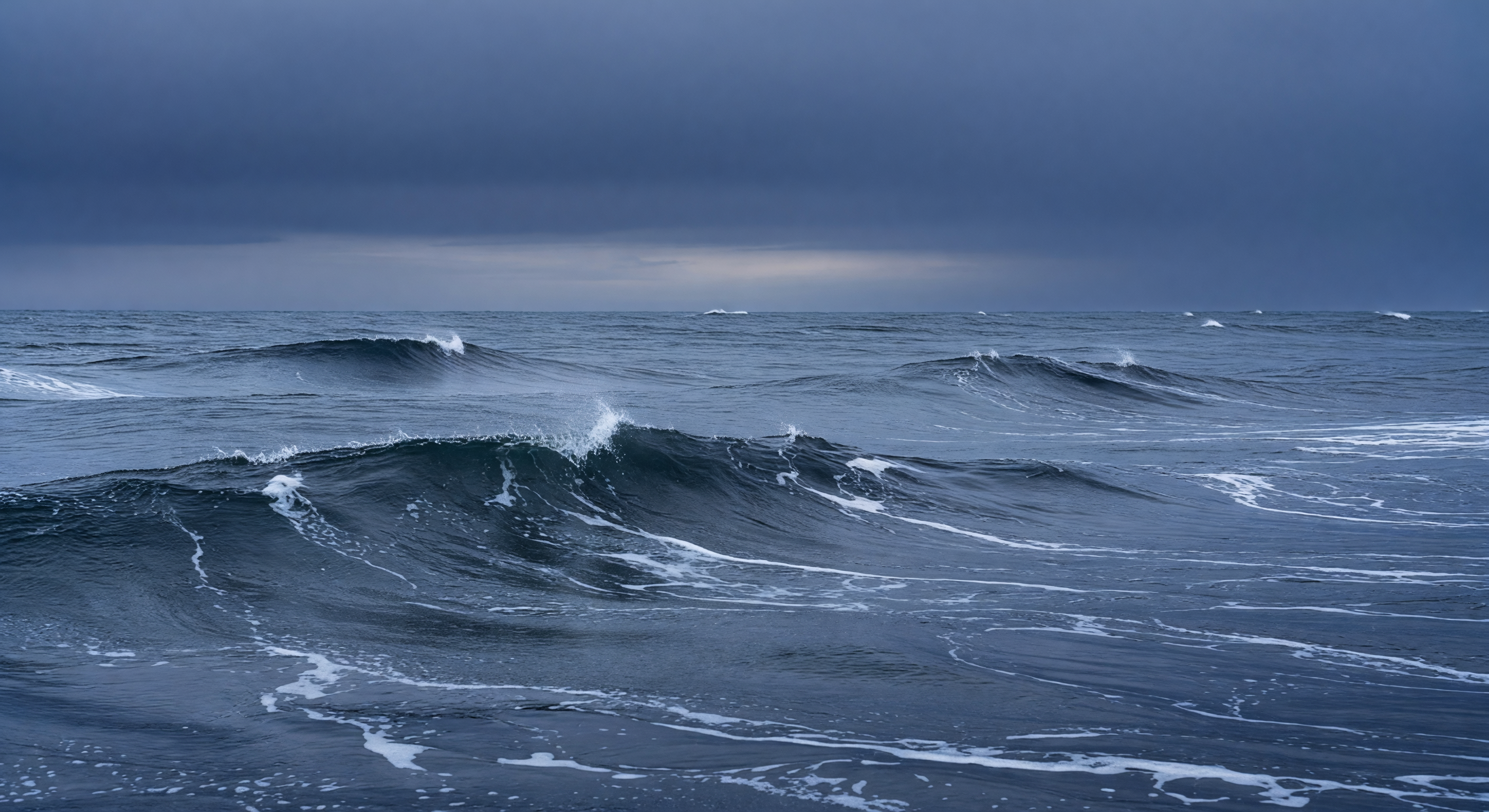
At the very threshold where atmosphere and ocean become indistinguishable, the sea surface under storm-force winds is one of the most energetically violent environments on the planet, a place where momentum, heat, and mass transfer between two fluids at rates that shape climate itself. Long swell trains generated by distant pressure systems propagate beneath shorter, steeper wind waves, their superimposition producing the characteristic cross-hatched chaos of open ocean gale conditions, while breaking crests inject billions of microscopic bubbles into the upper meter, briefly supersaturating the water with oxygen and generating the sea-salt aerosols that seed clouds far inland. The sea-surface microlayer — that biochemically extraordinary film spanning barely a millimeter — is perpetually destroyed and reformed here, its concentrated organic molecules, bacteria, and lipids shredded by each breaking wave and redistributed as spindrift racing low across the water in pale, fast-moving veils. Langmuir circulation organizes the subsurface turbulence into paired helical cells aligned with the wind, collecting foam and biological material into the long windrows visible as combed streaks across the troughs, while the mixed layer deepens with every hour of sustained gale, entraining cooler, denser water from below and erasing the seasonal thermocline. This is the ocean at its most exposed and most consequential — a raw coupling of sky and sea that has operated without interruption across billions of years, indifferent and immense.
Other languages
- Français: Houle Orageuse Aube de Fer
- Español: Oleaje Tormentoso Alba de Hierro
- Português: Ondulação Tempestuosa Alvorada de Ferro
- Deutsch: Eiserner Morgen Sturmwelle
- العربية: أمواج العاصفة فجر الحديد
- हिन्दी: लौह भोर तूफानी लहर
- 日本語: 鉄の夜明け嵐のうねり
- 한국어: 철빛 새벽 폭풍 파도
- Italiano: Tempesta Alba di Ferro
- Nederlands: IJzeren Dageraad Stormgolf