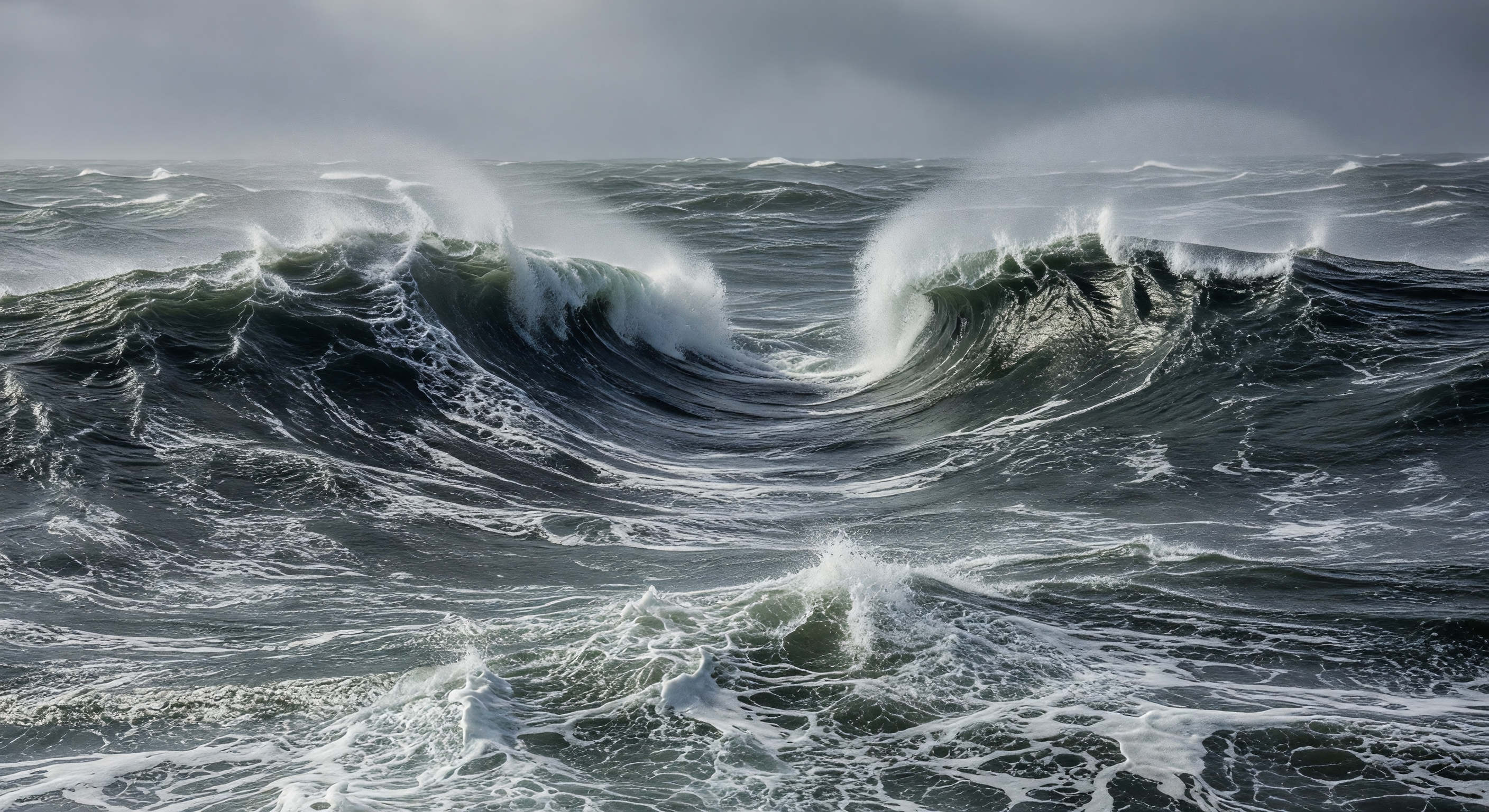
At the very boundary where atmosphere meets ocean, gale-force winds exceeding 20 metres per second drive towering walls of slate-green water into steep, heaving corridors, their forward faces glassy and dark beneath a uniformly overcast sky that diffuses cold daylight into a featureless silver-gray radiance. Each crest tears apart under wind shear, shedding curtains of spindrift and flinging aerosol droplets into a salt-heavy atmosphere where visibility dissolves into spray haze at the horizon; the sea-surface microlayer — that upper fraction of a millimetre governing gas exchange between ocean and atmosphere — is shattered and continuously remade thousands of times per second across every breaking wave. Beneath the collapsing whitecaps, bubble plumes carry entrained air meters deep, supersaturating the upper water column with oxygen and driving intense atmosphere-ocean coupling that transfers heat, moisture, and momentum on scales critical to global climate systems. Langmuir circulation cells align foam streaks into parallel downwind lanes, while the breaker-mixed surface layer churns temperature and salinity into near-homogeneity across the uppermost tens of metres, erasing any calm stratification that calmer days might have established. This is the ocean at its most mechanically violent and most atmospherically consequential — a self-contained engine of physical exchange that has operated across every storm-track on Earth for hundreds of millions of years, entirely indifferent to witness.
Other languages
- Français: Ligne d'eau entre géants
- Español: Horizonte entre gigantes
- Português: Linha d'água entre gigantes
- Deutsch: Wasserlinie zwischen Giganten
- العربية: خط الماء بين العمالقة
- हिन्दी: दिग्गजों के बीच जलरेखा
- 日本語: 巨波の間の水面
- 한국어: 거인들 사이 수평선
- Italiano: Linea d'acqua tra giganti
- Nederlands: Waterlijn tussen reuzen