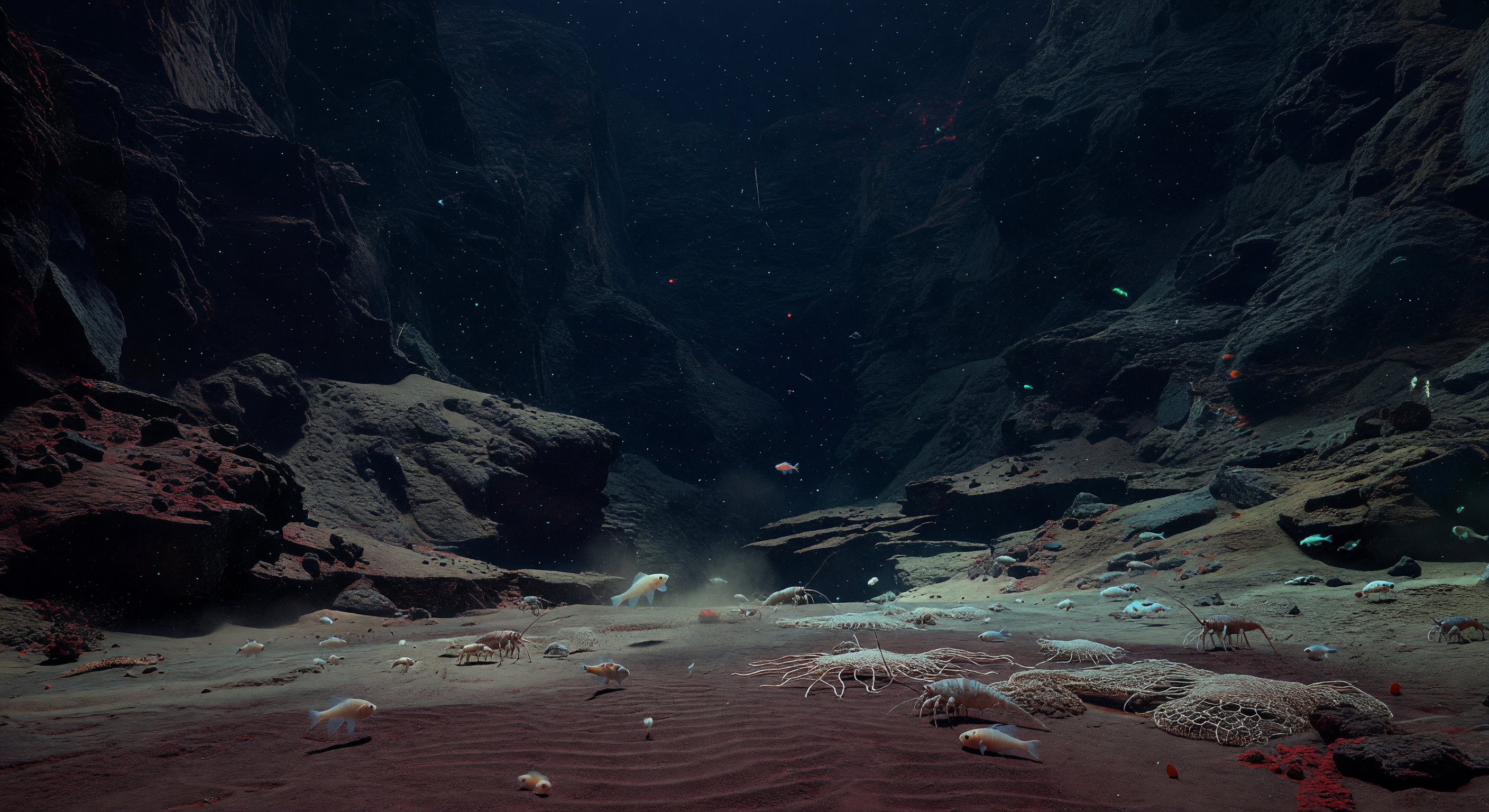
Scientific confidence: Medium
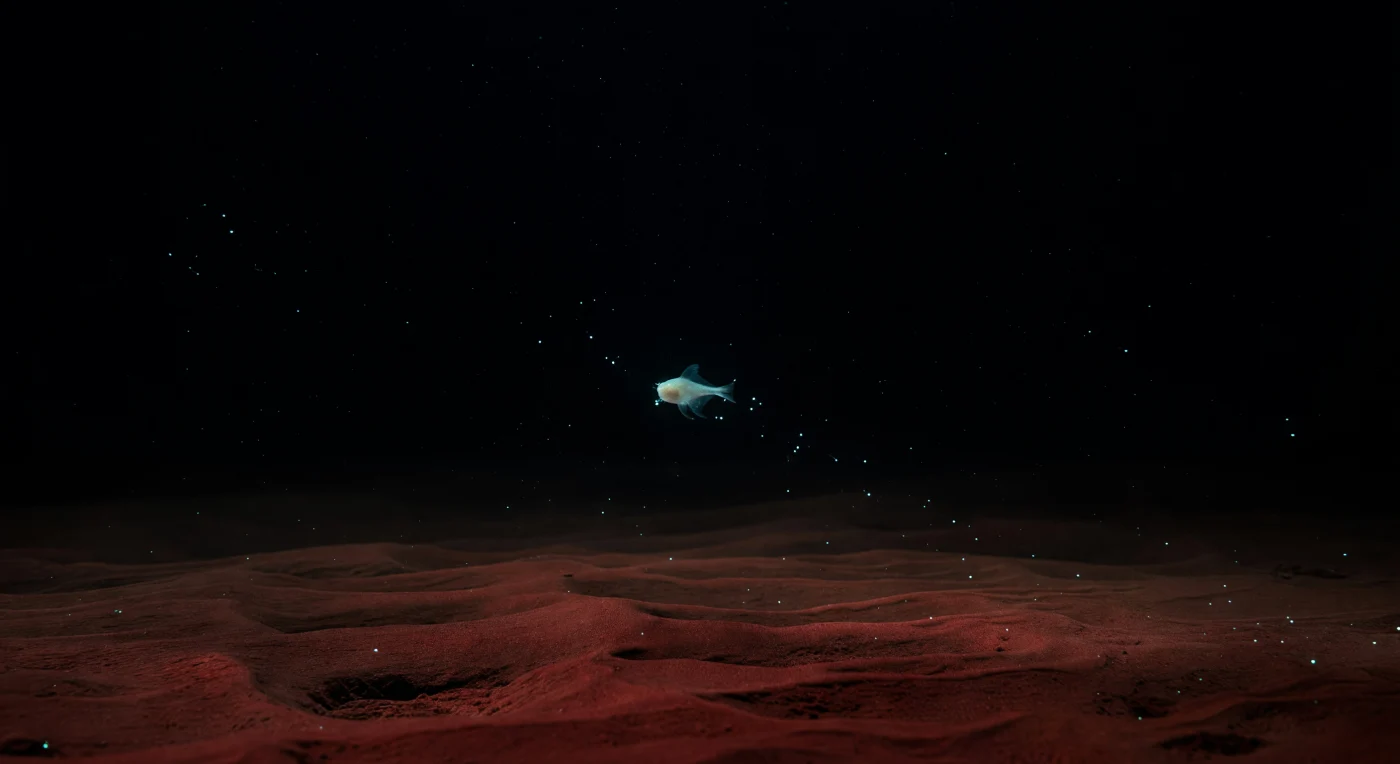
At the bottom of the Sirena Deep, one of the most profound depressions in the western Pacific, a solitary snailfish — *Pseudoliparis belyaevi* or a closely related hadal liparid — drifts in absolute darkness just centimeters above rippled sediment stained deep crimson and maroon by iron-rich minerals carried down through millennia of slow marine snowfall. Here, at pressures exceeding 1,100 atmospheres, the water temperature hovers near 1–2 °C, and no photon of sunlight has penetrated for the entire history of the ocean; the only light that has ever existed at this depth is biological — the cold blue-green pinpricks of bioluminescent plankton and bacteria drifting through the water column like scattered embers. The snailfish, gelatinous and nearly translucent, is an extreme specialist: its cell membranes are stabilized by high concentrations of trimethylamine oxide (TMAO), a piezolyte that counteracts the protein-crushing force of the deep, and its soft, unossified skeleton permits a flexibility that rigid bone could never sustain at this pressure. Around it, the rippled sediment records the faintest bottom currents — hadal flows so slow they are measured in millimeters per second — while particles of marine snow settle continuously from the water column above, carrying the compressed biochemical legacy of the sunlit world five miles overhead. This creature exists in a place that has never been witnessed, only inferred, a permanent resident of the planet's most extreme benthic silence.
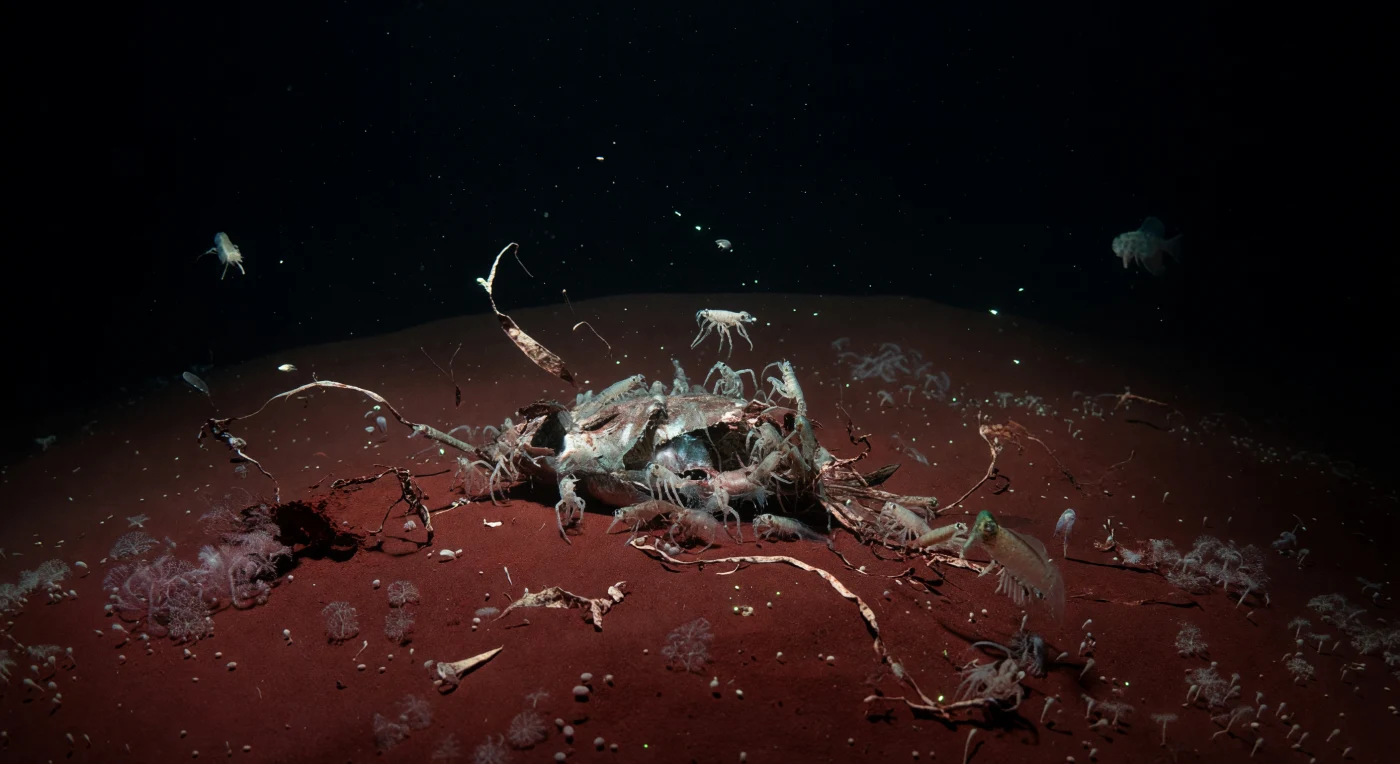
At approximately 10,800 metres below the surface in the Sirena Deep — the second-deepest depression yet confirmed in the Mariana Trench — pressures exceeding 1,080 atmospheres compress the water column into a medium so dense that sound itself travels differently, and no photon of solar origin has penetrated here in geological time. The red sediment blanketing the trench axis is coloured by iron-bearing clays and radiolarian tests accumulated over millions of years of slow deposition, and across its powder-soft surface the collapsed body of a naturally fallen fish has become an island of extraordinary chemical and biological energy in an otherwise nutrient-starved void. Dense aggregations of giant lysianassoid amphipods — Hirondellea gigas and related hadal scavengers capable of detecting a food-fall chemically across kilometres of abyssal darkness — swarm in layered, seething clusters over the flattened flesh, their translucent exoskeletons and segmented limbs intermittently outlined by cold green bioluminescent pulses drifting freely through the water from microorganisms in the marine snow. Beyond the swarm, fragile xenophyophores spread across the sediment like pale lacework, their single-celled bodies among the largest known on Earth, while at the furthest limit of perception a hadal snailfish — Pseudoliparis belyaevi or a close relative, the deepest-living vertebrate yet recorded — holds position as a ghostly pale form, drawn by the same chemical signal, its gelatinous flesh and reduced skeleton a quiet evolutionary answer to a world defined entirely by cold, darkness, and the crushing indifference of depth.
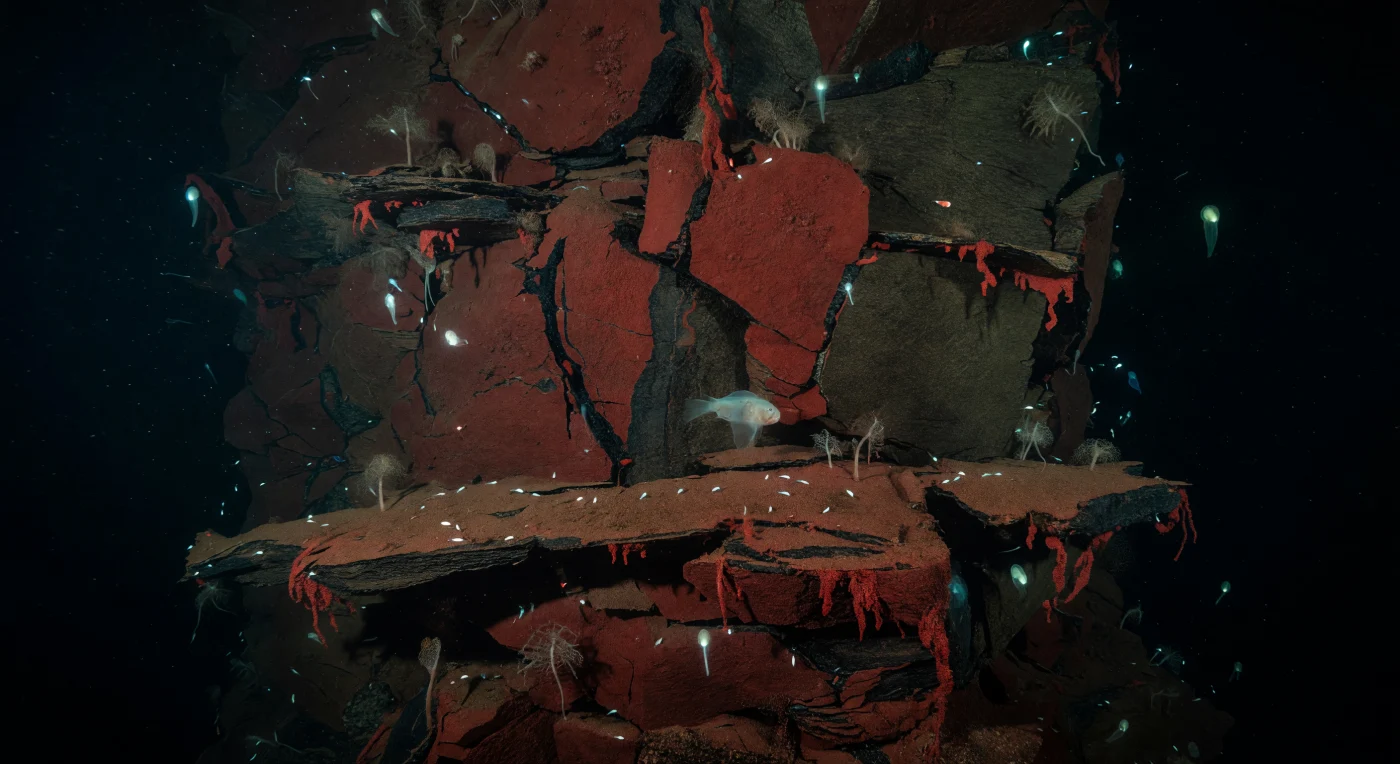
At roughly 10,800 meters beneath the surface, Sirena Deep occupies a hadal realm where hydrostatic pressure exceeds 1,080 atmospheres, a force sufficient to compress seawater itself into measurable density and to reshape the biochemistry of every organism present. The wall descending through this frame is ancient oceanic crust — fractured basalt accreted at a mid-ocean spreading center perhaps 180 million years ago, now armored in manganese oxide crusts and draped in compacted red pelagic clay, the oxidized residue of countless millennia of slow sediment rain from the sunlit ocean impossibly far above. In the complete absence of solar photons, the only illumination that has ever touched this rock arrives episodically from the organisms themselves: gelatinous drifters produce brief blue-green pulses that wash across jagged fracture planes and silt-dusted ledges before the darkness reclaims everything, a communication system, a predator lure, or simply a cellular accident witnessed by no witness at all. Against one rust-colored shelf, a hadal snailfish — among the deepest-living vertebrates known to science, its bones demineralized, its flesh suffused with pressure-stabilizing trimethylamine oxide — holds position in water just above 2°C, while xenophyophores, single-celled giants that aggregate sediment particles into fragile tests, cling to the quieter clay faces as the largest individual cells on Earth. This wall has never known light, never known stillness broken by anything other than life, and it will continue its slow subsidence into the subduction zone long after every surface ocean has changed beyond recognition.
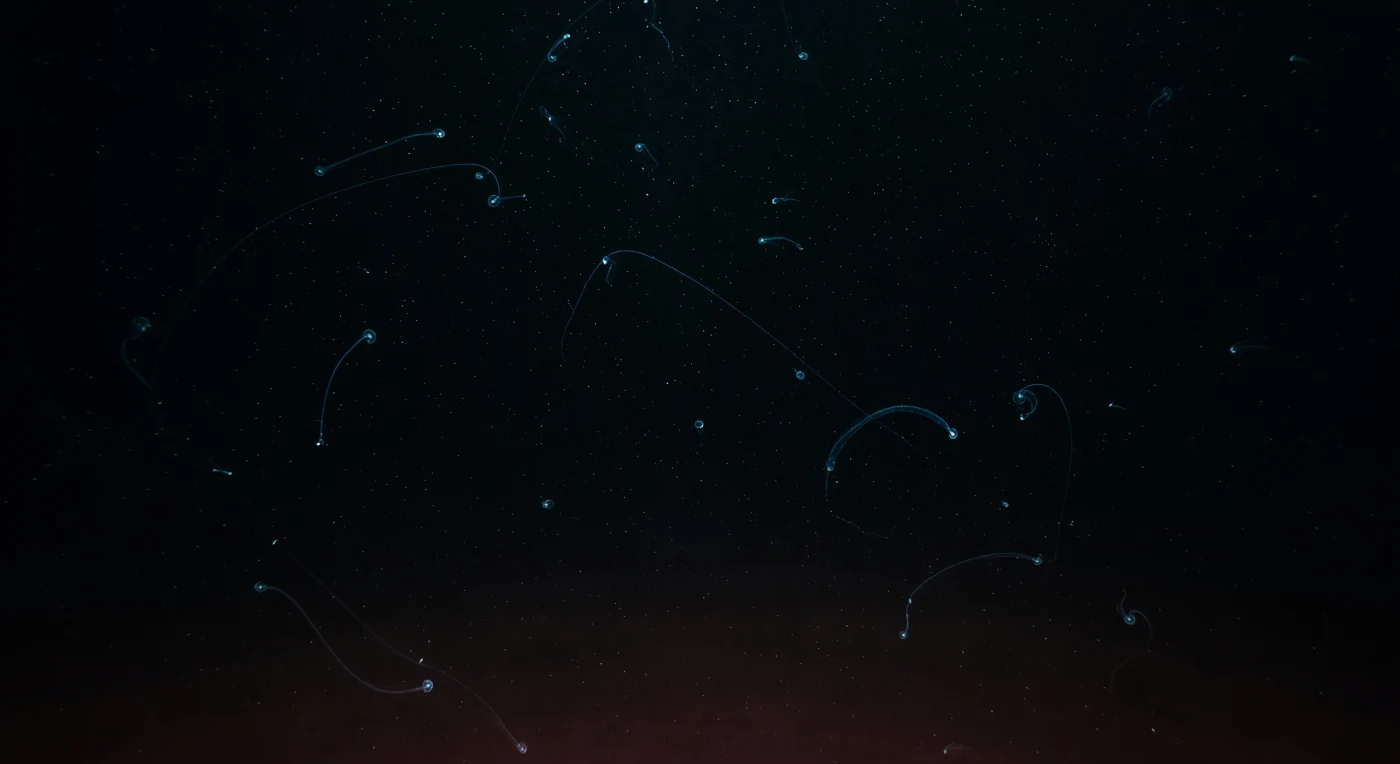
At the bottom of the world's most extreme geological wound, the Sirena Deep descends to roughly 10,809 meters beneath the western Pacific surface, carved where the Pacific Plate subducts beneath the Mariana microplate along one of Earth's oldest and most relentless convergent boundaries. In the water column suspended above this hadal depression, pressure exceeds 1,000 atmospheres and absolute darkness should reign — yet life refuses silence here, and small gelatinous organisms drift and pulse through the void, their bodies generating cold blue and cyan light through luciferin-luciferase reactions that evolution has refined across hundreds of millions of years. Transparent medusae trail luminescent curtains, ctenophores inscribe brief comb-rowed constellations with photophores along their ciliated bands, and thread-fine siphonophore colonies unravel like living calligraphy against water so black and cold it absorbs all memory of sunlight. Between these living sparks, marine snow — the perpetual slow rain of organic detritus, fecal pellets, and microbial aggregates — sinks at millimeters per second through water of extraordinary clarity, each mote separated from the next by meters of crushing, lightless ocean. This is the hadal realm as it has always existed: self-illuminating, utterly pressured, and wholly indifferent to any witness.
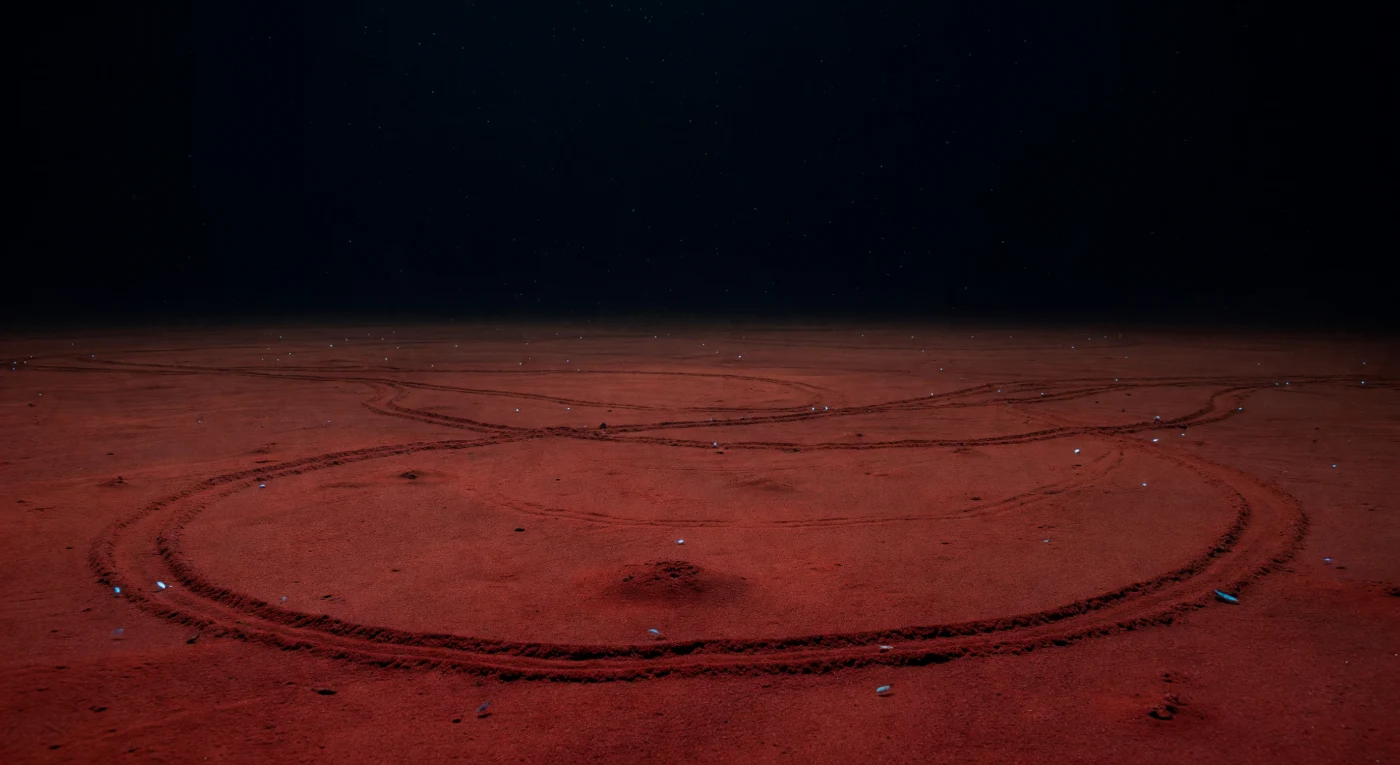
At roughly 10,809 meters beneath the surface, Sirena Deep occupies the eastern branch of the Mariana Trench, where the Pacific Plate subducts beneath the Mariana microplate at one of Earth's most extreme geological boundaries, generating pressures exceeding 1,080 atmospheres and compressing even the densest seawater into a medium measurably different from that of shallower seas. No photon of sunlight has ever reached this basin; the only illumination is the sporadic, cold blue-cyan pulse of bioluminescence produced by the organisms themselves — minute flickers from amphipods and isopods threading through the curving feeding furrows they have inscribed across a broad plain of compact crimson foraminifera-rich ooze, sediment that has accumulated grain by microscopic grain over millions of years of slow pelagic rain. These hadal scavengers and deposit-feeders are among the few macrofaunal specialists capable of surviving pressures that would crush conventional physiology, their piezophilic biochemistry and pressure-adapted cell membranes allowing them to exploit the sparse organic material — marine snow, sunken carcasses, microbial mats — that drifts down from a sunlit world ten kilometers above. The looping furrows they leave behind harden slowly under compression into a record written in sediment, curving across the basin floor like script in a language composed entirely in the dark, witnessed by nothing but the water itself.
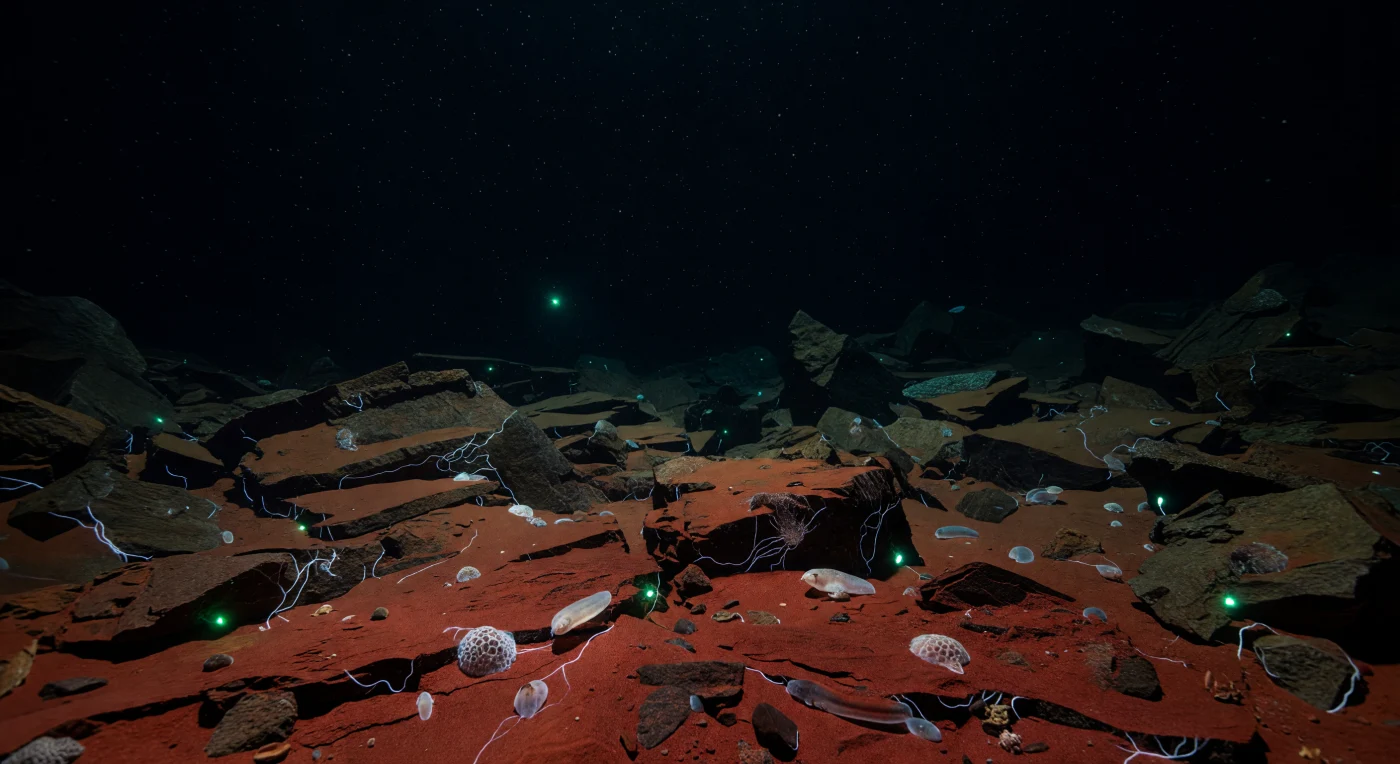
At the base of the Sirena Deep's towering trench wall — the second-deepest measured abyss in the Mariana Trench, plunging beyond ten and a half kilometers beneath the western Pacific — angular talus blocks of fractured basalt and serpentinite lie toppled and half-consumed by iron-rich red silt, the accumulated fallout of millennia of pelagic settling and wall collapse. Here, hydrostatic pressure exceeds one thousand atmospheres, compressing the near-freezing water to a density that slows every process to geologic patience, while marine snow drifts without direction through absolute darkness, pale specks of organic detritus descending from a sunlit world utterly unreachable above. Threadlike films of chemolithotrophic bacteria trace the crevices between rock faces, their faint metabolic glow barely distinguishable from the cold, and xenophyophore-like agglutinated foraminifera press themselves flat against the sediment surface, among the largest single-celled organisms on Earth, exploiting trace organic matter in sediment where almost nothing else survives. Pale holothurians — hadal sea cucumbers of the genus *Peniagone* or close relatives — move with impossible slowness across the silt between the blocks, their soft bodies intermittently catching distant emerald pulses from bioluminescent organisms drifting far out in the water column, organisms that never touch the floor yet briefly illuminate it. The trench wall rises into impenetrable blackness above, the scale of it geologic and indifferent, a subduction scar where the Pacific Plate bends downward into the mantle, carrying this silence with it.
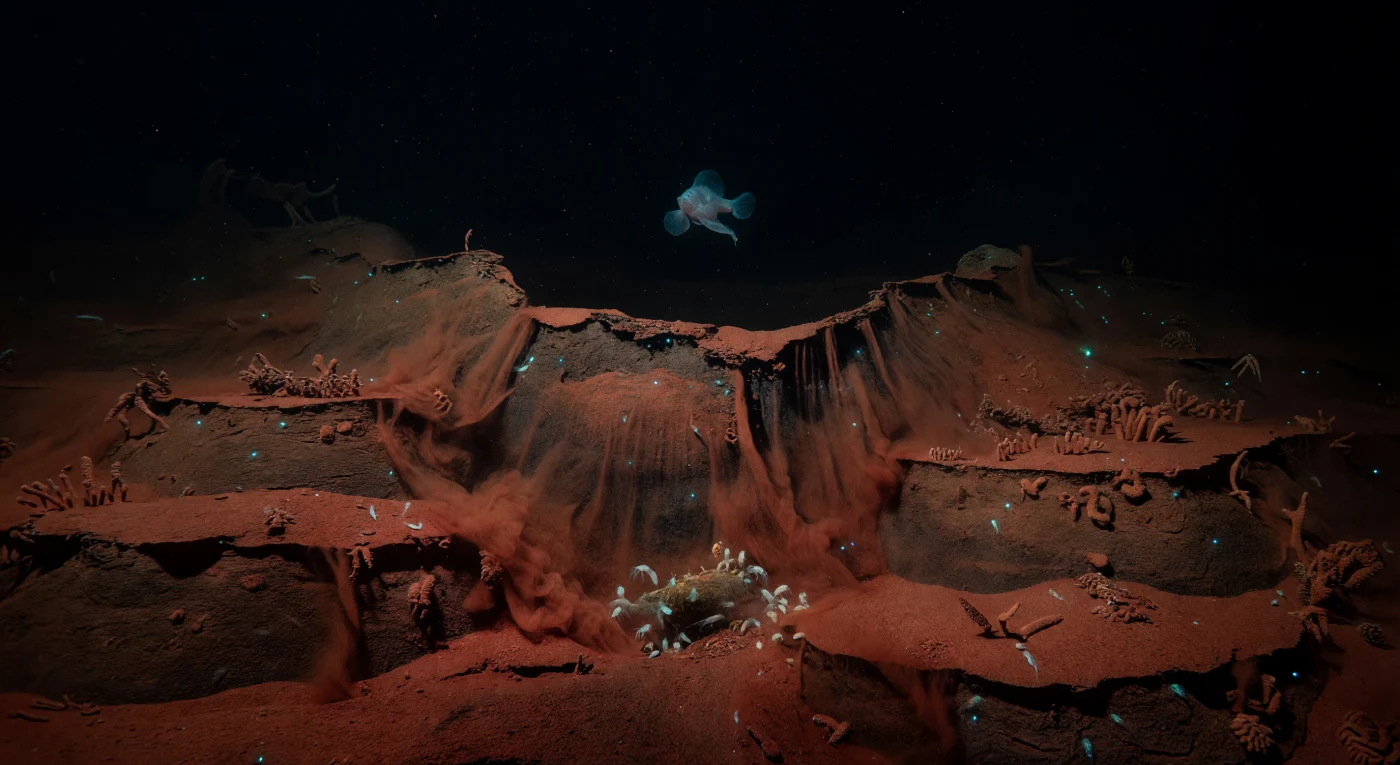
At roughly 10,800 metres below the surface in Sirena Deep, the second-deepest known abyss in the Mariana Trench, the hadal floor has recently failed — a slump scar splitting the iron-rich sediment into scalloped terraces whose upper lips are cleanly torn while their lower ledges receive a slow, continuous burial of rust-red clay and foraminiferan ooze cascading downslope in dense, curling veils. Pressure here exceeds 1,080 atmospheres, compressing seawater to a measurably greater density and rendering the collapsing silt almost smoke-like in its descent, each particle drifting under gravity in water so cold it hovers near two degrees Celsius. Where the terraces remain stable between scarps, fields of giant xenophyophores — single-celled foraminiferans that can exceed ten centimetres and represent among the largest individual cells on Earth — stand partially intact or lie dusted and half-consumed beneath the fresh fall, while at the base of the slope a vertebrate carcass draws dense swarms of pale *Hirondellea* amphipods whose scavenging metabolism is adapted precisely to this crushing dark. A translucent hadal snailfish, likely *Pseudoliparis* sp., hangs motionless above the slump front on spread pectoral fins, and along the red particle cloud, cold cyan and blue-green bioluminescent sparks from disturbed benthic organisms flicker briefly into existence — the only light this world has ever known, sketching for an instant the contour of a collapse that no witness was present to cause.
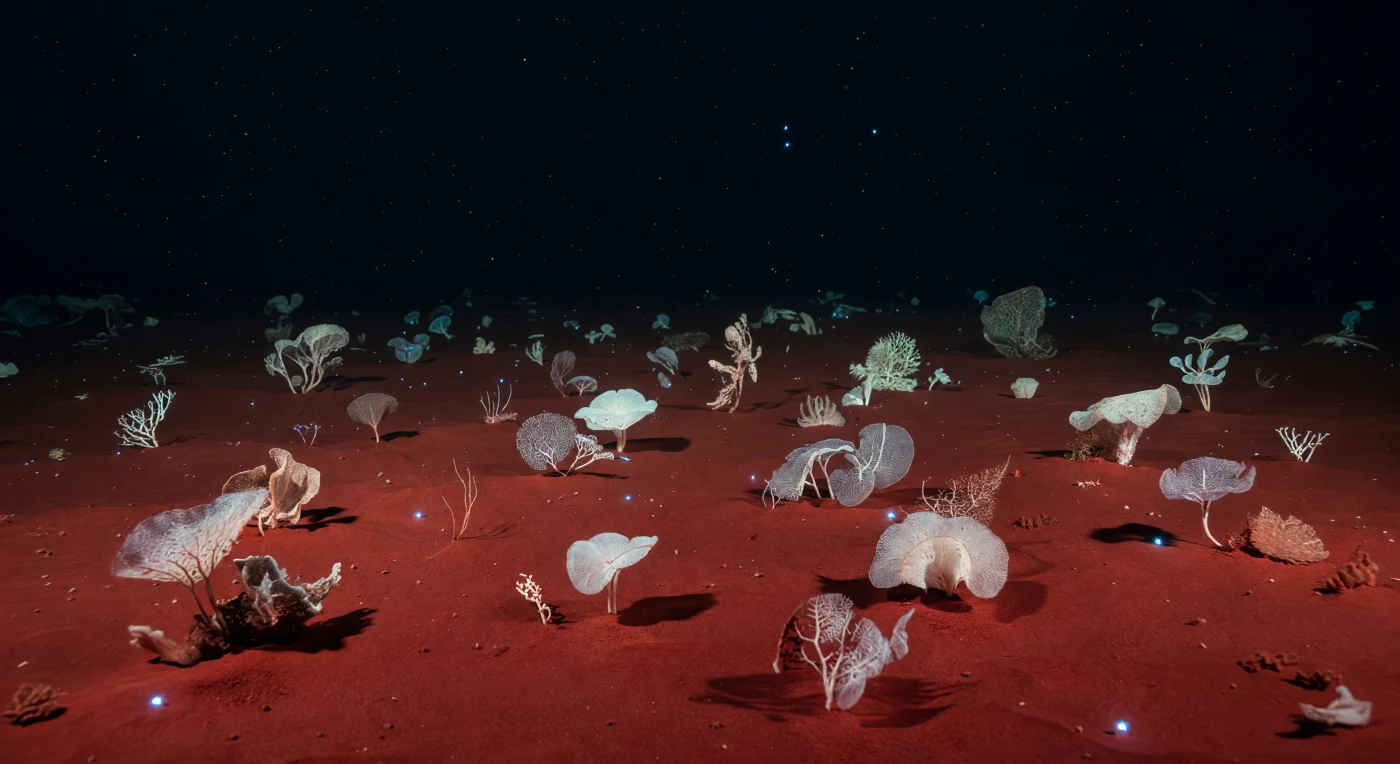
At roughly 10,800 metres beneath the surface, Sirena Deep occupies the eastern branch of the Mariana Trench where the Pacific Plate subducts beneath the Mariana microplate, generating one of the most extreme pressure environments on Earth — approximately 1,080 atmospheres bear down on every surface, compressing seawater itself into a slightly denser, colder medium that hovers near 1–2 °C. Across the hadal plain, iron and manganese oxides stain the fine pelagic ooze a deep brick-red, the sediment built grain by grain over geological epochs from the slow rain of radiolarian tests, clay particles, and organic detritus filtering down from the sunlit world more than ten kilometres above. Rising from this plain, xenophyophores — the largest known single-celled organisms on Earth, belonging to the foraminiferan lineage — construct their branching and disc-like agglutinated tests from sediment particles bound by a cytoplasmic network, forming centimetre-to-decimetre structures of extraordinary fragility that serve as microhabitat refugia for meiofauna and small crustaceans in an otherwise featureless expanse. No photon of solar origin survives to this depth; the only light is metabolic, emitted by drifting organisms in brief cyan-blue pulses that scatter softly through water of exceptional clarity before the darkness reclaims the plain, leaving the xenophyophore field to persist in silence, utterly indifferent to any witness.