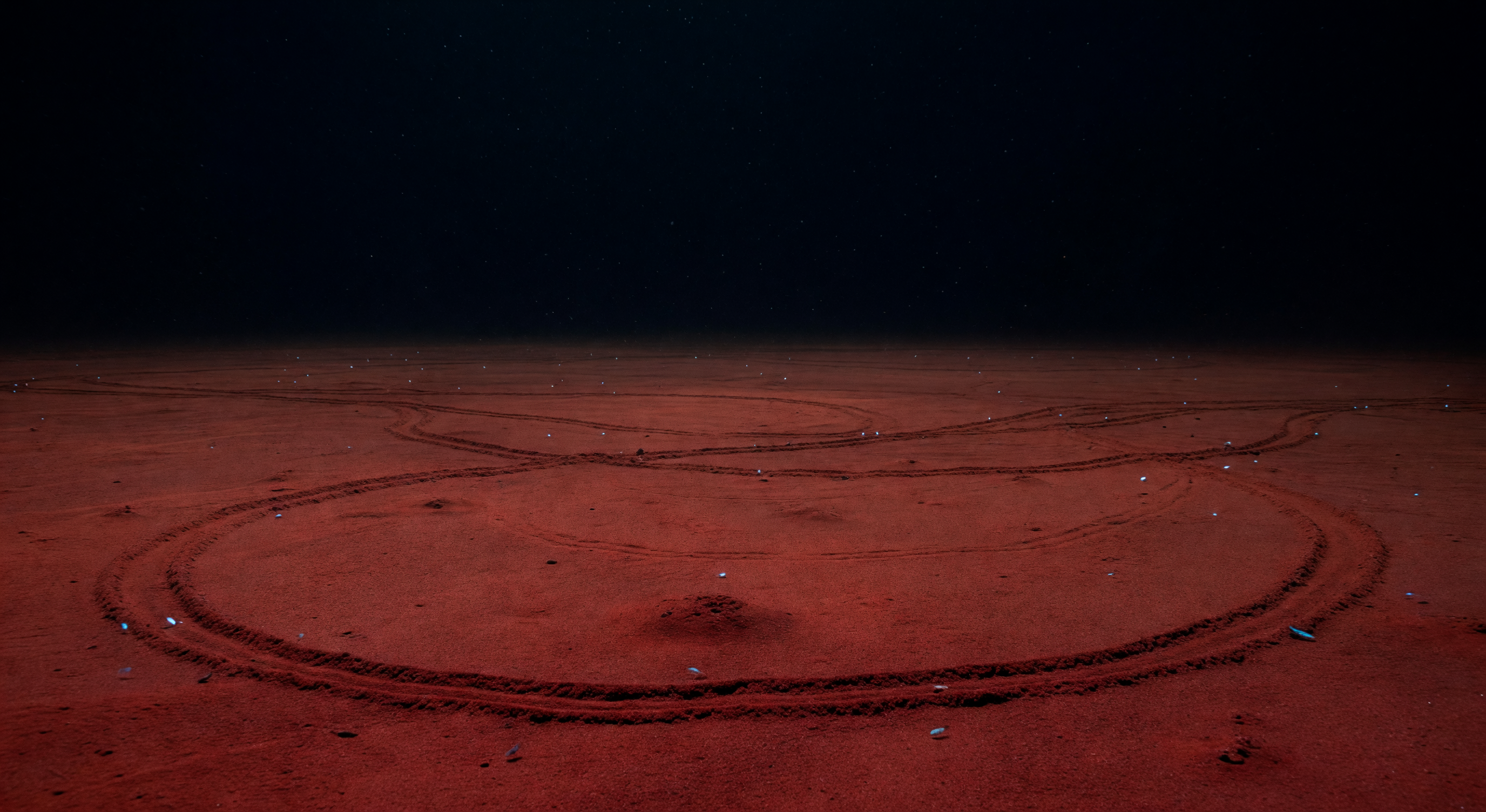
At roughly 10,809 meters beneath the surface, Sirena Deep occupies the eastern branch of the Mariana Trench, where the Pacific Plate subducts beneath the Mariana microplate at one of Earth's most extreme geological boundaries, generating pressures exceeding 1,080 atmospheres and compressing even the densest seawater into a medium measurably different from that of shallower seas. No photon of sunlight has ever reached this basin; the only illumination is the sporadic, cold blue-cyan pulse of bioluminescence produced by the organisms themselves — minute flickers from amphipods and isopods threading through the curving feeding furrows they have inscribed across a broad plain of compact crimson foraminifera-rich ooze, sediment that has accumulated grain by microscopic grain over millions of years of slow pelagic rain. These hadal scavengers and deposit-feeders are among the few macrofaunal specialists capable of surviving pressures that would crush conventional physiology, their piezophilic biochemistry and pressure-adapted cell membranes allowing them to exploit the sparse organic material — marine snow, sunken carcasses, microbial mats — that drifts down from a sunlit world ten kilometers above. The looping furrows they leave behind harden slowly under compression into a record written in sediment, curving across the basin floor like script in a language composed entirely in the dark, witnessed by nothing but the water itself.
Sirena Deep