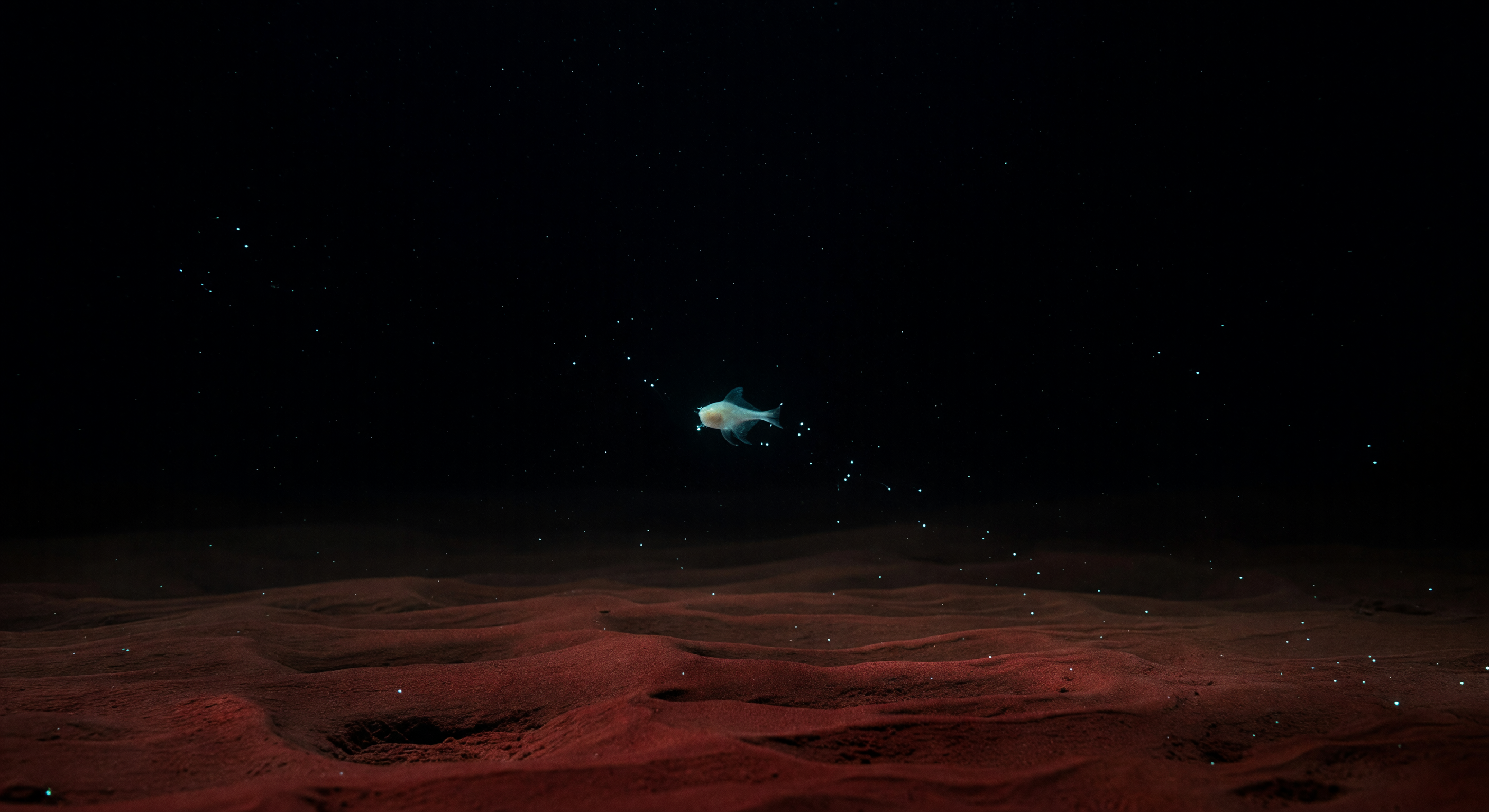
At the bottom of the Sirena Deep, one of the most profound depressions in the western Pacific, a solitary snailfish — *Pseudoliparis belyaevi* or a closely related hadal liparid — drifts in absolute darkness just centimeters above rippled sediment stained deep crimson and maroon by iron-rich minerals carried down through millennia of slow marine snowfall. Here, at pressures exceeding 1,100 atmospheres, the water temperature hovers near 1–2 °C, and no photon of sunlight has penetrated for the entire history of the ocean; the only light that has ever existed at this depth is biological — the cold blue-green pinpricks of bioluminescent plankton and bacteria drifting through the water column like scattered embers. The snailfish, gelatinous and nearly translucent, is an extreme specialist: its cell membranes are stabilized by high concentrations of trimethylamine oxide (TMAO), a piezolyte that counteracts the protein-crushing force of the deep, and its soft, unossified skeleton permits a flexibility that rigid bone could never sustain at this pressure. Around it, the rippled sediment records the faintest bottom currents — hadal flows so slow they are measured in millimeters per second — while particles of marine snow settle continuously from the water column above, carrying the compressed biochemical legacy of the sunlit world five miles overhead. This creature exists in a place that has never been witnessed, only inferred, a permanent resident of the planet's most extreme benthic silence.
Other languages
- Français: Limace Solitaire des Abysses
- Español: Pez Caracol Solitario Sirena
- Português: Peixe Caramujo Solitário Sirena
- Deutsch: Einsamer Sirena Schneckenfisch
- العربية: سمكة القوقع المنعزلة
- हिन्दी: एकाकी सिरेना घोंघा मछली
- 日本語: 孤独なシレナカタツムリウオ
- 한국어: 고독한 시레나 달팽이물고기
- Italiano: Lumaca di Mare Solitaria Sirena
- Nederlands: Eenzame Sirena Slakkenvis