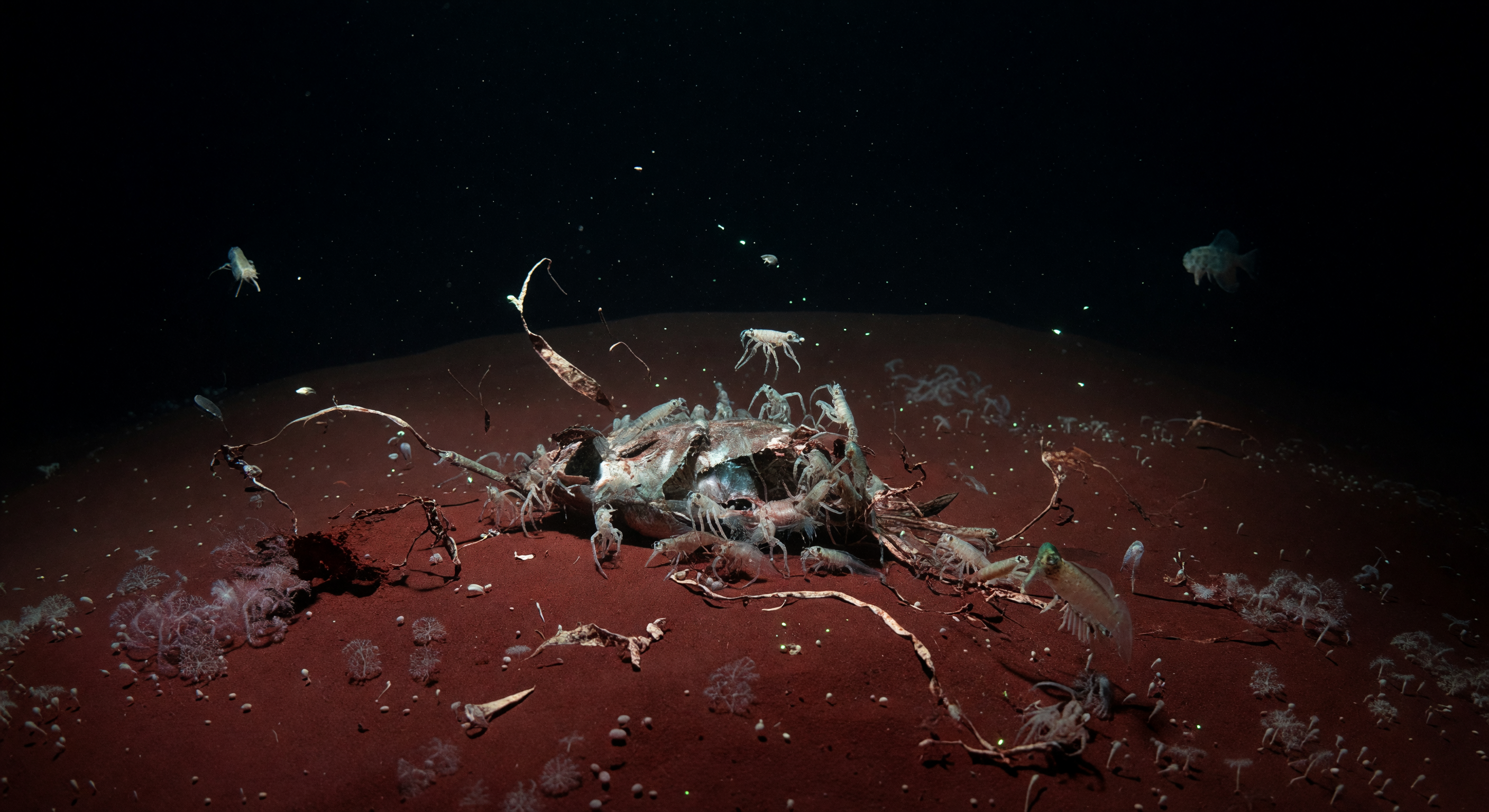
At approximately 10,800 metres below the surface in the Sirena Deep — the second-deepest depression yet confirmed in the Mariana Trench — pressures exceeding 1,080 atmospheres compress the water column into a medium so dense that sound itself travels differently, and no photon of solar origin has penetrated here in geological time. The red sediment blanketing the trench axis is coloured by iron-bearing clays and radiolarian tests accumulated over millions of years of slow deposition, and across its powder-soft surface the collapsed body of a naturally fallen fish has become an island of extraordinary chemical and biological energy in an otherwise nutrient-starved void. Dense aggregations of giant lysianassoid amphipods — Hirondellea gigas and related hadal scavengers capable of detecting a food-fall chemically across kilometres of abyssal darkness — swarm in layered, seething clusters over the flattened flesh, their translucent exoskeletons and segmented limbs intermittently outlined by cold green bioluminescent pulses drifting freely through the water from microorganisms in the marine snow. Beyond the swarm, fragile xenophyophores spread across the sediment like pale lacework, their single-celled bodies among the largest known on Earth, while at the furthest limit of perception a hadal snailfish — Pseudoliparis belyaevi or a close relative, the deepest-living vertebrate yet recorded — holds position as a ghostly pale form, drawn by the same chemical signal, its gelatinous flesh and reduced skeleton a quiet evolutionary answer to a world defined entirely by cold, darkness, and the crushing indifference of depth.
Other languages
- Français: Amphipodes sur Chair Tombée
- Español: Anfípodos en Carne Caída
- Português: Anfípodos em Carne Caída
- Deutsch: Amphipoden am gefallenen Fleisch
- العربية: قشريات عند اللحم الساقط
- हिन्दी: गिरे मांस पर एम्फिपॉड
- 日本語: 沈んだ肉塊の端脚類
- 한국어: 쓰러진 살점의 단각류
- Italiano: Anfipodi sulla Carne Caduta
- Nederlands: Vlokreeften bij Gevallen Vlees