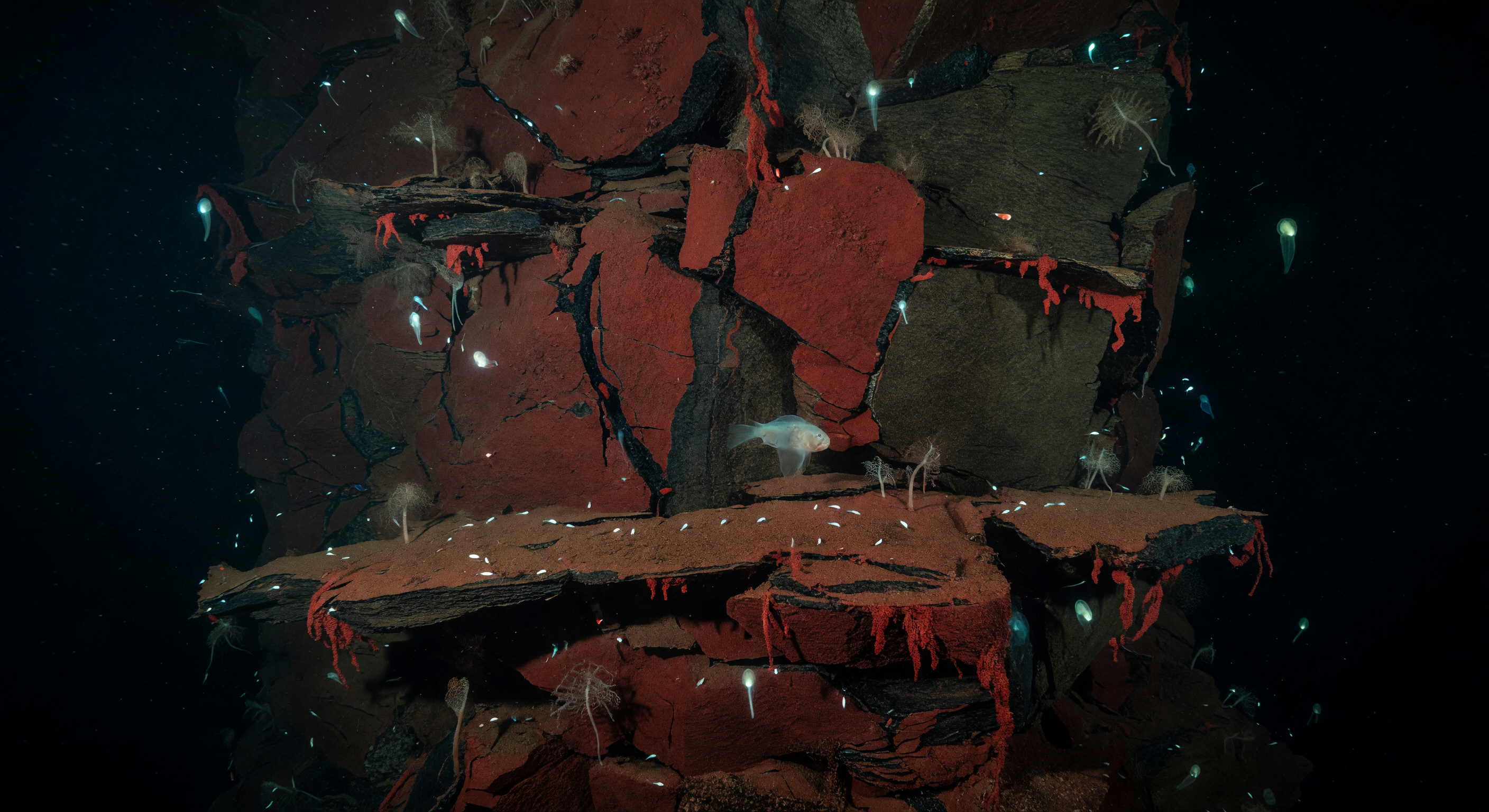
At roughly 10,800 meters beneath the surface, Sirena Deep occupies a hadal realm where hydrostatic pressure exceeds 1,080 atmospheres, a force sufficient to compress seawater itself into measurable density and to reshape the biochemistry of every organism present. The wall descending through this frame is ancient oceanic crust — fractured basalt accreted at a mid-ocean spreading center perhaps 180 million years ago, now armored in manganese oxide crusts and draped in compacted red pelagic clay, the oxidized residue of countless millennia of slow sediment rain from the sunlit ocean impossibly far above. In the complete absence of solar photons, the only illumination that has ever touched this rock arrives episodically from the organisms themselves: gelatinous drifters produce brief blue-green pulses that wash across jagged fracture planes and silt-dusted ledges before the darkness reclaims everything, a communication system, a predator lure, or simply a cellular accident witnessed by no witness at all. Against one rust-colored shelf, a hadal snailfish — among the deepest-living vertebrates known to science, its bones demineralized, its flesh suffused with pressure-stabilizing trimethylamine oxide — holds position in water just above 2°C, while xenophyophores, single-celled giants that aggregate sediment particles into fragile tests, cling to the quieter clay faces as the largest individual cells on Earth. This wall has never known light, never known stillness broken by anything other than life, and it will continue its slow subsidence into the subduction zone long after every surface ocean has changed beyond recognition.
Other languages
- Français: Descente du Mur Cramoisi
- Español: Descenso del Muro Carmesí
- Português: Descida da Parede Carmesim
- Deutsch: Abstieg der Purpurwand
- العربية: هبوط الجدار القرمزي
- हिन्दी: लाल दीवार का अवरोहण
- 日本語: 深紅の壁の降下
- 한국어: 진홍빛 절벽 하강
- Italiano: Discesa del Muro Cremisi
- Nederlands: Afdaling van de Karmozijnwand