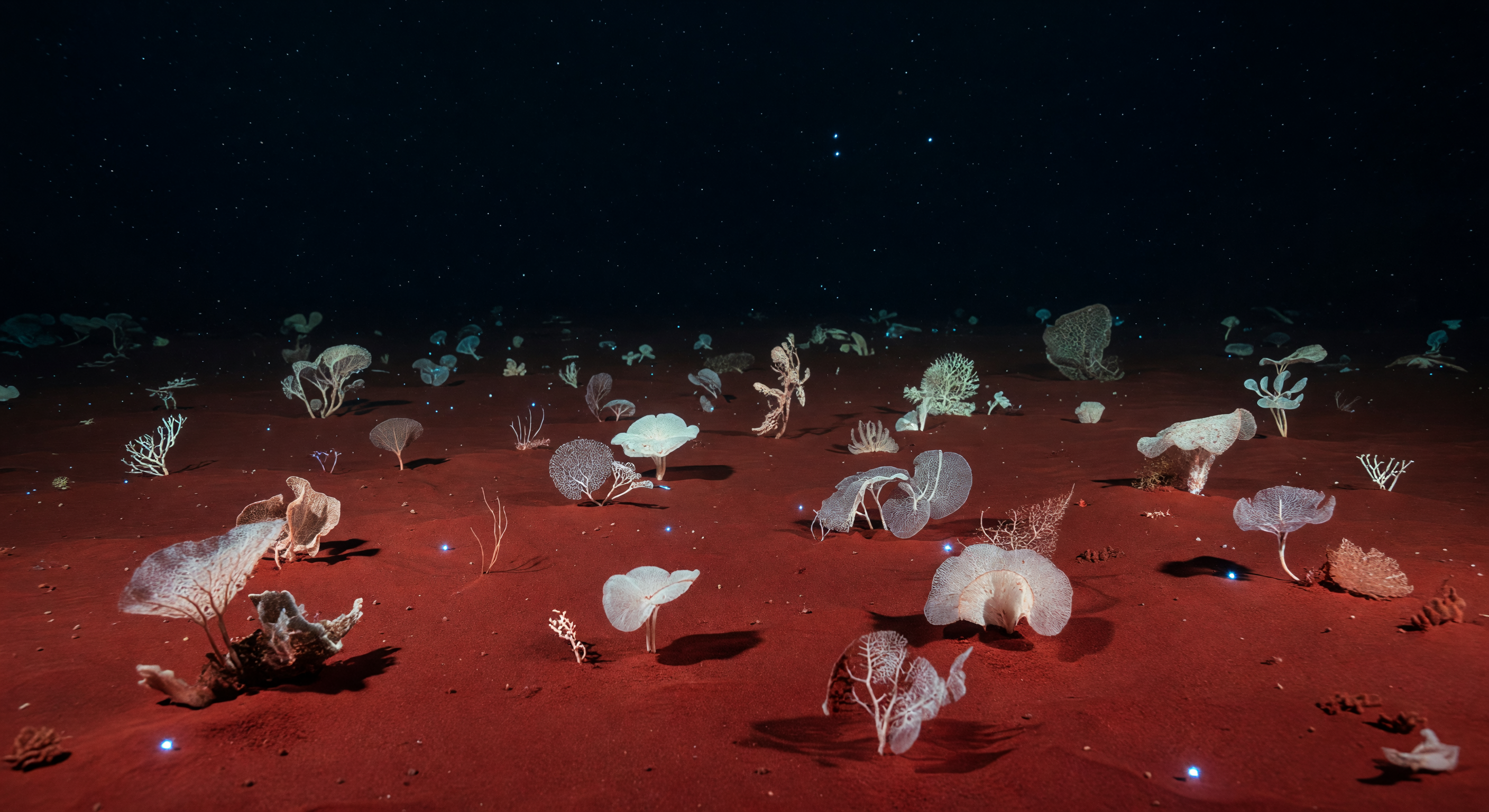
At roughly 10,800 metres beneath the surface, Sirena Deep occupies the eastern branch of the Mariana Trench where the Pacific Plate subducts beneath the Mariana microplate, generating one of the most extreme pressure environments on Earth — approximately 1,080 atmospheres bear down on every surface, compressing seawater itself into a slightly denser, colder medium that hovers near 1–2 °C. Across the hadal plain, iron and manganese oxides stain the fine pelagic ooze a deep brick-red, the sediment built grain by grain over geological epochs from the slow rain of radiolarian tests, clay particles, and organic detritus filtering down from the sunlit world more than ten kilometres above. Rising from this plain, xenophyophores — the largest known single-celled organisms on Earth, belonging to the foraminiferan lineage — construct their branching and disc-like agglutinated tests from sediment particles bound by a cytoplasmic network, forming centimetre-to-decimetre structures of extraordinary fragility that serve as microhabitat refugia for meiofauna and small crustaceans in an otherwise featureless expanse. No photon of solar origin survives to this depth; the only light is metabolic, emitted by drifting organisms in brief cyan-blue pulses that scatter softly through water of exceptional clarity before the darkness reclaims the plain, leaving the xenophyophore field to persist in silence, utterly indifferent to any witness.
Other languages
- Français: Plaine Rouge Xénophyophore
- Español: Llanura Roja Xenofíofora
- Português: Planície Vermelha Xenofíofora
- Deutsch: Xenophyophore Rote Ebene
- العربية: سهل أحمر زينوفيوفور
- हिन्दी: जेनोफायोफोर लाल मैदान
- 日本語: キセノフィオフォアの赤い平原
- 한국어: 제노피오포어 붉은 평원
- Italiano: Pianura Rossa Xenofioforа
- Nederlands: Xenofyofoor Rode Vlakte