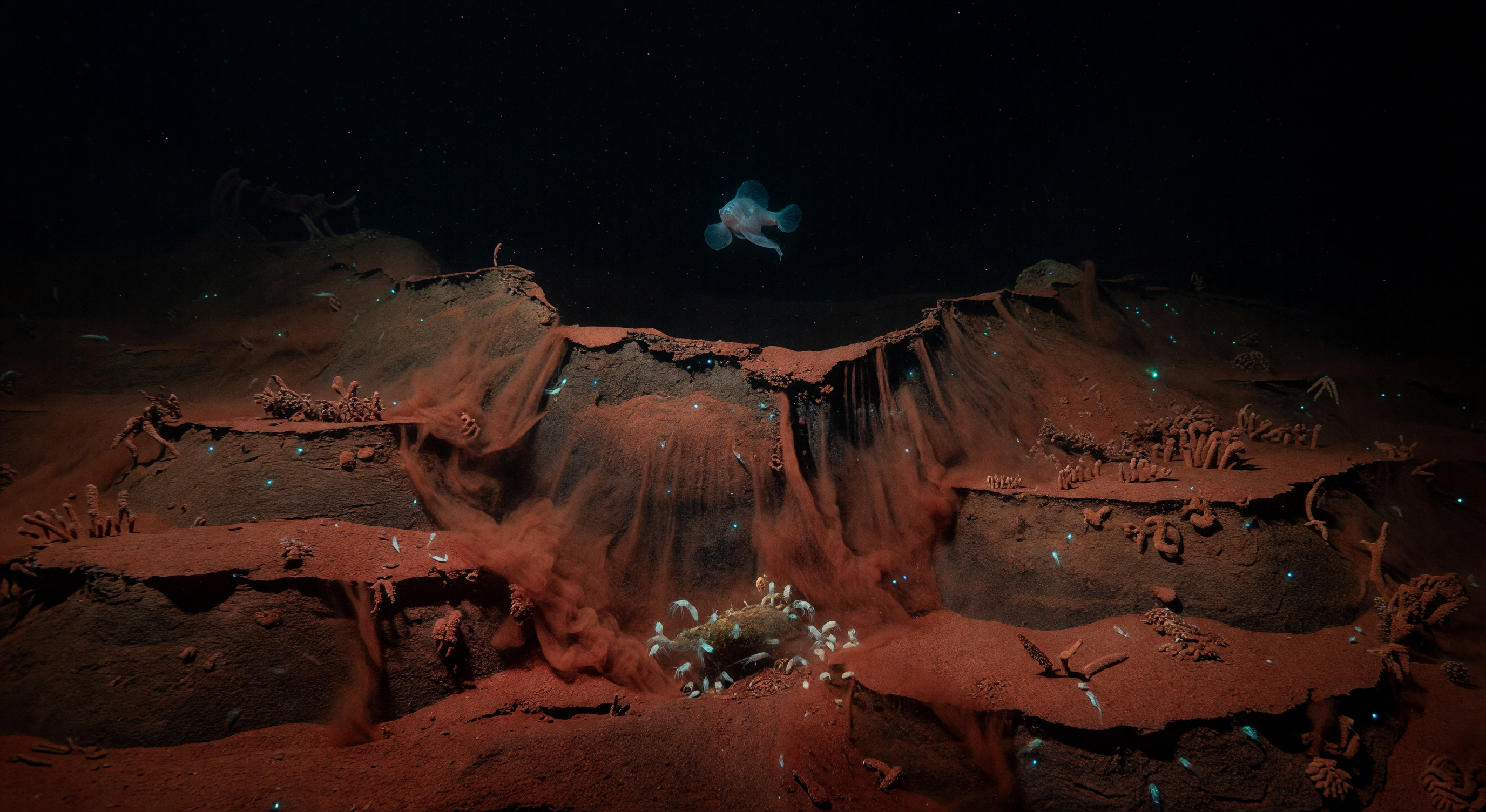
At roughly 10,800 metres below the surface in Sirena Deep, the second-deepest known abyss in the Mariana Trench, the hadal floor has recently failed — a slump scar splitting the iron-rich sediment into scalloped terraces whose upper lips are cleanly torn while their lower ledges receive a slow, continuous burial of rust-red clay and foraminiferan ooze cascading downslope in dense, curling veils. Pressure here exceeds 1,080 atmospheres, compressing seawater to a measurably greater density and rendering the collapsing silt almost smoke-like in its descent, each particle drifting under gravity in water so cold it hovers near two degrees Celsius. Where the terraces remain stable between scarps, fields of giant xenophyophores — single-celled foraminiferans that can exceed ten centimetres and represent among the largest individual cells on Earth — stand partially intact or lie dusted and half-consumed beneath the fresh fall, while at the base of the slope a vertebrate carcass draws dense swarms of pale *Hirondellea* amphipods whose scavenging metabolism is adapted precisely to this crushing dark. A translucent hadal snailfish, likely *Pseudoliparis* sp., hangs motionless above the slump front on spread pectoral fins, and along the red particle cloud, cold cyan and blue-green bioluminescent sparks from disturbed benthic organisms flicker briefly into existence — the only light this world has ever known, sketching for an instant the contour of a collapse that no witness was present to cause.
Sirena Deep