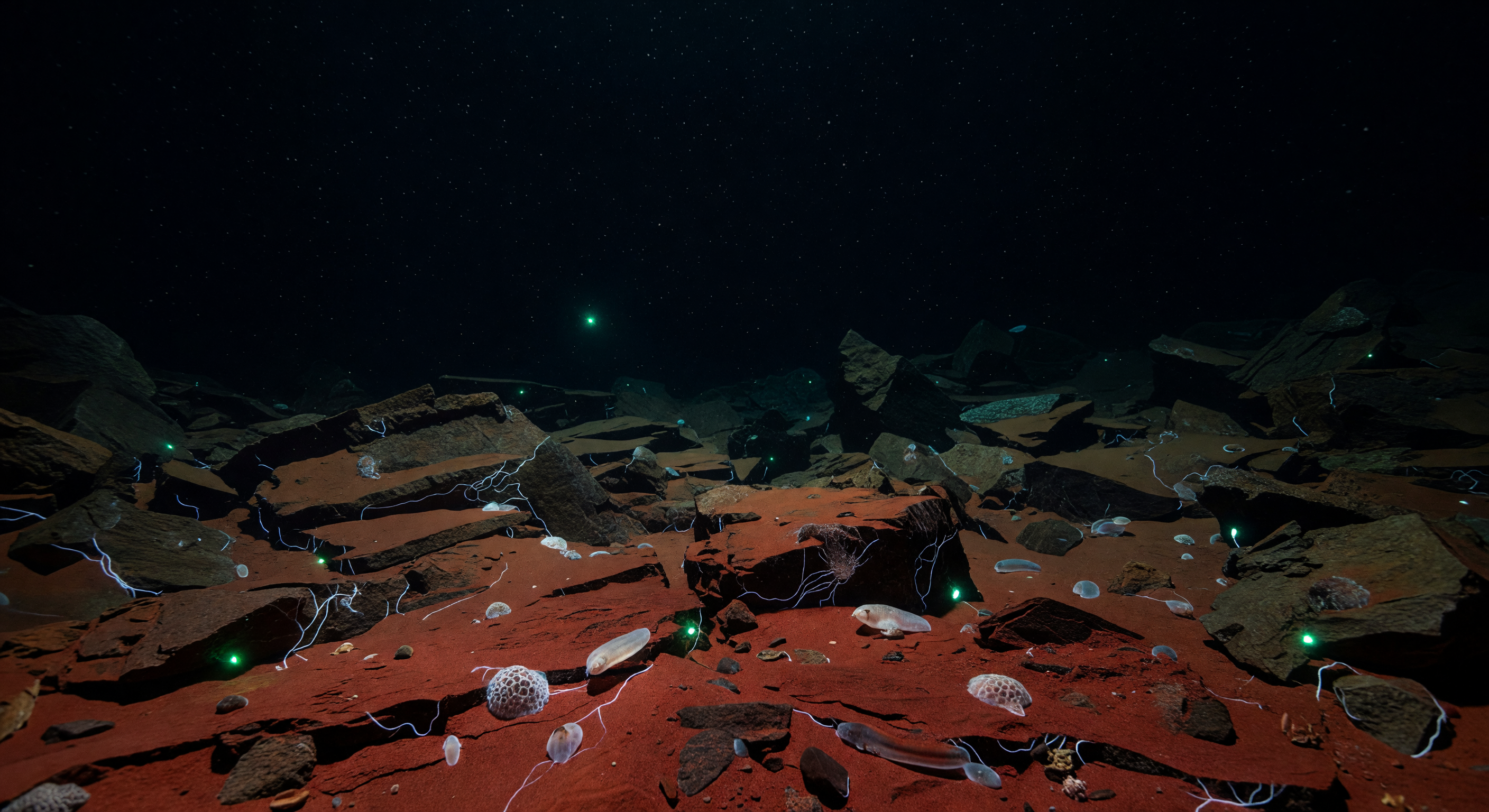
At the base of the Sirena Deep's towering trench wall — the second-deepest measured abyss in the Mariana Trench, plunging beyond ten and a half kilometers beneath the western Pacific — angular talus blocks of fractured basalt and serpentinite lie toppled and half-consumed by iron-rich red silt, the accumulated fallout of millennia of pelagic settling and wall collapse. Here, hydrostatic pressure exceeds one thousand atmospheres, compressing the near-freezing water to a density that slows every process to geologic patience, while marine snow drifts without direction through absolute darkness, pale specks of organic detritus descending from a sunlit world utterly unreachable above. Threadlike films of chemolithotrophic bacteria trace the crevices between rock faces, their faint metabolic glow barely distinguishable from the cold, and xenophyophore-like agglutinated foraminifera press themselves flat against the sediment surface, among the largest single-celled organisms on Earth, exploiting trace organic matter in sediment where almost nothing else survives. Pale holothurians — hadal sea cucumbers of the genus *Peniagone* or close relatives — move with impossible slowness across the silt between the blocks, their soft bodies intermittently catching distant emerald pulses from bioluminescent organisms drifting far out in the water column, organisms that never touch the floor yet briefly illuminate it. The trench wall rises into impenetrable blackness above, the scale of it geologic and indifferent, a subduction scar where the Pacific Plate bends downward into the mantle, carrying this silence with it.
Sirena Deep