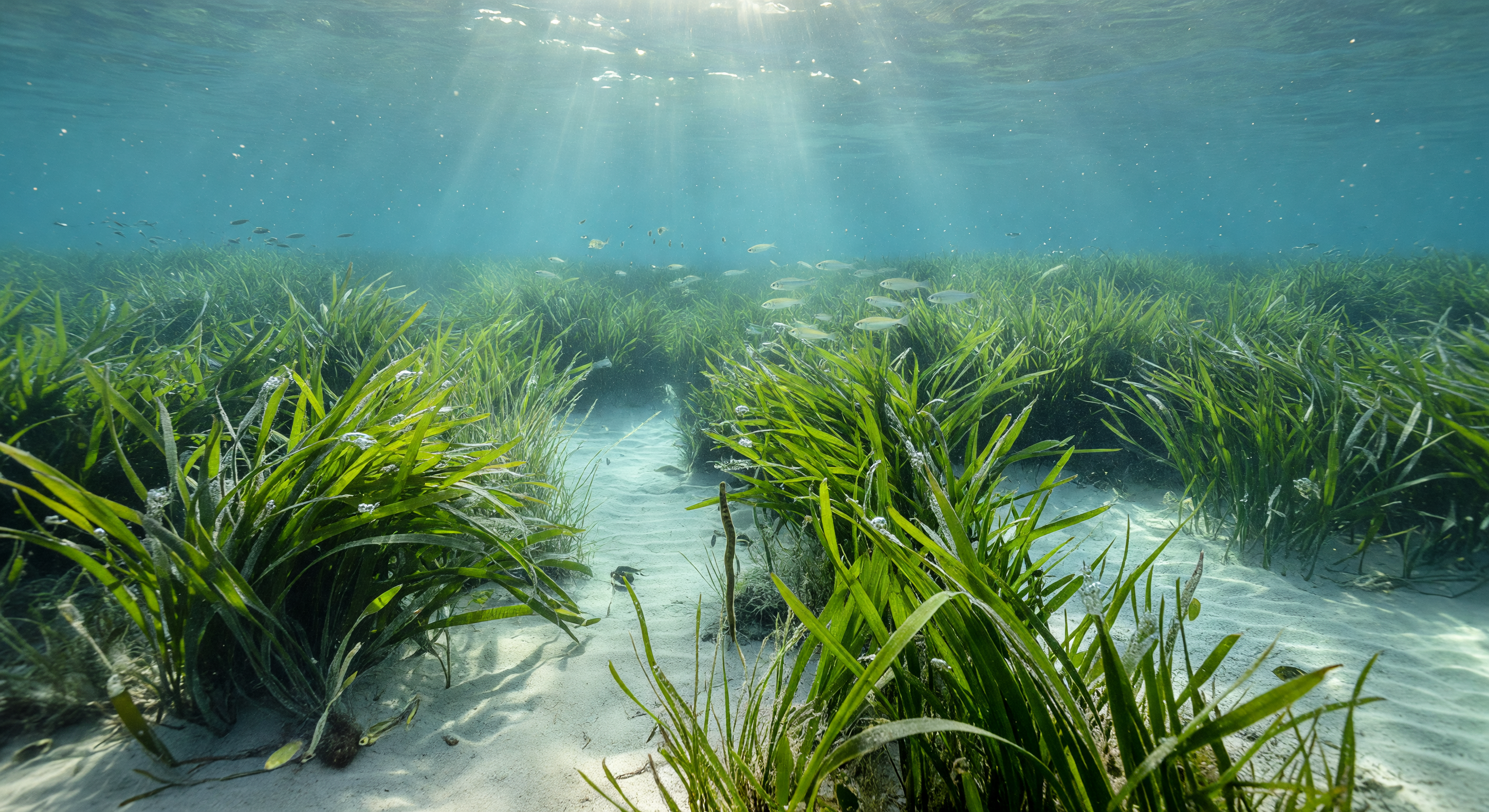
Scientific confidence: Very High
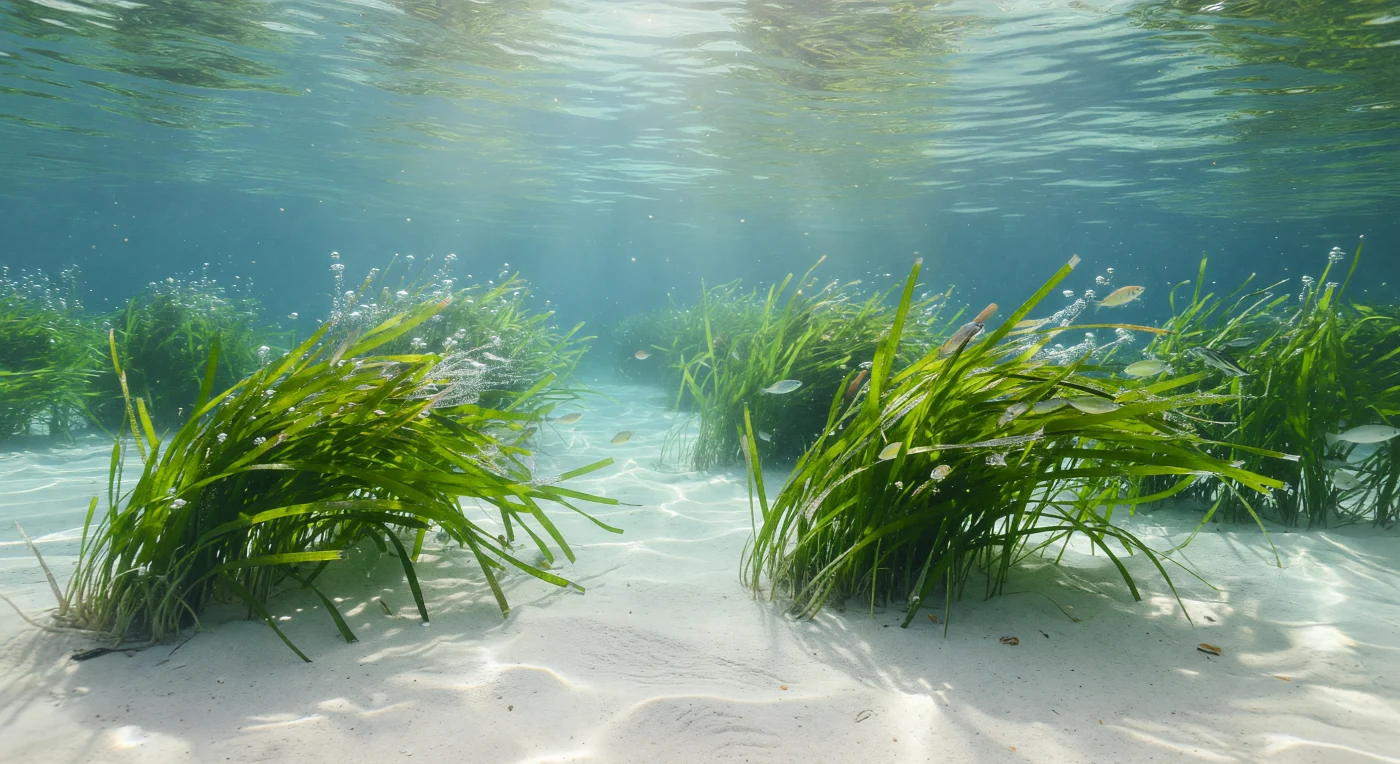
At just two meters below the sunlit surface, this coastal lagoon is one of the most productive ecosystems on Earth — a submerged prairie of *Zostera marina* whose strap-like leaves, anchored by rhizomes in pale sandy sediment, sway in slow unison with each passing ripple. Brilliant caustic patterns race continuously across the seafloor as the calm surface above refracts midday sunlight into shifting nets of gold and white, while softer god rays descend through the shallow water column in long, diffuse shafts. Every leaf blade is actively photosynthesizing, releasing oxygen directly into the water as tiny silvery bubbles that cling to the green surface before rising free — a visible signature of primary production that makes seagrass meadows among the most carbon-efficient habitats in the marine world, sequestering organic carbon in their sediments at rates rivaling tropical forests. Clouds of juvenile fish — likely sparids, atherinids, or small gobies depending on the bioregion — use the dense canopy as refuge and feeding ground, their translucent bodies flickering with refracted light as they navigate the vertical architecture of the blades. This shallow, pressure-gentle world, barely 1.2 atmospheres at its floor, hums with biological activity entirely indifferent to any observer: a self-sustaining nursery and carbon sink that has existed in coastal seas for tens of millions of years.
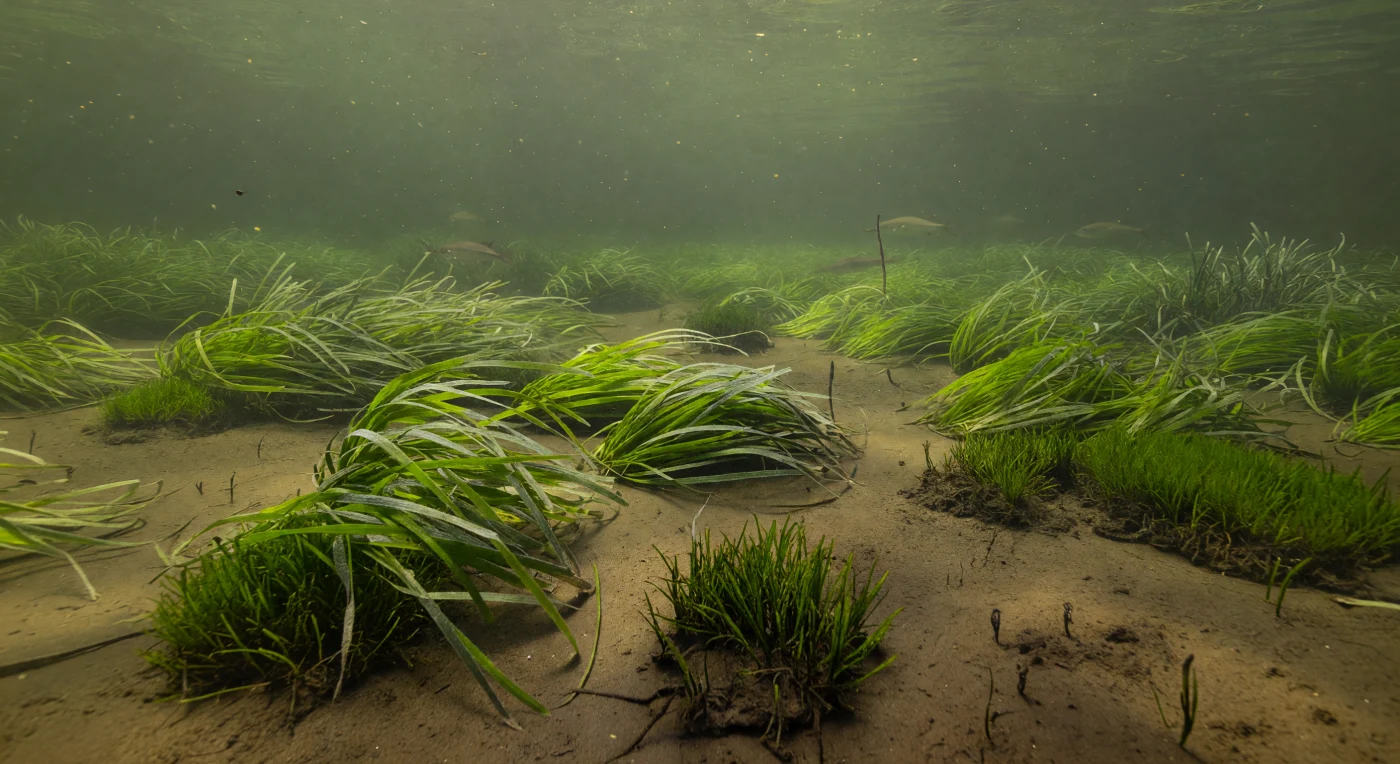
Where a river softens its grip on the land, the estuary holds a world of its own — brackish, turbid, and tender. Here, in just a few metres of water where sunlight still reaches the seafloor but is strained through tannins and suspended silt into tones of olive and amber, a patchy bed of *Zostera marina* takes root in dark, organic-rich sediment. The eelgrass blades, ribbon-thin and flexible, bend and recover in rhythmic unison with each tidal pulse, their surfaces faintly filmed with epiphytic microalgae and dotted with tiny oxygen bubbles produced by the quiet work of photosynthesis — a process that makes seagrass meadows among the most productive and carbon-dense ecosystems on Earth, sequestering organic matter in anoxic sediments below. Grey mullet — opportunistic omnivores tolerant of the wide salinity swings and low dissolved oxygen that define estuarine life — drift as soft silver silhouettes through the green-brown midwater, while a pipefish, a member of the family Syngnathidae, hangs nearly motionless among the leaves, its elongated body so precisely matched in colour and posture to the surrounding blades that it exists, effectively, as a living piece of the meadow. Fine particulate matter — sediment, organic detritus, planktonic fragments — drifts freely through the water column, softening contrast and distance, a reminder that this is a place of constant flux, where freshwater and saltwater negotiate at the edge of the land, and where life has learned, without witness or audience, to thrive in the in-between.
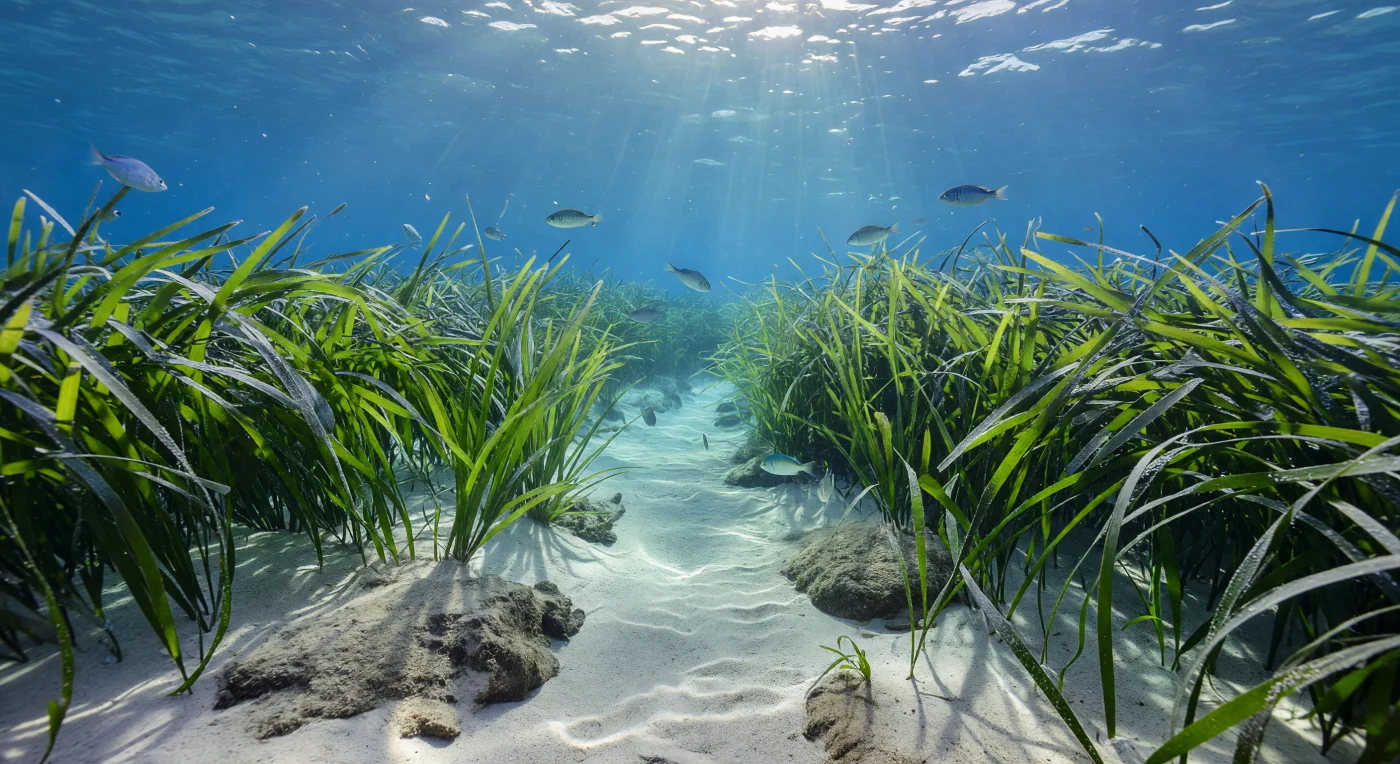
Beneath the sun-drenched surface of the Mediterranean, ribbons of *Posidonia oceanica* rise from pale sand and ancient matte in a dense, swaying prairie, each blade catching the vivid god rays that spear downward through just twelve metres of crystalline blue water — barely more than two atmospheres of pressure, yet a world of extraordinary biological richness. The salinity hovers near 38 PSU, the water temperature warm and stable with the season, and the light here is still so abundant that the uppermost leaf tips glisten with tiny oxygen bubbles, the quiet signatures of active photosynthesis converting Mediterranean sunlight into living tissue. Fine plankton and suspended particles drift through the water column, lit from above by soft caustic shimmer that ripples across the sand lane winding between the meadow beds, while epiphytic algae and microorganisms encrust the older leaf blades, building the complex micro-habitat that makes *Posidonia* one of the most biodiverse ecosystems in the European sea. Wrasse and juvenile bream move through the canopy and across open sand, exploiting the nursery shelter the meadow provides, their scales catching refracted light for an instant before the slow, rhythmic pulse of the current returns the leaves to their quiet, collective sway — a world of deep biological consequence unfolding in the bright, shallow margin of the sea, wholly indifferent to any witness.
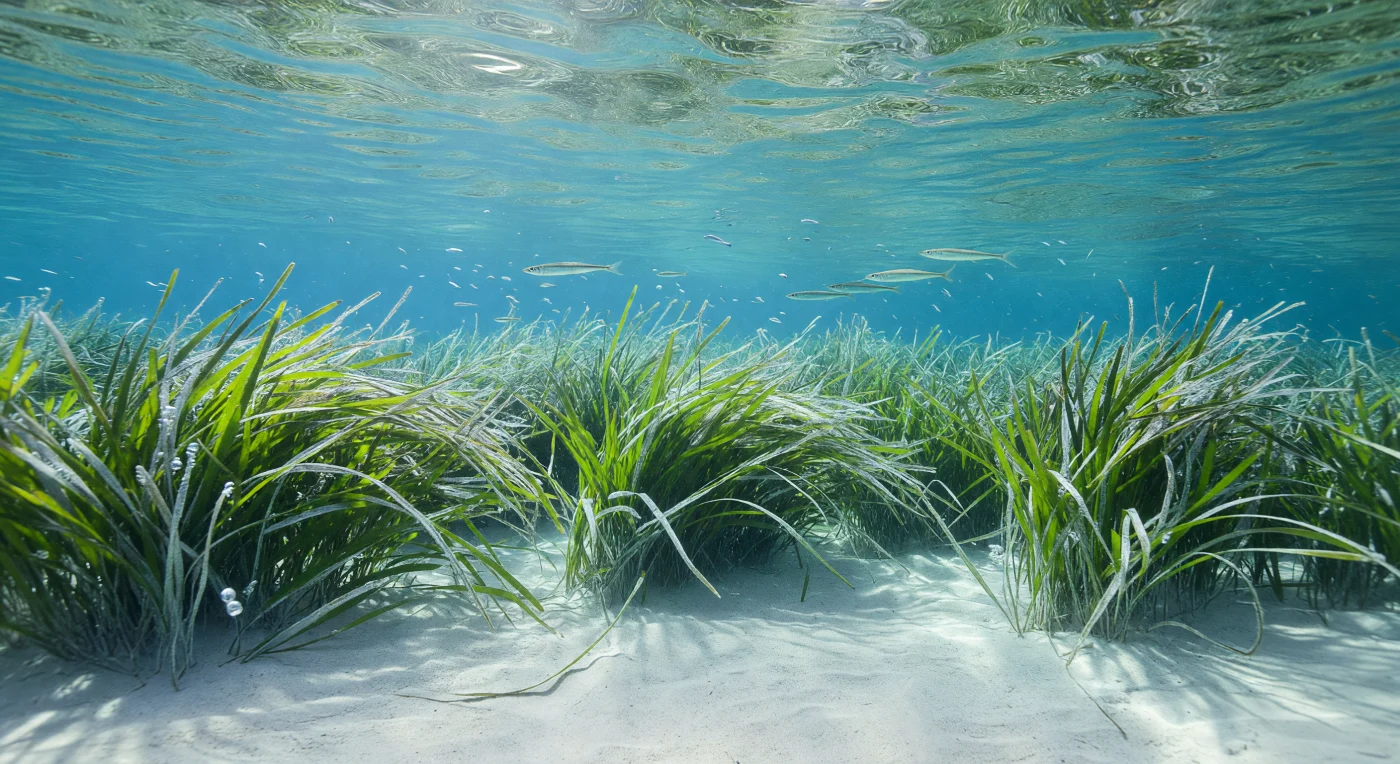
Beneath a mirror of liquid silver, a dense prairie of *Posidonia oceanica* ribbons rolls in slow synchrony with the passing swell, each blade a vivid green lance rooted in pale carbonate sand that has accumulated over centuries of leaf-fall and sediment binding — a geological process as much as a biological one. Here, barely a few metres below the air-sea interface, pressure is negligible and sunlight penetrates with full force, fracturing into shifting god rays and dancing caustics that trace ceaselessly moving patterns across the meadow canopy. Slender needlefish — *Belone belone* — cruise just beneath the surface in loose formation, their elongated silver bodies evolved to exploit exactly this liminal zone where sky and sea blur together, while clouds of translucent juvenile fish, the recruits of sea bream, wrasse, and mullet species, flicker above the blades in pulses of refracted light, sheltered by the meadow's structural complexity. *Posidonia* meadows are among the most productive ecosystems in the Mediterranean, generating oxygen through photosynthesis, locking blue carbon in their deep matte accumulations, and providing nursery architecture for dozens of species that will disperse into open water as adults. This sunlit world turns entirely on its own axis — regulated by tides, temperature, and the angle of the sun — indifferent to and entirely independent of any gaze from beyond its surface.
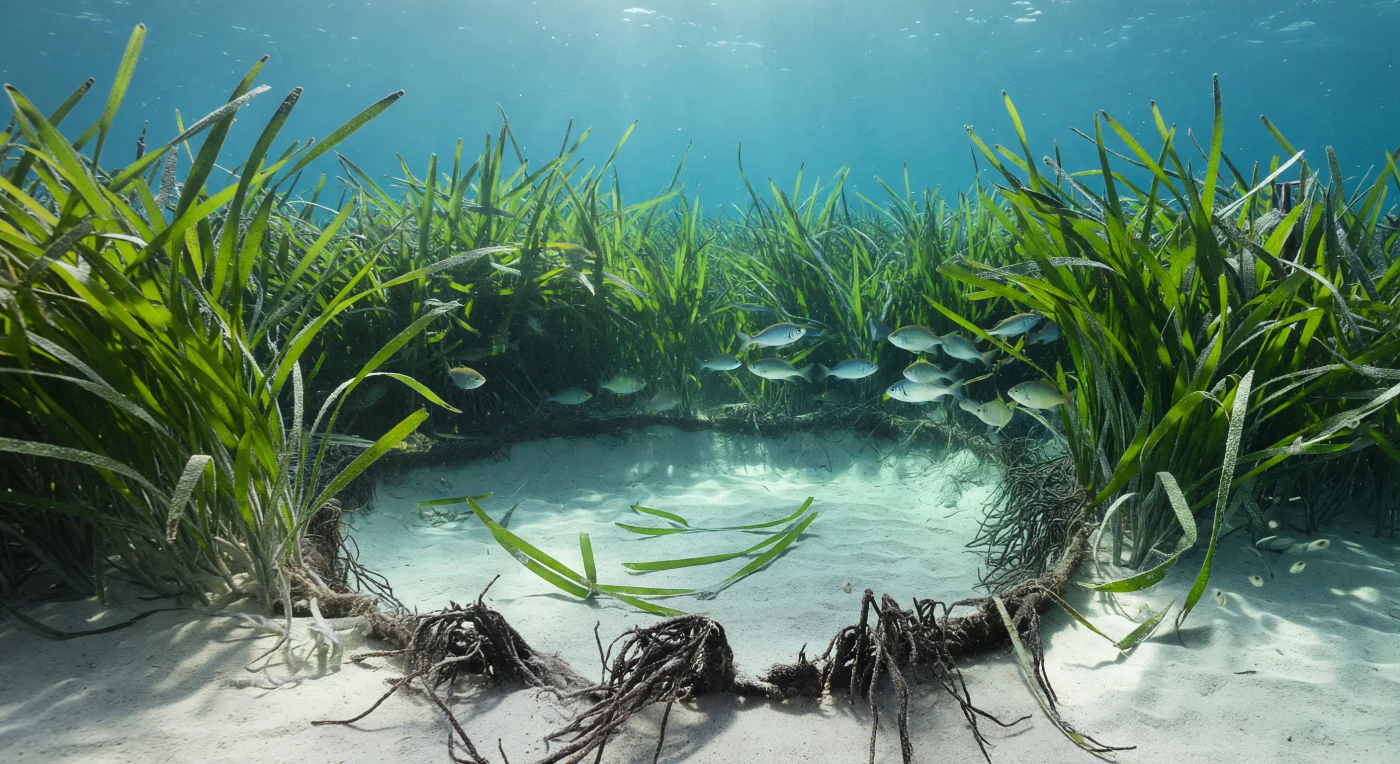
Beneath the Mediterranean sun, a dense prairie of *Posidonia oceanica* stretches across pale carbonate sand at roughly five to eight meters depth, its long ribbon-like leaves rising and swaying in coherent pulses driven by coastal currents, each blade trimmed with microscopic epiphytes and jewelled with tiny oxygen bubbles produced by active photosynthesis in the midday light. Soft caustics ripple continuously across the seafloor, cast downward through the blue-green water column where fine marine snow drifts in slow suspension, and at the centre of the meadow an oval wound of raw sand interrupts the living canopy — a fresh scar exposing the dark fibrous matte, the dense interweaving of roots and rhizomes that *Posidonia* builds over centuries at rates of just a few centimetres per year, making this slow-growing endemic among the most ecologically irreplaceable habitats in the Mediterranean basin. At the abrupt green margin of the scar, juvenile silvery seabream and small wrasse cluster tightly where the intact canopy still offers shelter and food, a slender pipefish threads itself invisibly among the blades, and translucent shrimps pick across leaf surfaces — all of them dependent on this nursery landscape, whose meadows support an estimated eighteen percent of Mediterranean fish species during their early lives. At roughly 1.5 atmospheres of pressure, water temperature hovering near the summer thermocline, and dissolved oxygen near saturation from photosynthetic output, this shallow benthic world runs on sunlight alone, its processes cycling carbon, trapping sediment, and sheltering life in a silence that requires no witness.
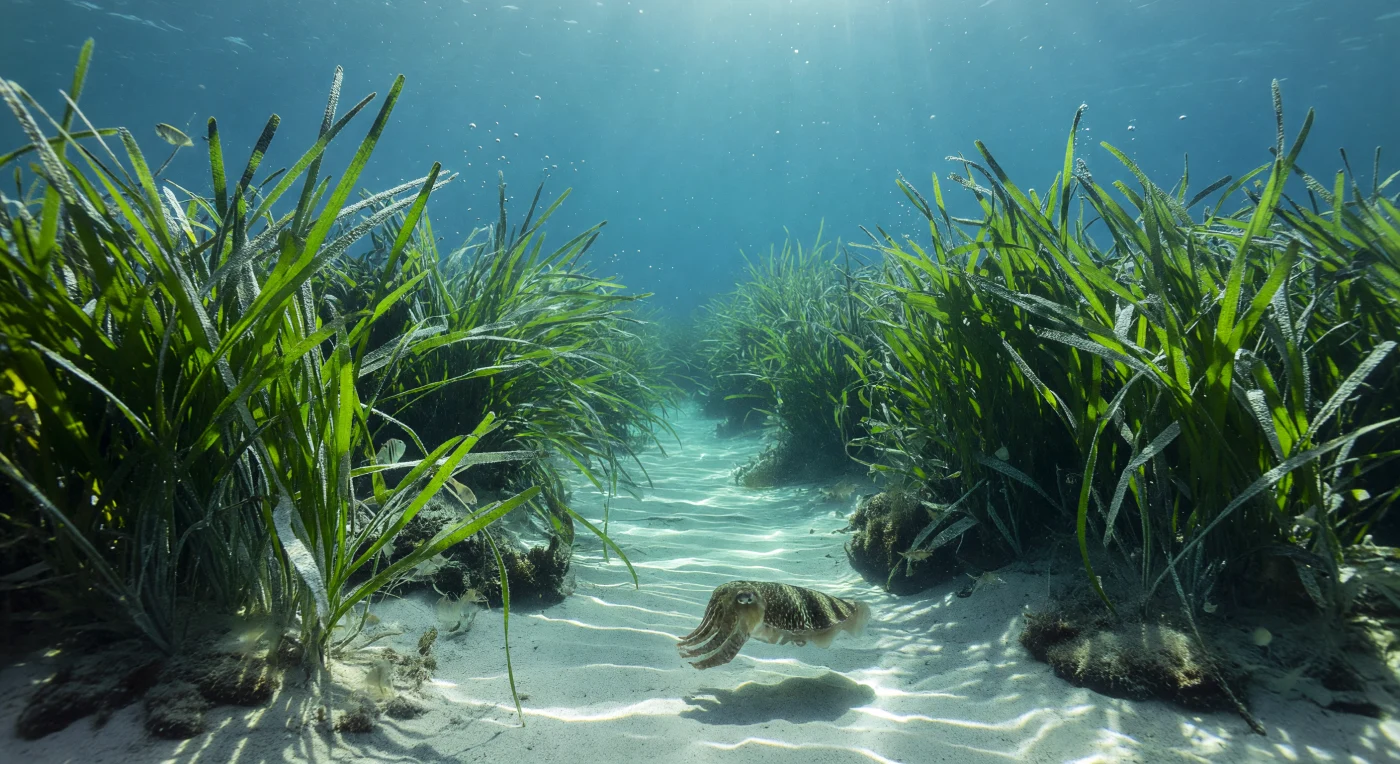
In the shallows of the Mediterranean coast, where sunlight still commands the seafloor, a narrow corridor of pale sand threads between towering stands of *Posidonia oceanica* — one of Earth's oldest and most productive marine flowering plants, whose continuous meadows have carpeted these shelves for millennia. At scarcely two atmospheres of pressure, the water column glows a luminous blue-green, and solar caustics race across the rippled sand in shifting ribbons, lighting the lower leaves from below and catching the fine suspended particles that drift freely between the blades. A common cuttlefish (*Sepia officinalis*) holds its position centimetres above the substrate in near-perfect stillness, its lateral fin frill oscillating in micro-pulses that betray extraordinary muscular control, while chromatophores and iridophores collaborate across its mantle in a real-time imitation of the striped, mottled bottom — a predatory disguise refined over hundreds of millions of years of cephalopod evolution. Translucent shrimp dart from the organic-rich mat of roots and sediment at the bases of the seagrass shoots, exploiting the structural complexity that makes these meadows among the most biodiverse coastal habitats on Earth, rivalling coral reefs in the density of species they shelter at each life stage. Here, at a depth where photosynthesis still drives the entire food web and light itself is the architecture, the meadow breathes, bends, and hunts in a self-contained world of perfect, unhurried purpose.
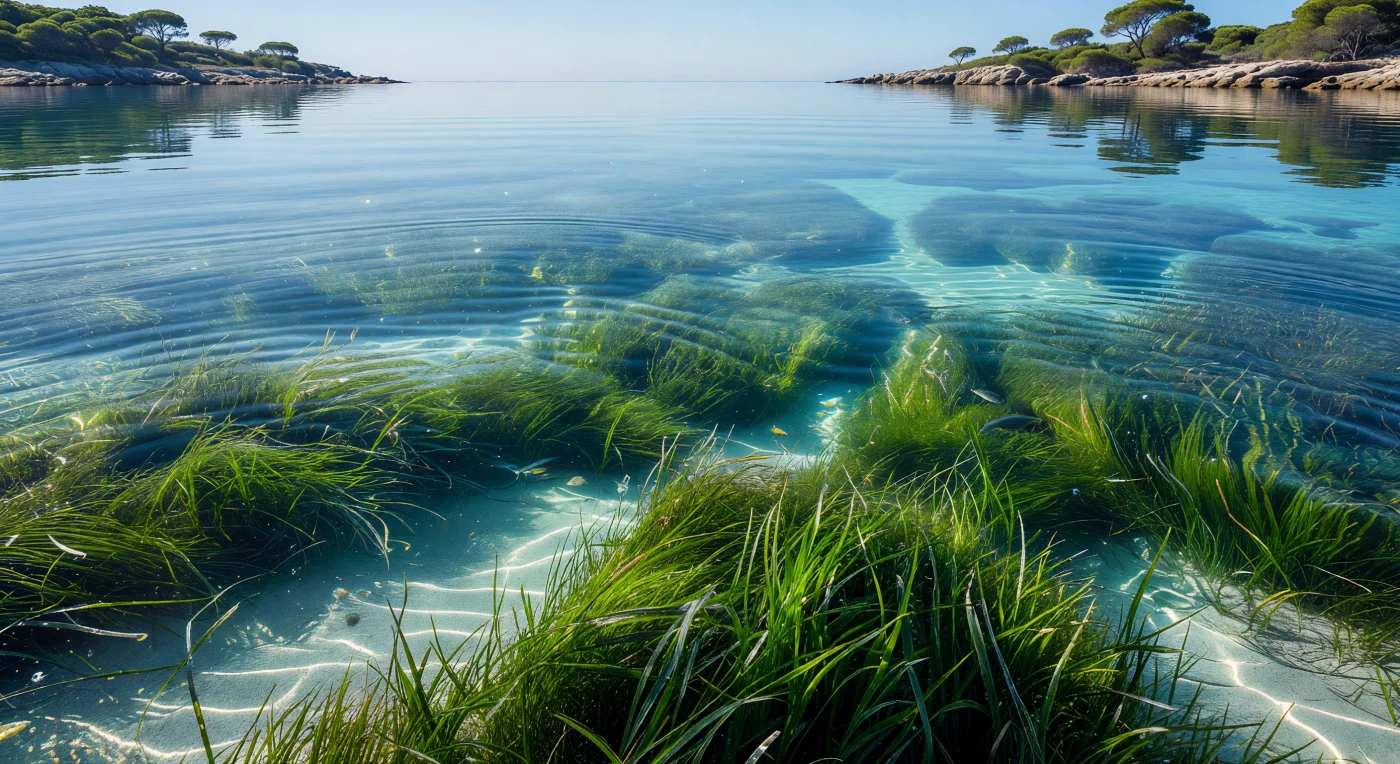
Where the sea meets the sky in a windless Mediterranean cove, the water is so shallow and so clear that sunlight descends almost undiminished, refracting into shifting caustic nets across pale carbonate sand and the dense ribbon-leaves of *Posidonia oceanica* — a flowering plant, not an alga, rooted in sediment and ancient in its lineage, with meadows that can persist for thousands of years. At depths of just a few meters, pressure barely exceeds one and a half atmospheres, and the full solar spectrum still penetrates, driving vigorous photosynthesis and releasing the tiny oxygen bubbles that bead along the leaf surfaces like strung glass. *Posidonia* meadows are among the most productive ecosystems in the Mediterranean basin, binding sediment, sequestering carbon, and oxygenating the water column, while their dense canopy shelters an entire nursery world: juvenile sparids and wrasses threading between the leaves, translucent shrimp hovering at the canopy edge, invertebrate larvae drifting in the suspended particulate haze. Above, the glassy surface holds a perfect mirror of pale sky and pine-edged limestone shore, the boundary between air and sea so undisturbed that it doubles the light, and the whole shallow world hums with photosynthetic life in a silence that needs no witness.
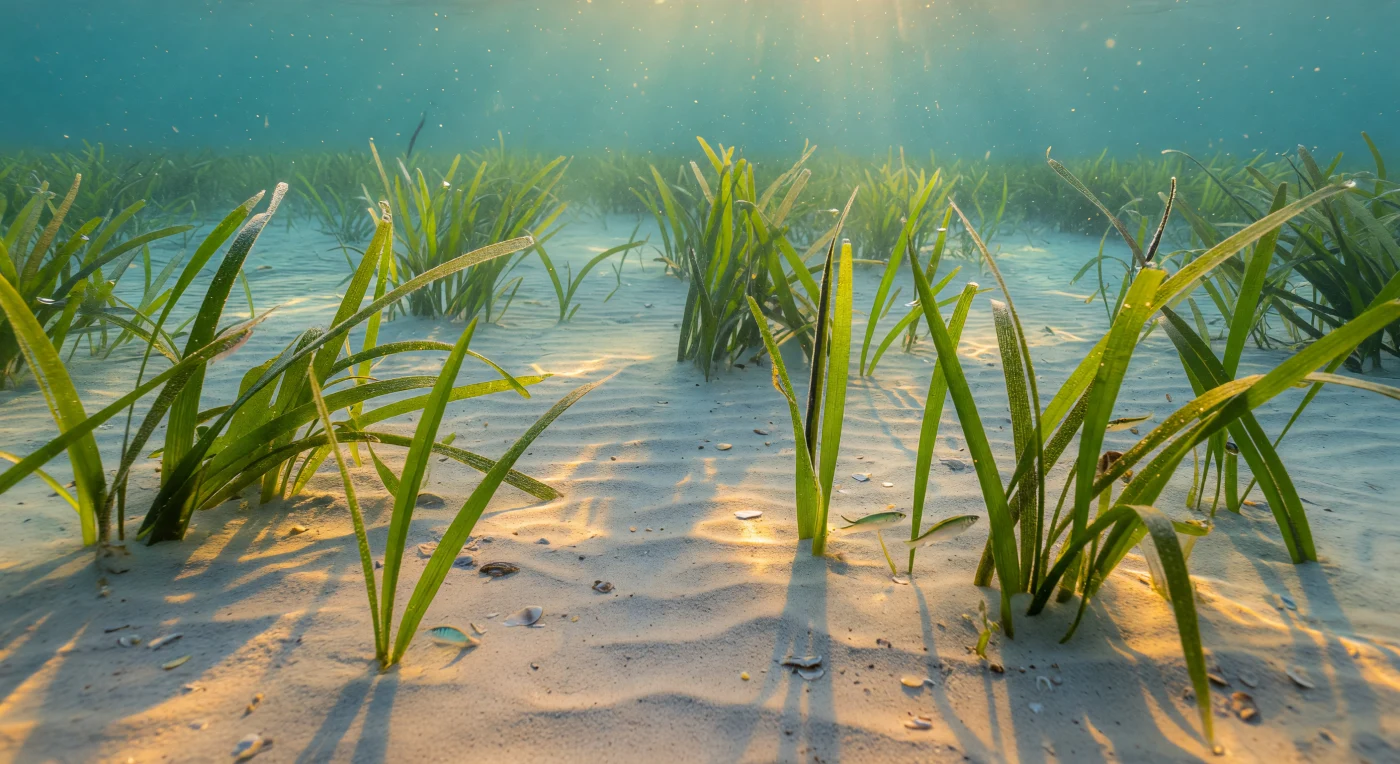
In the last hours of the afternoon, low Atlantic or Mediterranean sunlight angles through a few meters of clear water, painting the seabed in warm amber-gold caustics that shift and ripple as each swell passes overhead. This is a seagrass meadow in full vitality — a rooted, flowering-plant ecosystem, not an alga, anchored by rhizomes into pale rippled sand where fine sediment collects in organic-dark troughs between blade clusters. Eelgrass leaves (*Zostera marina*) bend in long arcs as a slow tidal pulse moves through the canopy, then recover, then bend again, the entire prairie breathing in unison under roughly 1.5 to 2 atmospheres of gentle coastal pressure. Between the grass patches, shell fragments and sediment mounds mark where rooted shoots slow the current, and among the leaves a slender pipefish holds itself rigid against a blade while juvenile fish and translucent shrimp exploit the structural shelter that makes these meadows among the most productive nursery habitats on the temperate shelf. Oxygen bubbles, photosynthesized by the grass itself in the last bright light of the day, cling sparkling to sunlit blades — a quiet chemical record of a living ecosystem converting sunlight into carbon and oxygen with no witness and no interruption.
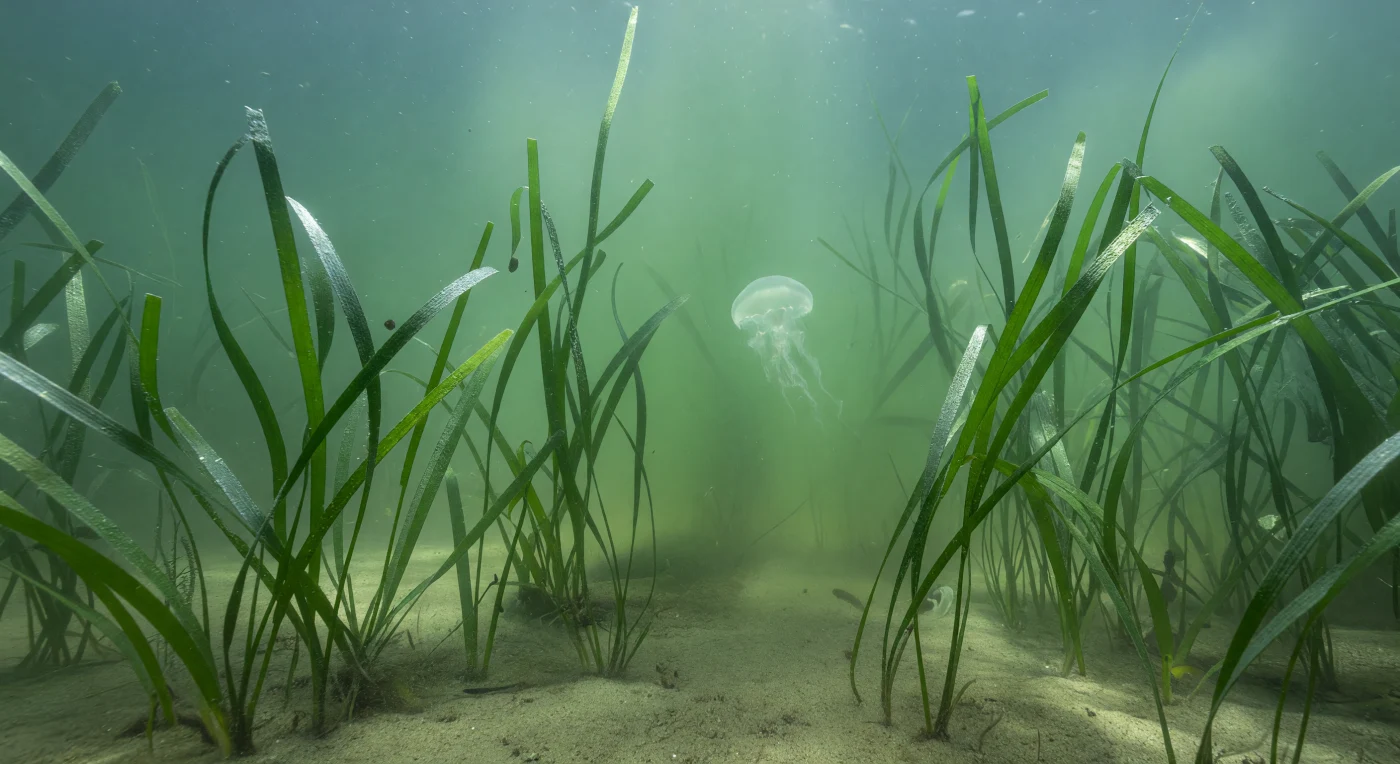
In the shallows of a temperate coastline, dense stands of eelgrass (*Zostera marina*) rise from pale muddy sediment, their ribbon-like leaves swaying in slow, coherent pulses driven by gentle tidal currents — a benthic flowering-plant ecosystem rooted firmly in the seafloor yet wholly dependent on the sunlight filtering down from above. Today, a powerful phytoplankton bloom has transformed the water column into a milky, luminous green, collapsing visibility to just a few meters and wrapping the meadow in a soft vegetal haze; this kind of bloom is a natural feature of productive coastal shelves, where nutrients from riverine input or upwelling fuel explosive growth of microscopic algae, elevating chlorophyll concentrations and scattering light until the sea itself seems to glow from within. At this shallow depth — just a few meters below the surface, under barely more than one and a half atmospheres of pressure — diffuse sunlight still reaches the canopy, catching the nearest leaf blades in silver-green highlights and tracing faint broken caustics across their epiphyte-dusted surfaces, while the rest of the meadow dissolves into wavering silhouettes behind the green veil. A moon jelly (*Aurelia aurita*) pulses silently through the haze, its translucent bell barely distinguishable from the diffuse ambient glow, oral arms trailing and dissolving into the plankton-rich water — a medusa at home in exactly these warm, productive, particle-laden coastal waters where zooplankton and phytoplankton blooms offer abundant prey. Near the sediment, among the sheltering shoots, juvenile fish and tiny crustaceans move in the nursery calm of a meadow that has existed, grown, and sustained countless generations of coastal life entirely without witness.
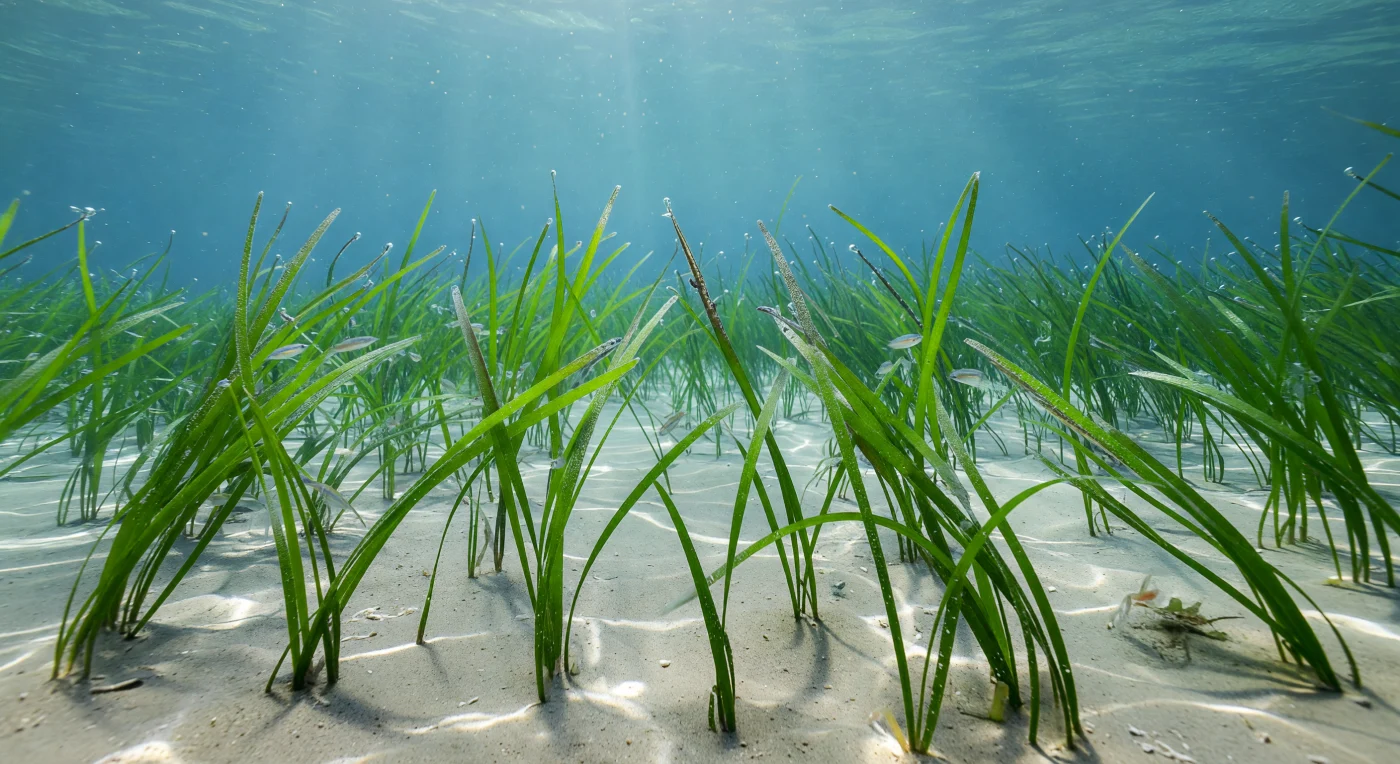
Beneath a few meters of sun-warmed coastal water, long ribbon-like leaves of *Zostera marina* stream in near-perfect unison through a gentle tidal current, their green blades catching dappled caustic light that ripples ceaselessly across pale sandy mud below — a shallow temperate seagrass meadow at the peak of its biological vitality. At roughly 3–5 meters depth, pressure is barely above one atmosphere, and full-spectrum sunlight still pours through the blue-green water column in soft god rays, fueling continuous photosynthesis along every blade while fine oxygen microbubbles cling like jewels to the sunlit surfaces. Within the swaying vertical canopy, translucent mysid shrimps hover in loose constellations between shoots, their compound eyes glinting, while slender pipefish — *Syngnathus* sp. — hold themselves rigidly upright and perfectly parallel to the surrounding blades, their segmented, epiphyte-mottled bodies rendering them nearly indistinguishable from the vegetation itself, a strategy of stillness honed over millions of years of co-evolution with this habitat. *Zostera marina* meadows are among the most productive coastal ecosystems on Earth, sequestering carbon in their roots and rhizomes, stabilizing sediment against erosion, and functioning as irreplaceable nursery grounds where the structural complexity of the canopy shelters juvenile fishes and invertebrates from open-water predators. This meadow exists in its own suspended silence, breathing with the tide, indifferent and complete.
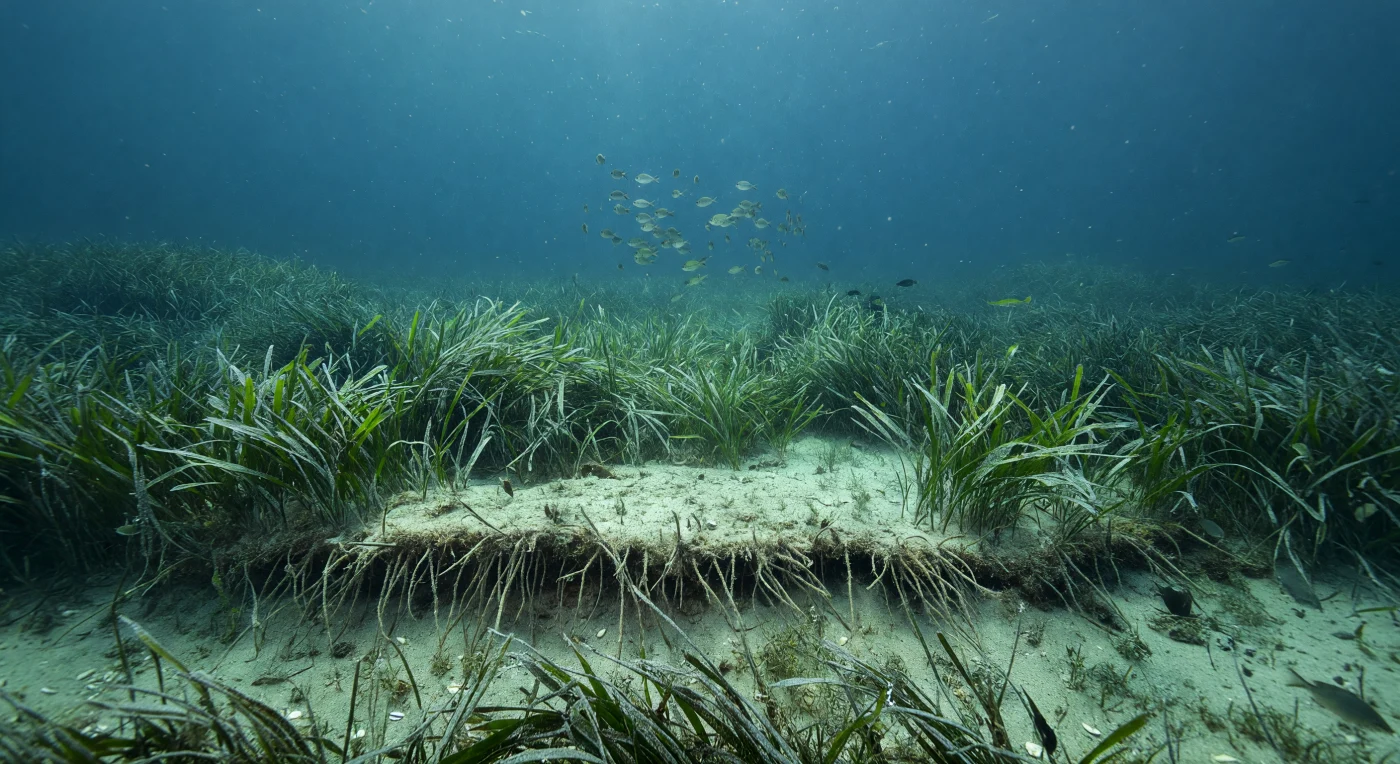
At around 28 metres, the deep frontier of a *Posidonia oceanica* meadow marks one of the most ancient living structures in the Mediterranean — the compacted matte of dead rhizomes and roots beneath each shoot represents centuries of slow biological accumulation, a carbonate-rich platform that itself reshapes the seafloor topography into subtle scarps and terraces. Here, at the very limit of sufficient photosynthetic light, the ribbon-like leaves grow shorter and more sparsely spaced, each blade still carrying a delicate crust of epiphytic algae and diatoms that forms its own miniature ecosystem, while pale sediment and scattered shell fragments settle between the shoots in the calmed near-bottom current. Natural sunlight, filtered through nearly 30 metres of clear open water, arrives as cool blue-green ambient radiance with only faint, attenuated god rays tracing the surface far above — reds and oranges have been absorbed entirely, leaving a world rendered in cyan, teal, and deepening blue, at a pressure of roughly 3.8 atmospheres that the seagrass, its epiphytes, and the juvenile wrasse, pipefish, and small crustaceans sheltering among the blades all endure as simply the ordinary condition of their existence. Above the canopy, a compact shoal of small pelagic fish moves as a single coherent body, their silvered flanks catching what diffuse light remains, casting a slow drift of mottled shadow across the meadow below — a fleeting interaction between two ecological worlds, the benthic prairie and the open water column, at the precise depth where rooted plant life begins to yield to the unlit sea beyond.
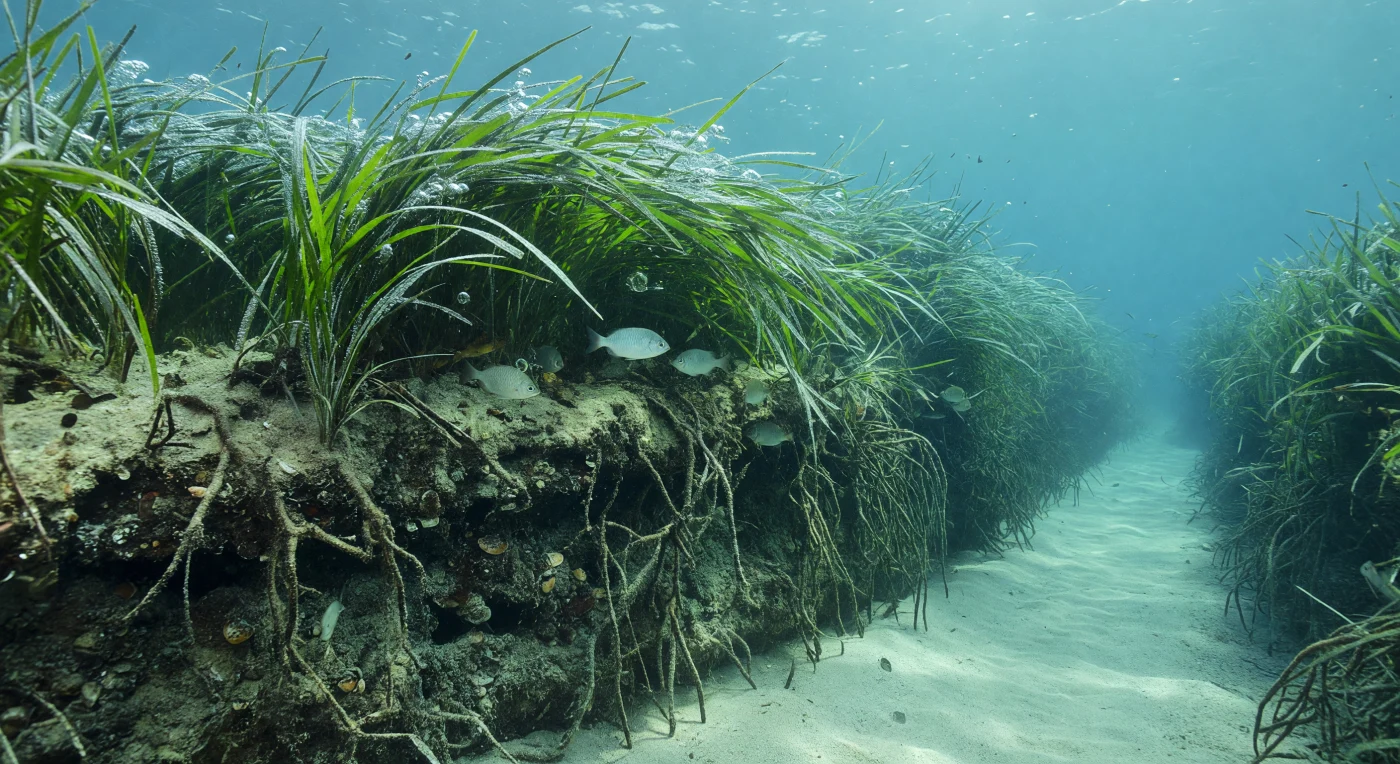
At roughly 8 to 12 meters depth along the Mediterranean coast, where pressure barely exceeds two atmospheres, a dense *Posidonia oceanica* meadow has spent centuries building its own geology: the matte, a compacted wall of dead rhizomes, trapped sediment, shell debris, and accumulated organic matter that can rise a meter or more from the seafloor like a living cliff face, its eroded surface riddled with small cavities that shelter invertebrates and juvenile fish seeking refuge from open water. Sunlight descending through the calm surface above fractures into soft caustic patterns that skitter across the pale rippled sand channel beside the scarp, filling the water column with a vivid blue-green luminance while the matte face itself sits in cooler shade, its root-tangled mass absorbing rather than reflecting the light. Above the scarp's edge, long ribbon-like leaves bend and recover in slow coherent pulses driven by the current, some blades studded with tiny silver bubbles of photosynthetically produced oxygen — a reminder that *Posidonia* meadows are among the most productive ecosystems in the Mediterranean, sequestering carbon and oxygenating coastal waters at rates comparable to terrestrial forests. A small group of silver seabream holds position at the boundary between open sand and the meadow's shelter, that ecotone edge where prey availability and escape cover balance perfectly, while finer suspended organic particles drift freely through the clear water, carrying the chemical signatures of a habitat that has existed here, entirely on its own terms, for thousands of years.