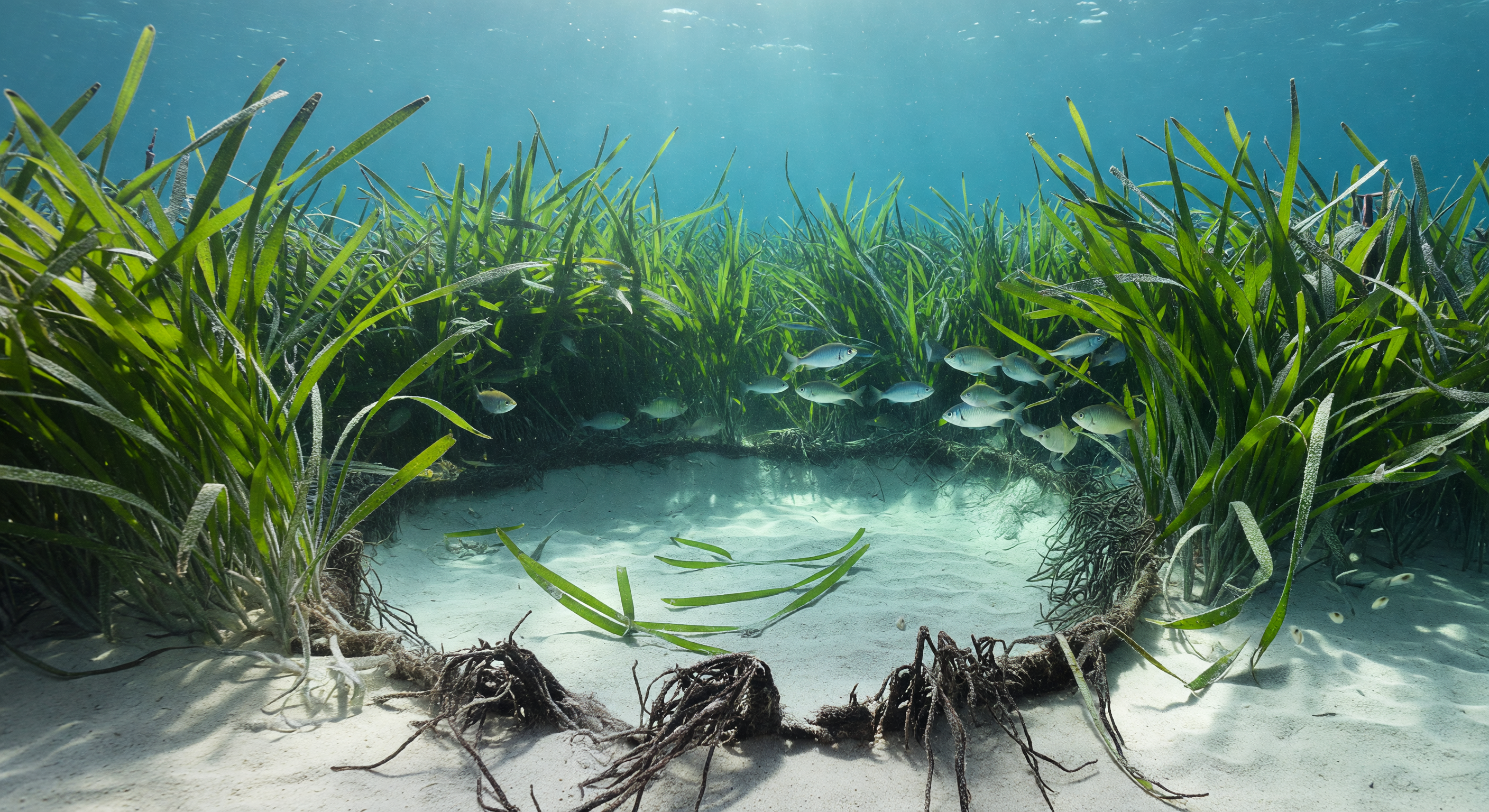
Beneath the Mediterranean sun, a dense prairie of *Posidonia oceanica* stretches across pale carbonate sand at roughly five to eight meters depth, its long ribbon-like leaves rising and swaying in coherent pulses driven by coastal currents, each blade trimmed with microscopic epiphytes and jewelled with tiny oxygen bubbles produced by active photosynthesis in the midday light. Soft caustics ripple continuously across the seafloor, cast downward through the blue-green water column where fine marine snow drifts in slow suspension, and at the centre of the meadow an oval wound of raw sand interrupts the living canopy — a fresh scar exposing the dark fibrous matte, the dense interweaving of roots and rhizomes that *Posidonia* builds over centuries at rates of just a few centimetres per year, making this slow-growing endemic among the most ecologically irreplaceable habitats in the Mediterranean basin. At the abrupt green margin of the scar, juvenile silvery seabream and small wrasse cluster tightly where the intact canopy still offers shelter and food, a slender pipefish threads itself invisibly among the blades, and translucent shrimps pick across leaf surfaces — all of them dependent on this nursery landscape, whose meadows support an estimated eighteen percent of Mediterranean fish species during their early lives. At roughly 1.5 atmospheres of pressure, water temperature hovering near the summer thermocline, and dissolved oxygen near saturation from photosynthetic output, this shallow benthic world runs on sunlight alone, its processes cycling carbon, trapping sediment, and sheltering life in a silence that requires no witness.
Seagrass meadows