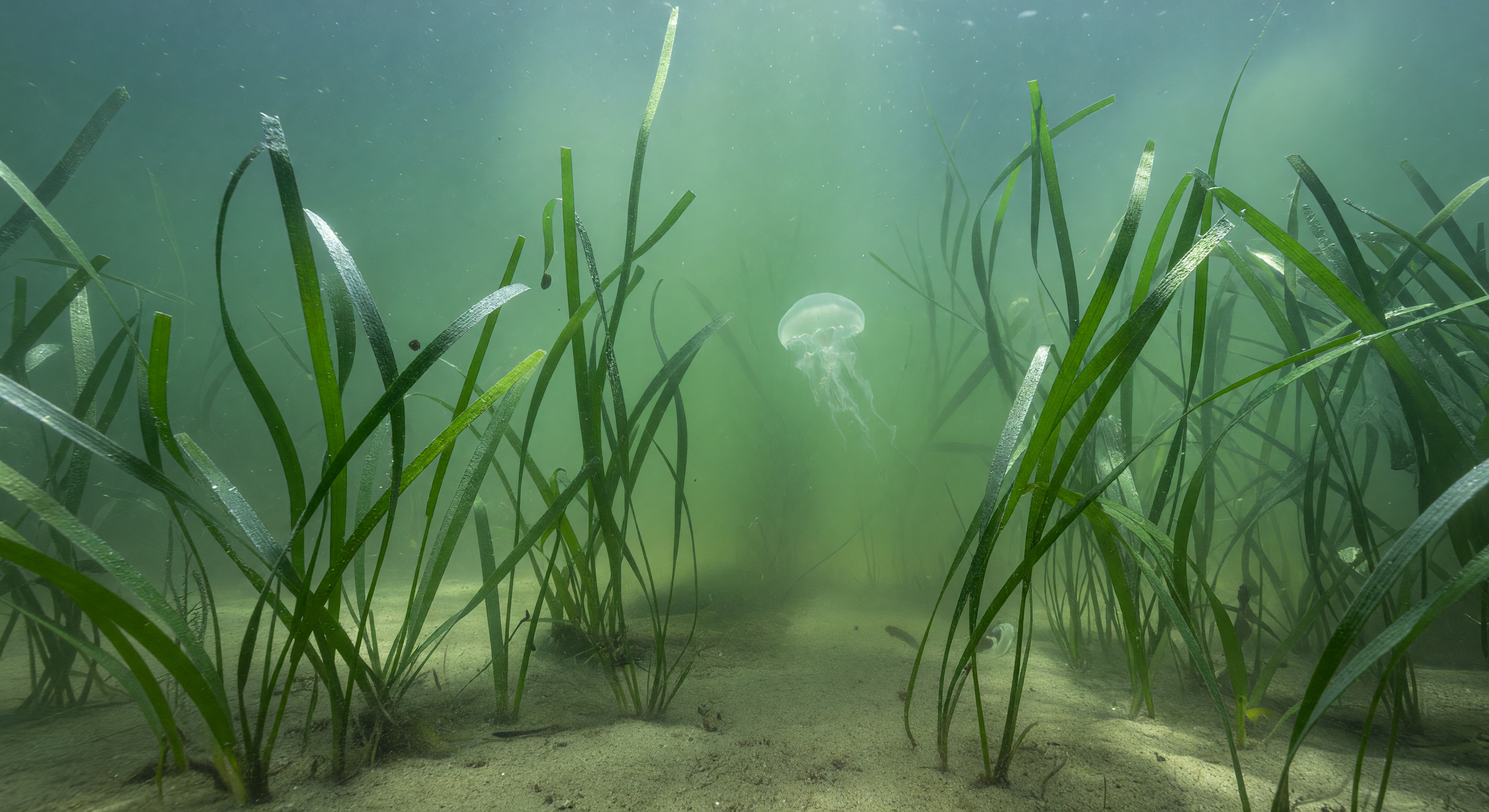
In the shallows of a temperate coastline, dense stands of eelgrass (*Zostera marina*) rise from pale muddy sediment, their ribbon-like leaves swaying in slow, coherent pulses driven by gentle tidal currents — a benthic flowering-plant ecosystem rooted firmly in the seafloor yet wholly dependent on the sunlight filtering down from above. Today, a powerful phytoplankton bloom has transformed the water column into a milky, luminous green, collapsing visibility to just a few meters and wrapping the meadow in a soft vegetal haze; this kind of bloom is a natural feature of productive coastal shelves, where nutrients from riverine input or upwelling fuel explosive growth of microscopic algae, elevating chlorophyll concentrations and scattering light until the sea itself seems to glow from within. At this shallow depth — just a few meters below the surface, under barely more than one and a half atmospheres of pressure — diffuse sunlight still reaches the canopy, catching the nearest leaf blades in silver-green highlights and tracing faint broken caustics across their epiphyte-dusted surfaces, while the rest of the meadow dissolves into wavering silhouettes behind the green veil. A moon jelly (*Aurelia aurita*) pulses silently through the haze, its translucent bell barely distinguishable from the diffuse ambient glow, oral arms trailing and dissolving into the plankton-rich water — a medusa at home in exactly these warm, productive, particle-laden coastal waters where zooplankton and phytoplankton blooms offer abundant prey. Near the sediment, among the sheltering shoots, juvenile fish and tiny crustaceans move in the nursery calm of a meadow that has existed, grown, and sustained countless generations of coastal life entirely without witness.
Seagrass meadows