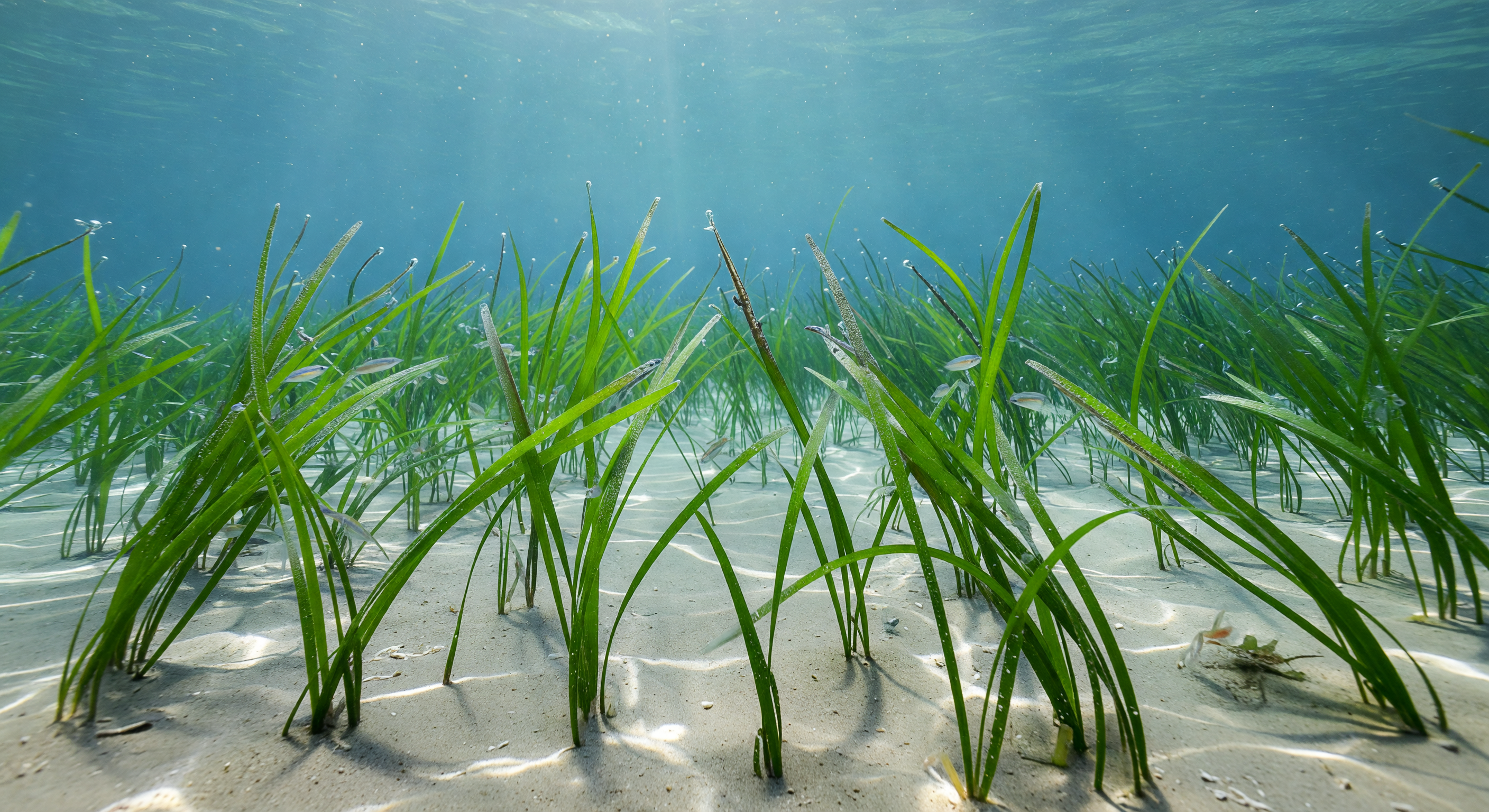
Beneath a few meters of sun-warmed coastal water, long ribbon-like leaves of *Zostera marina* stream in near-perfect unison through a gentle tidal current, their green blades catching dappled caustic light that ripples ceaselessly across pale sandy mud below — a shallow temperate seagrass meadow at the peak of its biological vitality. At roughly 3–5 meters depth, pressure is barely above one atmosphere, and full-spectrum sunlight still pours through the blue-green water column in soft god rays, fueling continuous photosynthesis along every blade while fine oxygen microbubbles cling like jewels to the sunlit surfaces. Within the swaying vertical canopy, translucent mysid shrimps hover in loose constellations between shoots, their compound eyes glinting, while slender pipefish — *Syngnathus* sp. — hold themselves rigidly upright and perfectly parallel to the surrounding blades, their segmented, epiphyte-mottled bodies rendering them nearly indistinguishable from the vegetation itself, a strategy of stillness honed over millions of years of co-evolution with this habitat. *Zostera marina* meadows are among the most productive coastal ecosystems on Earth, sequestering carbon in their roots and rhizomes, stabilizing sediment against erosion, and functioning as irreplaceable nursery grounds where the structural complexity of the canopy shelters juvenile fishes and invertebrates from open-water predators. This meadow exists in its own suspended silence, breathing with the tide, indifferent and complete.
Other languages
- Français: Couloir des aiguilles de mer
- Español: Pasaje de peces pipa
- Português: Passagem do berçário de peixe-cachimbo
- Deutsch: Seenadel Kinderstube
- العربية: ممر حضانة أسماك الإبرة
- हिन्दी: पाइपफिश नर्सरी मार्ग
- 日本語: ヨウジウオの揺り籠路
- 한국어: 실고기 보금자리 통로
- Italiano: Corridoio dei pesci ago
- Nederlands: Zeenaald Kraamkamer Doorgang