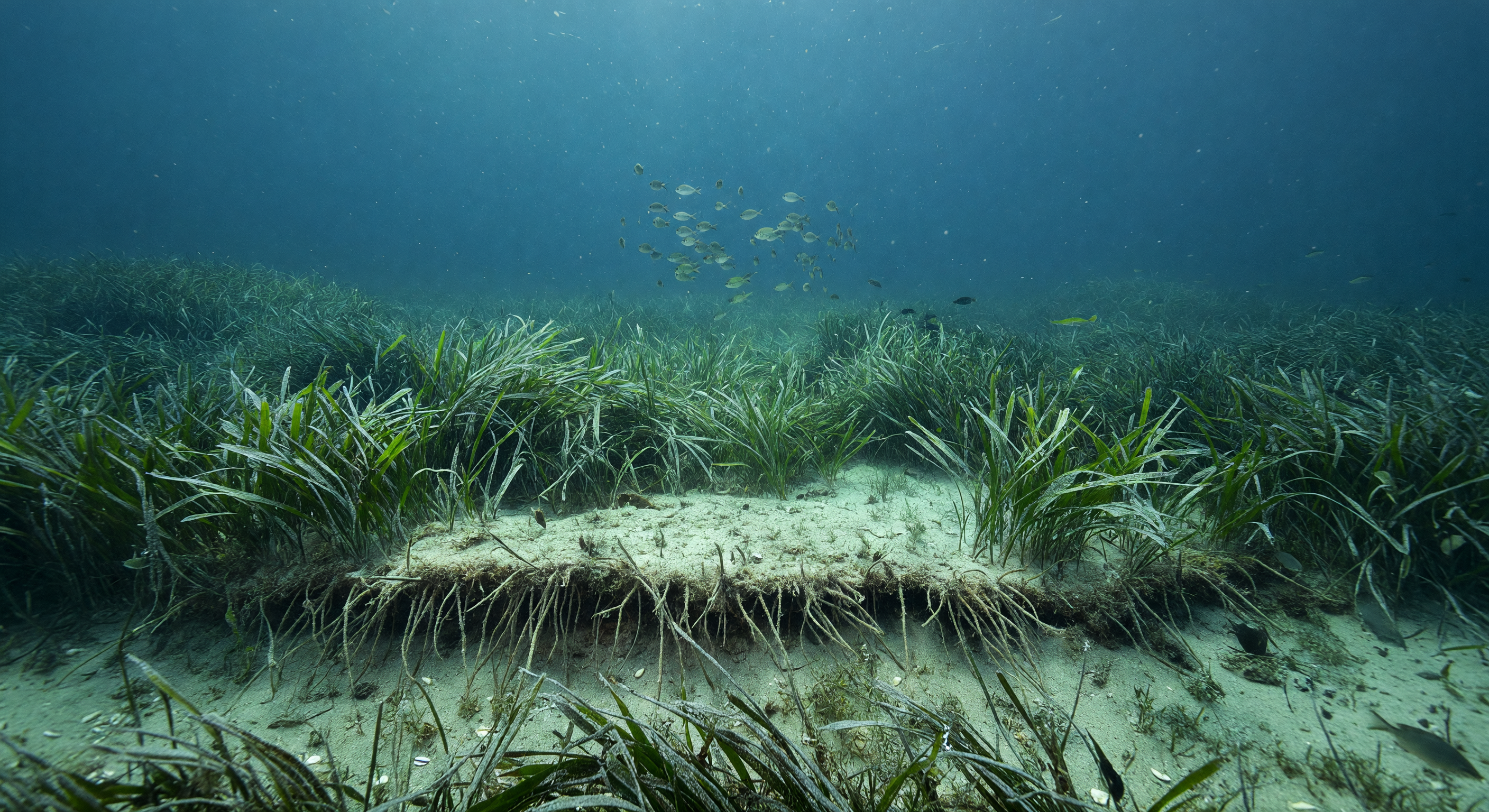
At around 28 metres, the deep frontier of a *Posidonia oceanica* meadow marks one of the most ancient living structures in the Mediterranean — the compacted matte of dead rhizomes and roots beneath each shoot represents centuries of slow biological accumulation, a carbonate-rich platform that itself reshapes the seafloor topography into subtle scarps and terraces. Here, at the very limit of sufficient photosynthetic light, the ribbon-like leaves grow shorter and more sparsely spaced, each blade still carrying a delicate crust of epiphytic algae and diatoms that forms its own miniature ecosystem, while pale sediment and scattered shell fragments settle between the shoots in the calmed near-bottom current. Natural sunlight, filtered through nearly 30 metres of clear open water, arrives as cool blue-green ambient radiance with only faint, attenuated god rays tracing the surface far above — reds and oranges have been absorbed entirely, leaving a world rendered in cyan, teal, and deepening blue, at a pressure of roughly 3.8 atmospheres that the seagrass, its epiphytes, and the juvenile wrasse, pipefish, and small crustaceans sheltering among the blades all endure as simply the ordinary condition of their existence. Above the canopy, a compact shoal of small pelagic fish moves as a single coherent body, their silvered flanks catching what diffuse light remains, casting a slow drift of mottled shadow across the meadow below — a fleeting interaction between two ecological worlds, the benthic prairie and the open water column, at the precise depth where rooted plant life begins to yield to the unlit sea beyond.
Seagrass meadows