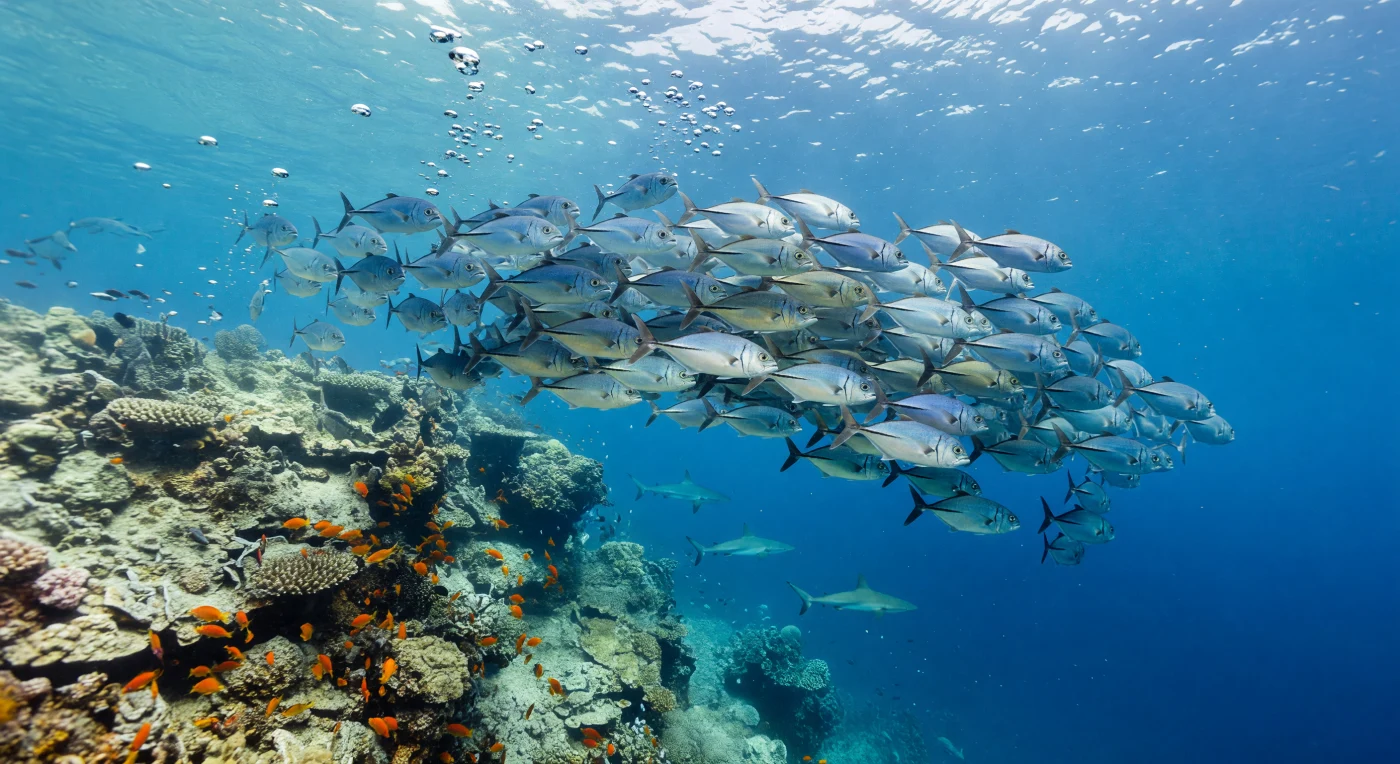
The wall of bigeye jacks materializes before you like a living mirror, thousands of chrome-flanked bodies pivoting in perfect synchrony as your exhaled bubbles spiral upward through water so clear that god rays from the rippled surface above stab all the way to the coral face in unwavering columns of light. This is classic schooling behavior driven by hydrodynamic coupling and lateral-line sensing, each fish maintaining precise spacing through pressure-wave feedback, the entire mass functioning as a single polarized entity capable of reshaping itself in milliseconds against any perceived threat. Along the limestone wall at your left shoulder, orange anthias flare and dart above encrusting corals and shadowed overhangs, occupying the narrow interface where reef productivity meets the open pelagic column, their coloration a product of shallow-water pigment and carotenoid-rich diet made possible by the intense photosynthetically active radiation still penetrating at this depth. Gray reef sharks quarter through the blue beyond the school with the unhurried efficiency of apex predators whose electroreceptive ampullae of Lorenzini can detect the bioelectric fields of prey at close range, their presence explaining why the jack formation holds its dense, defensive geometry rather than dispersing. The pressure here sits light enough against your ears that you almost forget you are suspended in the ocean's most biologically productive layer, where dissolved oxygen is high, temperature gradients drive upwelling nutrients, and the full visible spectrum from violet to red still reaches you, painting everything in a clarity that will not last as the bottom falls silently away below.
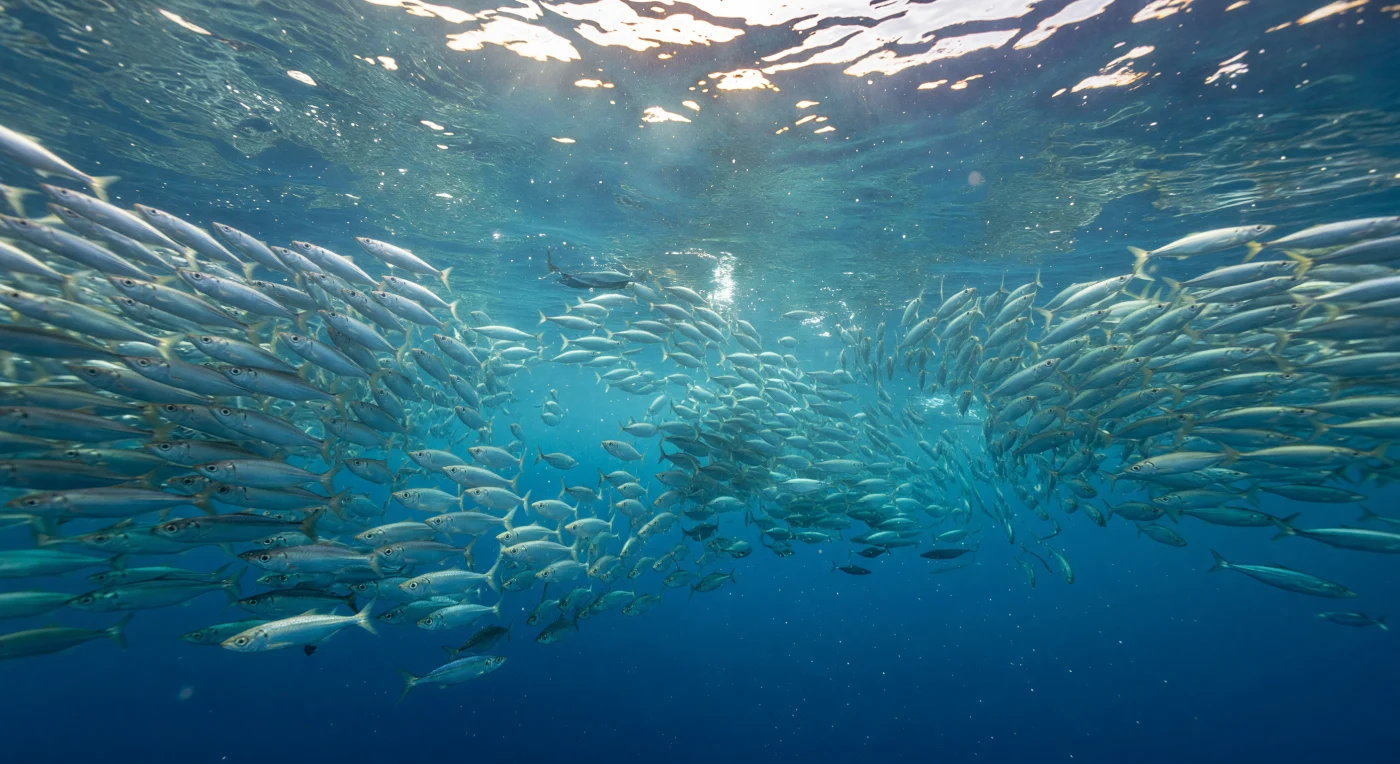
Just beneath the wind-ruffled surface, the water erupts into living silver as thousands of sardines fold around you in tight, coordinated pulses, their scales catching the hard tropical sunlight that pours through the chop above in flickering god rays and caustic bands. This is the epipelagic ocean at its most electric — the uppermost stratum where solar radiation still penetrates with full intensity, water temperatures peak near 26–28 °C, and phytoplankton blooms fuel the base of a food web dense enough to support predators at every scale. The shoal itself is not a fixed structure but a dynamic collective behavior: tens of thousands of individuals shifting instantaneously between shoal and school formation, each fish responding to its neighbors through hydrodynamic pressure waves and lateral-line sensing, the group becoming a single fluid architecture that opens briefly around the torpedo-shaped silhouette of a yellowfin tuna before sealing shut again. Dolphins work the upper margins of the ball with surgical efficiency, herding compressed layers of sardines toward the surface while the tuna slash upward from below, and for a moment the entire structure folds around the lens like a breathing room with no walls. Below, the vivid turquoise gives way to a dark cobalt drop-off — a reminder that beneath this sunlit abundance lies open, unstructured water column stretching downward into cold and pressure and silence.
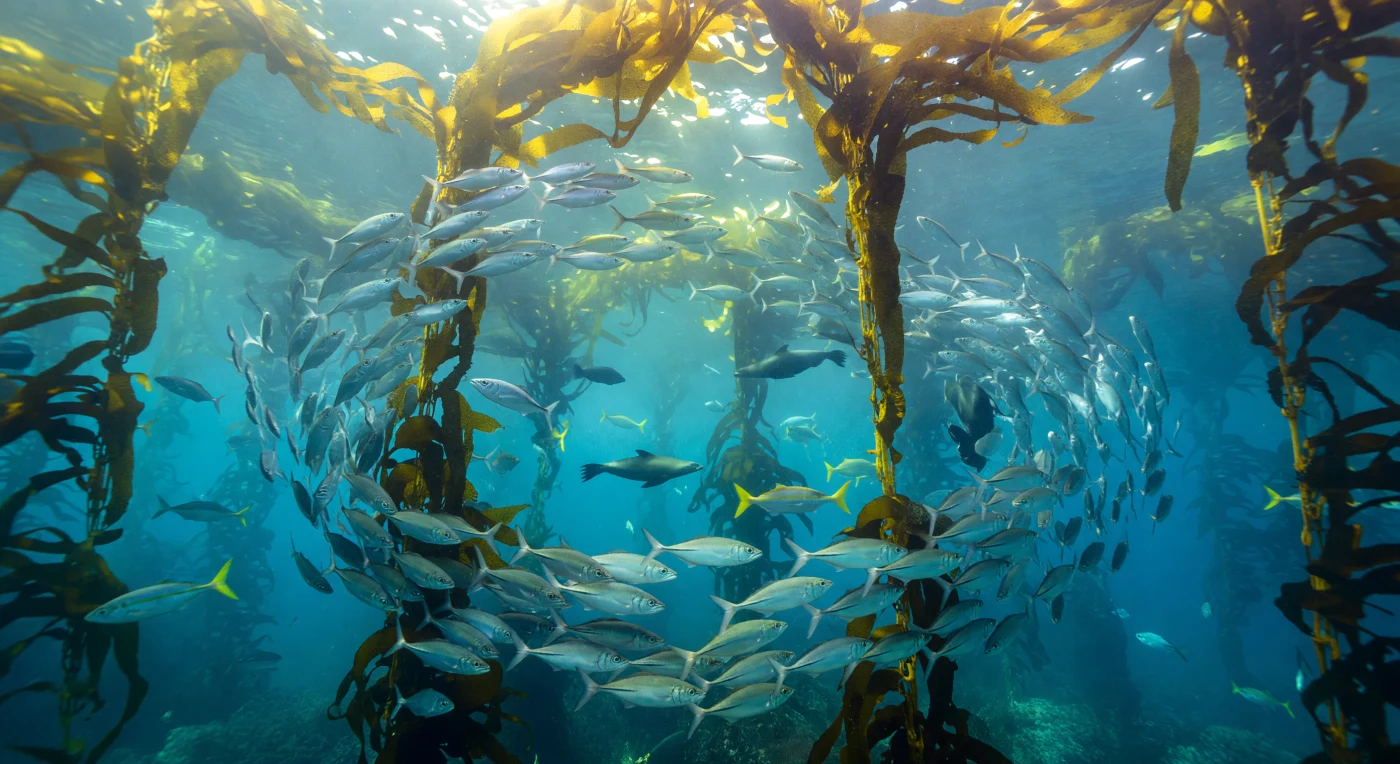
Suspended in the uppermost, sun-drenched layer of the ocean, the freediver drifts weightless between kelp stipes that rise like the pillars of a submerged basilica, their golden-brown blades swaying in a gentle surge while cathedral shafts of refracted light lance downward through gaps in the dense canopy overhead. What dominates the midwater is not any single organism but a collective one: tens of thousands of silversides compressed into a living metallic wall, each fish orienting within milliseconds of its neighbors through mechanoreceptor signals carried by the lateral line, the whole formation bending and parting in fluid ribbons around the diver's presence — a self-organizing biological structure with no fixed address, perpetually recalibrating against predation pressure. From deeper in the canopy, California sea lions torpedo through the shoal in burst accelerations that shatter the formation into spinning fragments before it re-coheres, while yellowtail — pelagic jacks with the endurance physiology to sustain high-oxygen ram-ventilation — thread the kelp columns from below, exploiting the disorienting column geometry to isolate individuals at the shoal's ragged edges. The water column here, rich in cold upwelled nutrients and suspended phytoplankton, is what anchors this entire trophic engine: the silversides graze on zooplankton concentrating near the surface, the predators concentrate on the silversides, and the kelp forest itself — rooted in rocky substrate below — provides the three-dimensional architecture that makes ambush and coordinated herding possible in ways the open ocean never allows. To hang motionless at the center of it, breath held, is to occupy the precise focal point of a living food web operating at full pressure.
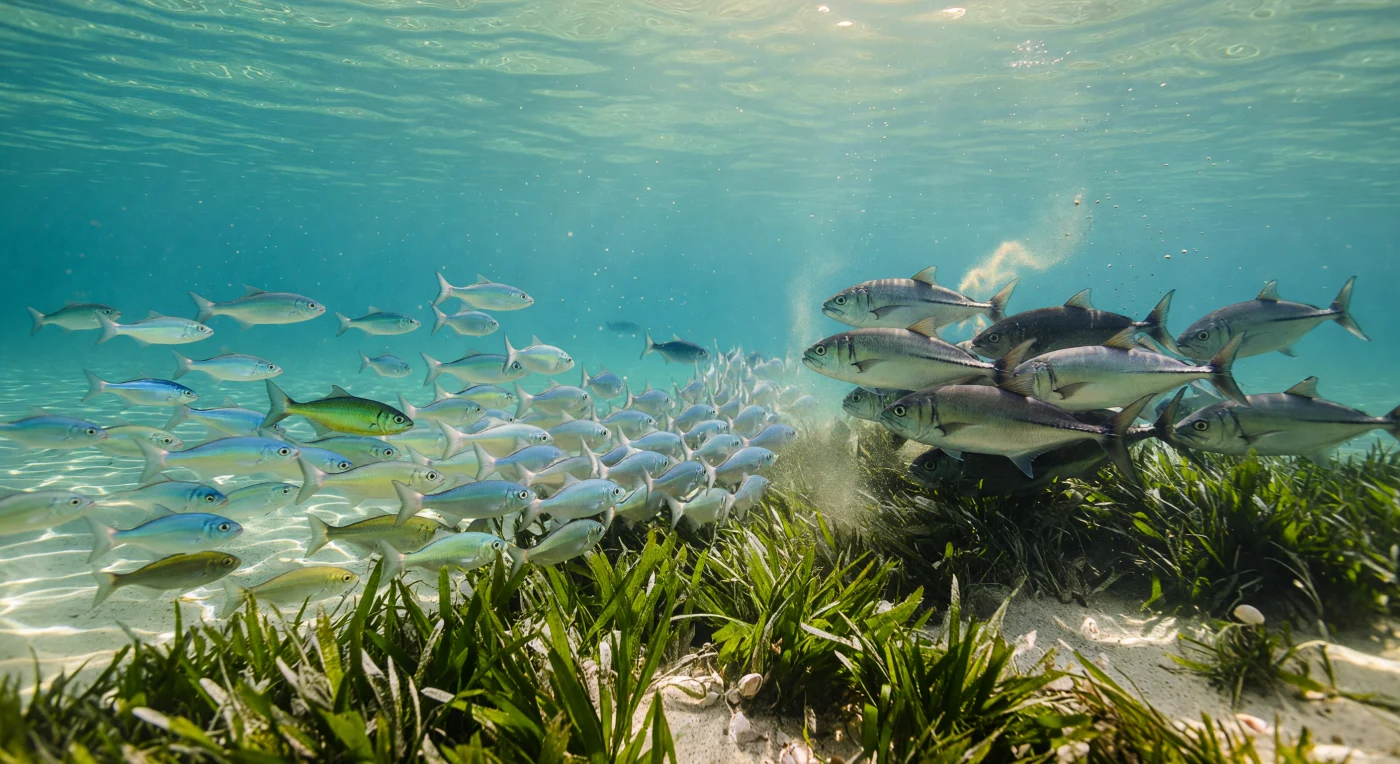
The water here is warm, alive, and almost weightless — barely a metre of sun-drenched column separates the snorkeler's mask from a seagrass meadow whose olive-green blades sway in the gentle surge, anchoring sediment, sheltering invertebrates, and exhaling oxygen into the illuminated shallows. Without warning the loose shoal of juvenile mullet ahead undergoes a phase transition, each fish abandoning individual movement to join a single polarised entity: thousands of bodies align in milliseconds, scales flashing chrome and pale blue as the group collapses into a dense, mirror-bright ribbon — a collective anti-predator response known as flash expansion and compression that confuses a predator's ability to single out one target. The trigger is already visible: two giant trevally (*Caranx ignobilis*) erupt from the darker meadow edge in a coordinated ambush burst, their torpedo-shaped, slow-twitch and fast-twitch muscle architecture optimised for exactly this explosive acceleration, metallic charcoal backs catching the caustic light as displaced sediment wisps drift upward like pale smoke. At this negligible depth, pressure is barely above atmospheric, sunlight still peaks above 400 µmol photons m⁻² s⁻¹, and the water column functions as a transparent arena where visual predation dominates — every refracted god ray, every suspended sand mote, every flicker of silver scale is both beauty and mortal information.
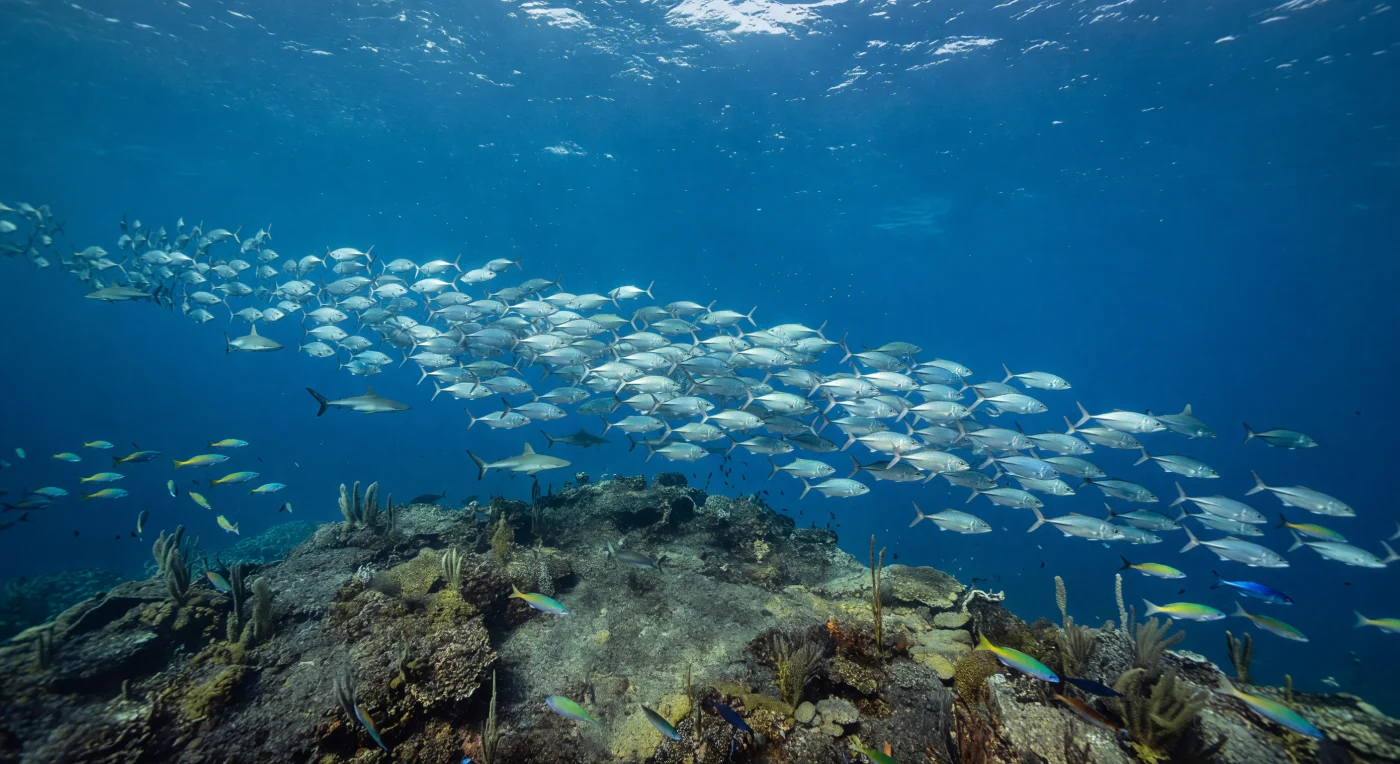
The AUV drifts just above a wave-scoured basalt summit, its sensors reading a steady thermocline-driven current as thousands of horse-eye jacks *Caranx latus* surge past in a single coordinated mass — flanks flashing silver-cobalt in the intense tropical midday light that still reaches this depth with almost undiminished force. This is the sunlit epipelagic realm where photosynthetically active radiation penetrates fully, fueling the plankton drift that accumulates along seamount ridges and transforms submerged volcanic topography into biological hotspots: the summit acts as an obstacle forcing nutrient-rich water upward, concentrating prey and drawing every tier of the pelagic food web into alignment. Silky sharks *Carcharhinus falciformis* work the current seam with hydraulic efficiency, their fusiform bodies angled precisely into flow, exploiting the confusion and compression at the shoal's trailing edge, while rainbow runners *Elagatis bipinnulata* knife through the periphery in streaks of green-gold — secondary predators occupying the productive middle of the water-column hierarchy. Below the AUV, encrusting coralline algae and low gorgonians grip the exposed basalt, testament to a substrate perpetually sandblasted by current, more open-ocean seamount than sheltered reef. The water is a lens of extraordinary clarity, god rays threading down from a bright surface barely thirty-five meters overhead, yet the cobalt blue dissolving beyond the ridge carries the unmistakable psychological weight of immense open-ocean volume pressing in from every direction.
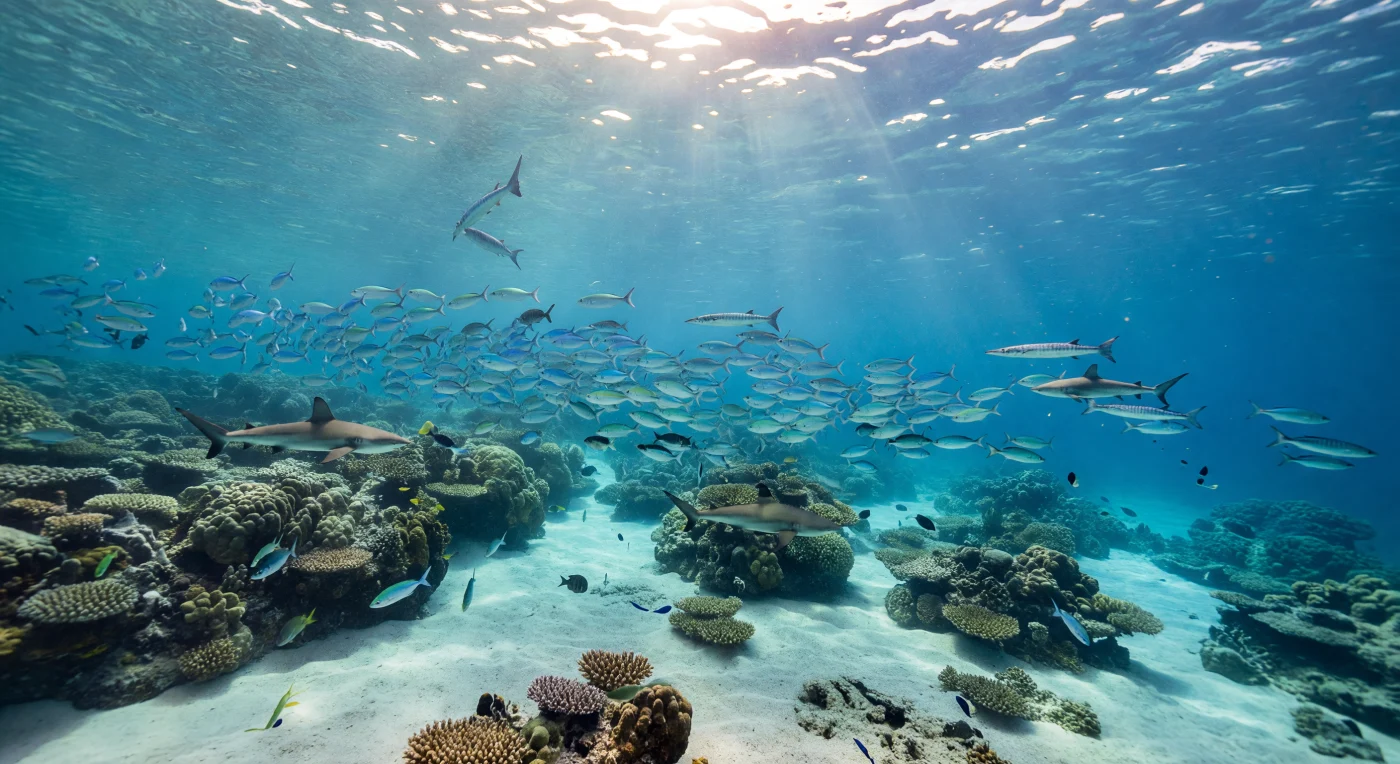
Suspended just beneath the sun-dappled surface, the snorkeler drifts over a mosaic of coral bommies rising from pale sand gullies, as a living river of fusiliers — thousands strong — surges and bends in perfect synchrony, their metallic-blue flanks catching every shaft of light like scattered mirrors. This is the epipelagic ocean at its most dynamic: water temperatures hover near 28 °C, salinity is oceanic, and photosynthetically active radiation still reaches the reef with enough intensity to drive the symbiotic zooxanthellae within the hard coral colonies below. The fusiliers form a classic pelagic shoal, a fluid biological structure in which collective motion, governed by lateral-line sensing and visual cueing across thousands of individuals simultaneously, creates an emergent organism that confuses predators — yet the system is failing at its edges, where two blacktip reef sharks sweep the reef slope in low, economical arcs and a line of barracuda hangs motionless above like polished blades, compressing the school against the coral structure with precision that only apex predators refined over millions of years can manage. The sand channels between bommies channel the school into ribbons, funneling prey and predator alike through corridors of extraordinary clarity, the caustic light lattices rippling across coral heads and darting bodies in patterns that belong as much to physics as to biology. In this shallow, oxygen-rich, pressure-gentle world — barely half an atmosphere above the surface — life is dense, fast, and luminous.
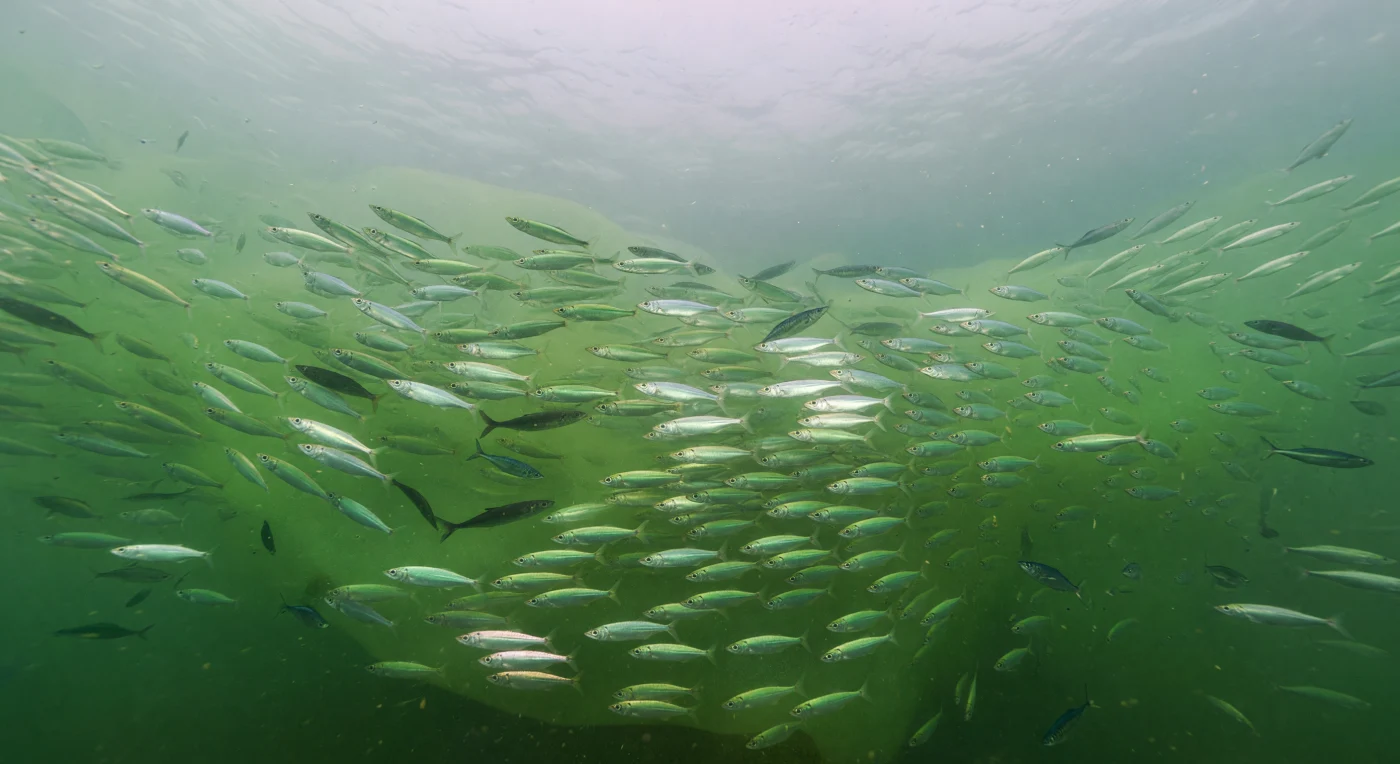
The diver hangs suspended in luminous green water, weightless inside a bloom so dense with phytoplankton that visibility collapses to a few body-lengths in every direction, the surface above reduced to a pale, diffuse ceiling of scattered silver light. Ahead, a living curtain of anchovies — *Engraulis encrasicolus* or a close relative — fills the entire frame, thousands of silver-green bodies executing split-second polarization responses so the shoal shifts in a heartbeat from a near-transparent mesh to a wall of mirrored flash, a collective behavior driven by hydrodynamic sensing through their lateral lines rather than any individual decision. Through this veil, Atlantic mackerel (*Scomber scombrus*) carve clean crescent arcs, each pass opening a momentary hollow in the fish wall before the anchovies close it again like a wound sealing, the predator-prey dynamic playing out as a fluid geometry of pressure waves and reactive scatter. The water column here sits within the productive, sunlit epipelagic realm, where dissolved nutrients upwelled from below fuel phytoplankton blooms of this density — the milky emerald color itself a signature of chlorophyll *a* concentrations dense enough to scatter and absorb red wavelengths, shifting ambient light toward cool green. Marine snow drifts through the frame in every direction, particulate organic matter aggregating from the bloom's own cellular debris, the whole scene feeling paradoxically quiet despite containing millions of animals — a pressurized, living haze with no bottom in sight.
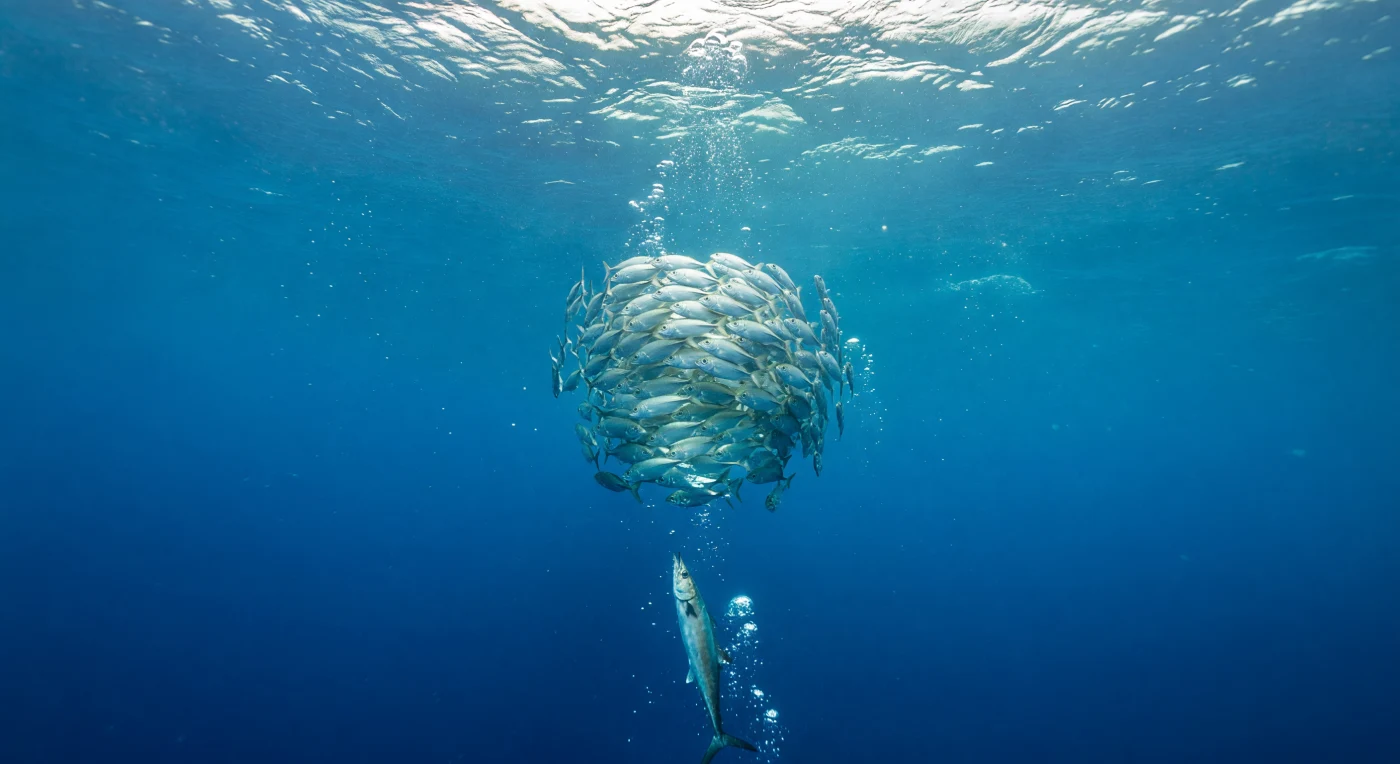
The diver hangs weightless in open blue, neither reef nor seafloor anywhere in sight, just the immense liquid cathedral of the upper water column pressing in from every direction. Directly below, a dense sphere of bigeye scad revolves like a living planet, thousands of individuals coordinating in near-perfect unison through lateral-line mechanoreception and visual cueing, their silvered flanks firing synchronized flashes of reflected sunlight — a collective antipredator display known as the confusion effect, mathematically reducing any single fish's odds of predation. From the deeper cobalt, a wahoo — *Acanthocybium solandri*, among the ocean's fastest bony fish, capable of bursts beyond 75 kilometers per hour — drives upward in a precision hunting pass, its hydrodynamically compressed body tensed against the pressure differential as it exploits the scad's momentary structural weakness at the ball's margin. God rays slope down from the bright, rippled surface overhead, illuminating fine marine snow drifting slowly through sun-warmed waters still rich in dissolved oxygen and phytoplankton-fueled productivity, while exhaled bubbles climb in silver ladders toward the light. This is the open-ocean epipelagic at its most alive — no substrate, no anchor, only biology performing its ancient arithmetic of pursuit and evasion in water column measured in sunlit fathoms.
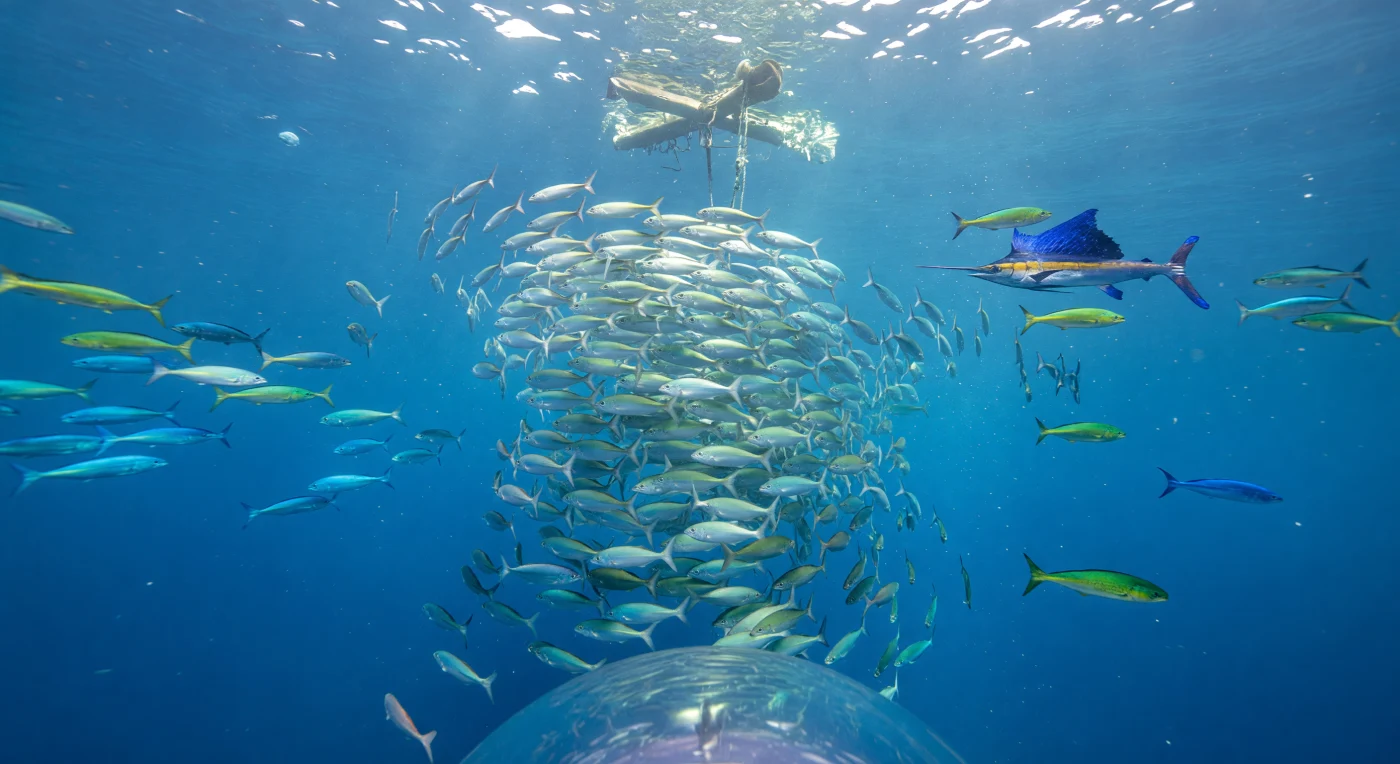
Suspended just beneath the buoy's latticed shadow, the submersible's acrylic dome frames a living spectacle that few humans have ever witnessed at this intimate range: a towering cylinder of juvenile triggerfish and baitfish spiraling in perfect, eerie synchrony, their collective flanks flashing silver, glass-pale blue, and olive as tropical sunlight fractures through the FAD's trailing ropes into cascading caustic bands and god rays. This is the epipelagic zone at its most theatrical — water temperatures hovering near 28°C, pressure still mild, and photosynthetically active radiation penetrating deep enough to power the entire food web radiating outward from this drifting artificial reef, which acts as a floating island of structure in an otherwise featureless open-ocean desert, concentrating life across multiple trophic levels through mechanisms oceanographers call the *meeting-point hypothesis* and *prey-aggregation effect*. At the shoal's glittering perimeter, neon mahi-mahi (*Coryphaena hippurus*) slash inward on iridescent green-gold bodies that can sprint beyond 90 km/h, while a sailfish (*Istiophorus platypterus*) lances through with its retractable bill, compressing the baitball into tighter, brighter ribbons of reflected light — a predator-prey interaction that generates the polarized flash-expansion responses observable only when a school cohesion threshold collapses under simultaneous multi-directional attack. Fine marine snow drifts through the sunbeams below, marking the invisible boundary where light begins its long, exponential fade into ultramarine silence, and the open water column yawns beneath the dome with the particular, vertiginous weight of knowing there is no bottom in sight — only pressure, distance, and the immense blue architecture of the pelagic realm.
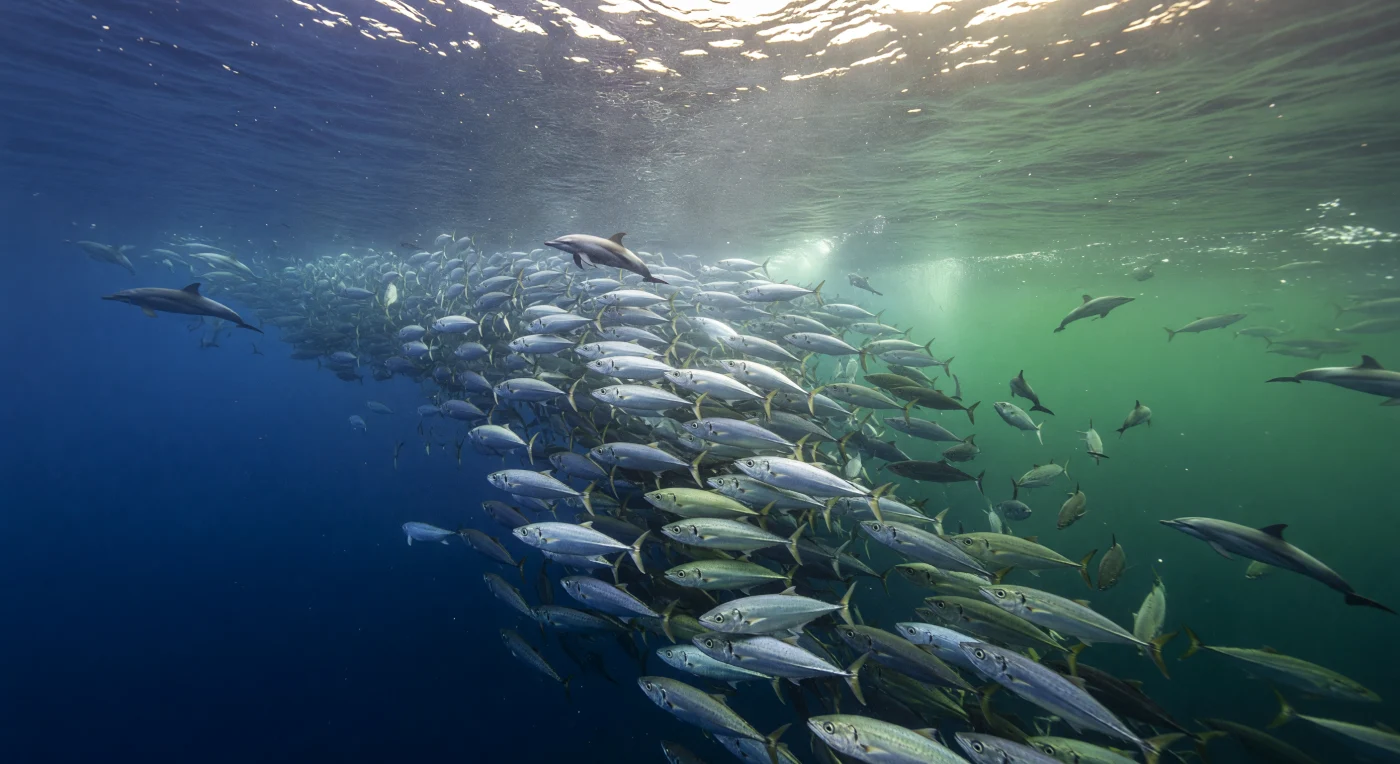
The ROV drifts weightless inside a living architecture — a dense, coordinated mass of jack mackerel that fills every direction of the water column, their flanks catching the descending god rays and throwing back shards of cold silver light. Directly ahead, the ocean is divided: to port, deep indigo water, clean and oligotrophic, pressing against a vivid boundary where it meets the greener, plankton-laden upwelling plume rising from the continental shelf edge, a frontal system driven by Ekman transport that forces cold, nutrient-dense water toward the surface and triggers explosive productivity. This biological hotspot is the reason the fish are here — the upwelling delivers nitrates that seed phytoplankton blooms, which feed zooplankton, which concentrate the jack mackerel in their hundreds of thousands into a single coordinated superorganism, schooling behaviour reducing individual predation risk through the confusion effect even as common dolphins work the margins, their bodies carving clean parabolas through the shoal and compressing it upward toward the brightest, warmest layer. The viewer is held inside open pelagic space with no bottom reference, suspended in pressure-neutral water where sunlight still carries energy down through a rippled ceiling in broken caustic shafts — but the sheer biomass pressing in on all sides, the faint haze of suspended particles marking the frontal boundary, and the continuous flash of thousands of synchronised, scale-bright bodies convey something vast and ancient, an open-ocean ecosystem at full productive force.
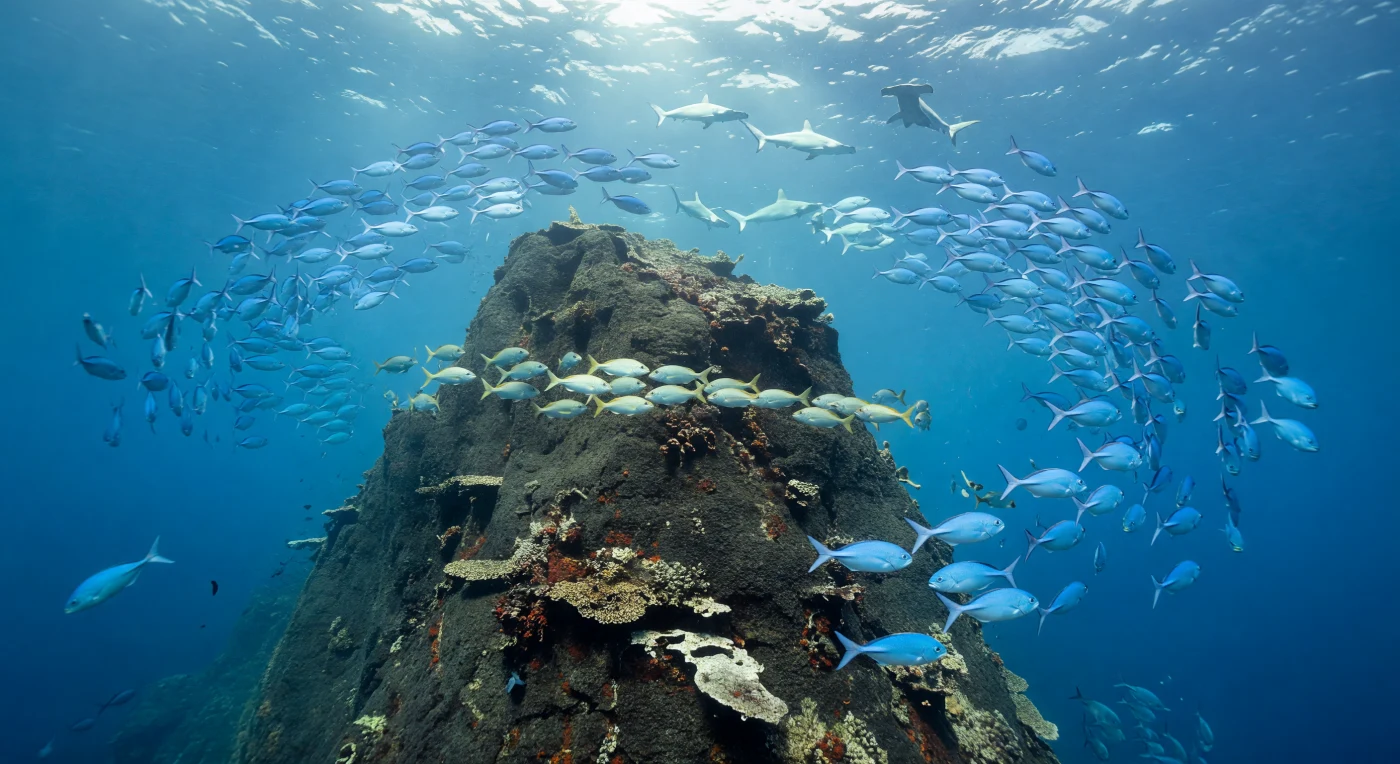
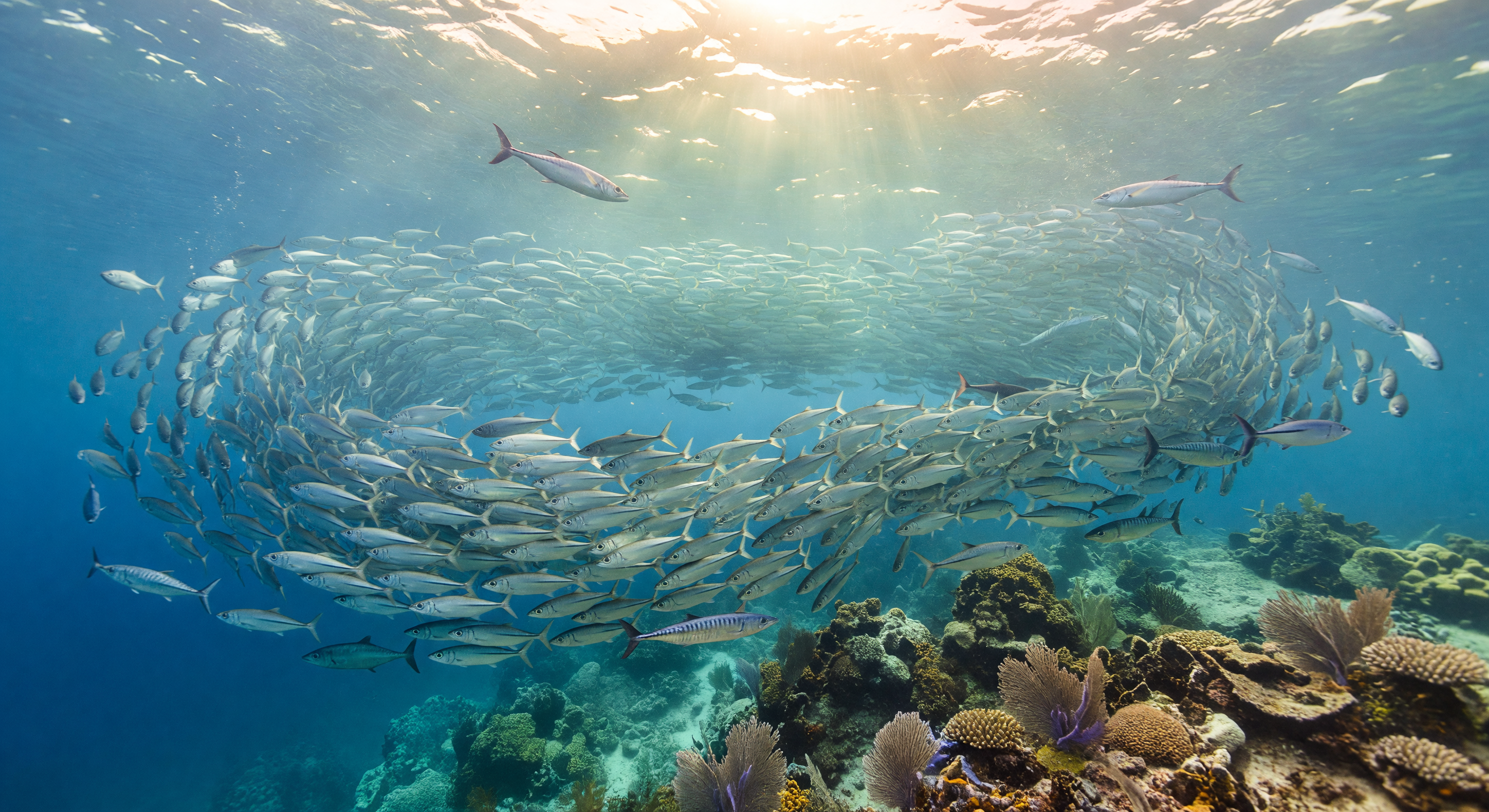
The descent brings you flush against dark basalt that rises like a drowned cathedral, its surface rough with encrusting coralline algae and pocked by decades of volcanic weathering, and then the pinnacle's summit erupts into motion — thousands of blue runners have organized themselves into a single living vortex, a coordinated spiral so dense and precise that the school becomes a rotating wall of silver-blue muscle, every body banked at the same angle, every forked tail beating in near-perfect unison, the mass of them flashing in the god rays that pour down through a rippled surface still close overhead. Scalloped hammerheads — their wide cephalofoils unmistakable even at the edge of visibility — drift through these upper beams with the unhurried authority of apex predators, electroreceptor-laden heads sweeping slowly as they read the pressure fields of ten thousand panicking runners and open brief, geometric lanes through the baitball before closing them again. Below the vortex, a tight shelf of snapper holds its position just above the rock, exploiting the upwelling currents that deflect off the pinnacle's flanks and concentrate zooplankton, small crustaceans, and larval fish against the structure in a reliable, renewable food source. The water here is extraordinarily clear but alive with fine suspended particulate catching each beam like smoke in a church, and the silence is total — no bubbles, no motor noise, only the faint collective click and rush of ten thousand bodies banking in unison, the ocean feeling both immense and compressed around you, as if the entire pelagic water column has briefly chosen this one dark rock as its center of gravity.
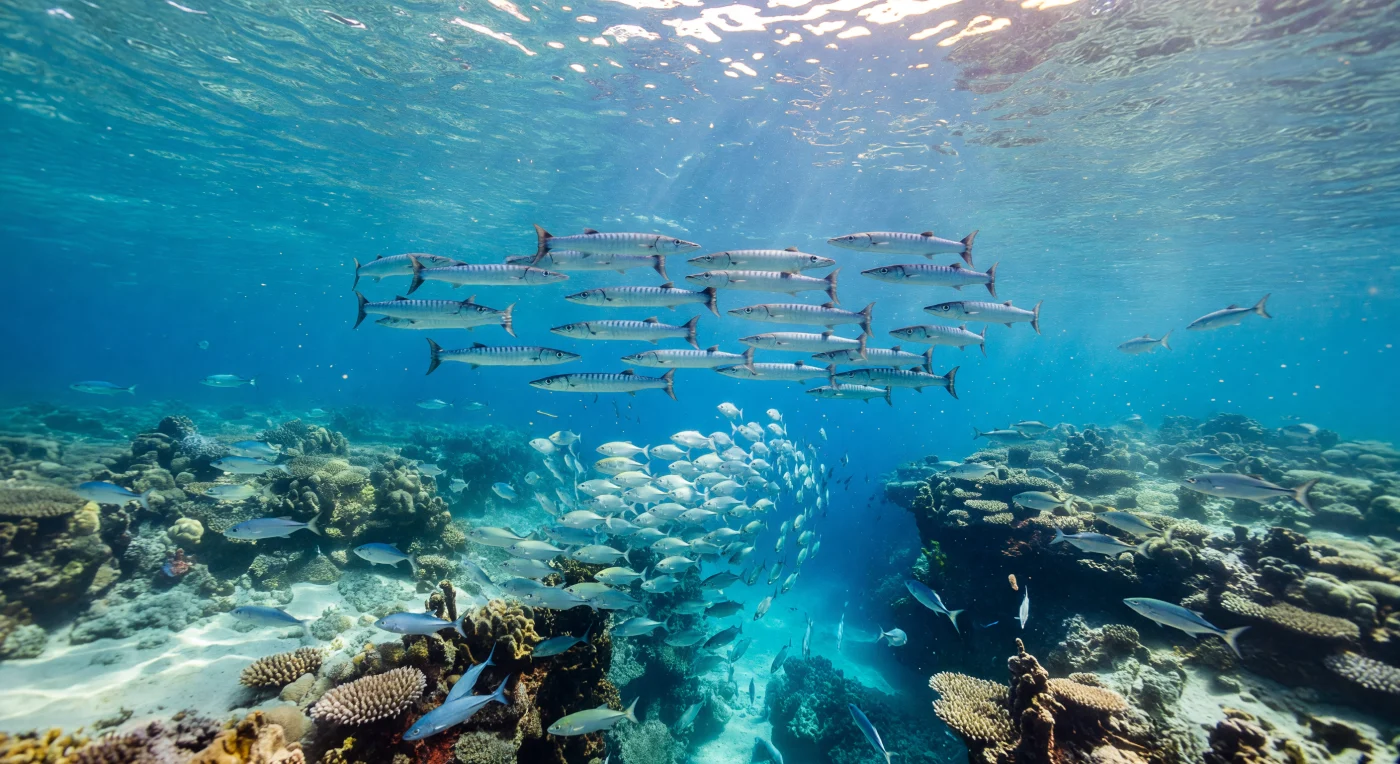
Suspended in the racing current of a tropical reef pass at scuba depth, you hover mid-water as an extraordinary biological theatre unfolds around you — the force of the tidal flow is palpable in your buoyancy compensator, and fine particles of suspended plankton stream past like slow sparks in the god rays that knife down from the surface twelve to eighteen metres above. Dominating the water column ahead, a ring of chevron barracuda — *Sphyraena putnamiae* — holds its formation with almost eerie precision, each metallic flank and dark chevron marking resolved in the crystalline tropical visibility; these animals are exploiting the hydraulic energy of the pass itself, station-keeping effortlessly in accelerated flow by fine-tuning their pectoral fins, conserving energy while maximising prey encounter rates. Below them, a dense bait ball of silversides compresses and flexes under collective threat assessment, the entire mass executing coordinated flash-expansion responses — an emergent anti-predator behaviour generated by thousands of individual fish obeying simple neighbour-distance rules, producing a structure with no leader and no fixed shape. Giant trevallies burst through the lower layers in sudden luminous arcs, their countershaded bodies igniting in bands of rippled caustic light before vanishing into the cooler cobalt of the channel, the ambush timed to the pass current that funnels prey into predictable corridors. Here, at the intersection of tidal hydrodynamics, reef topography, and pelagic predator-prey ecology, the water column itself becomes a living system — stratified by light, structured by flow, and dense with the silent negotiation between hunter and hunted.
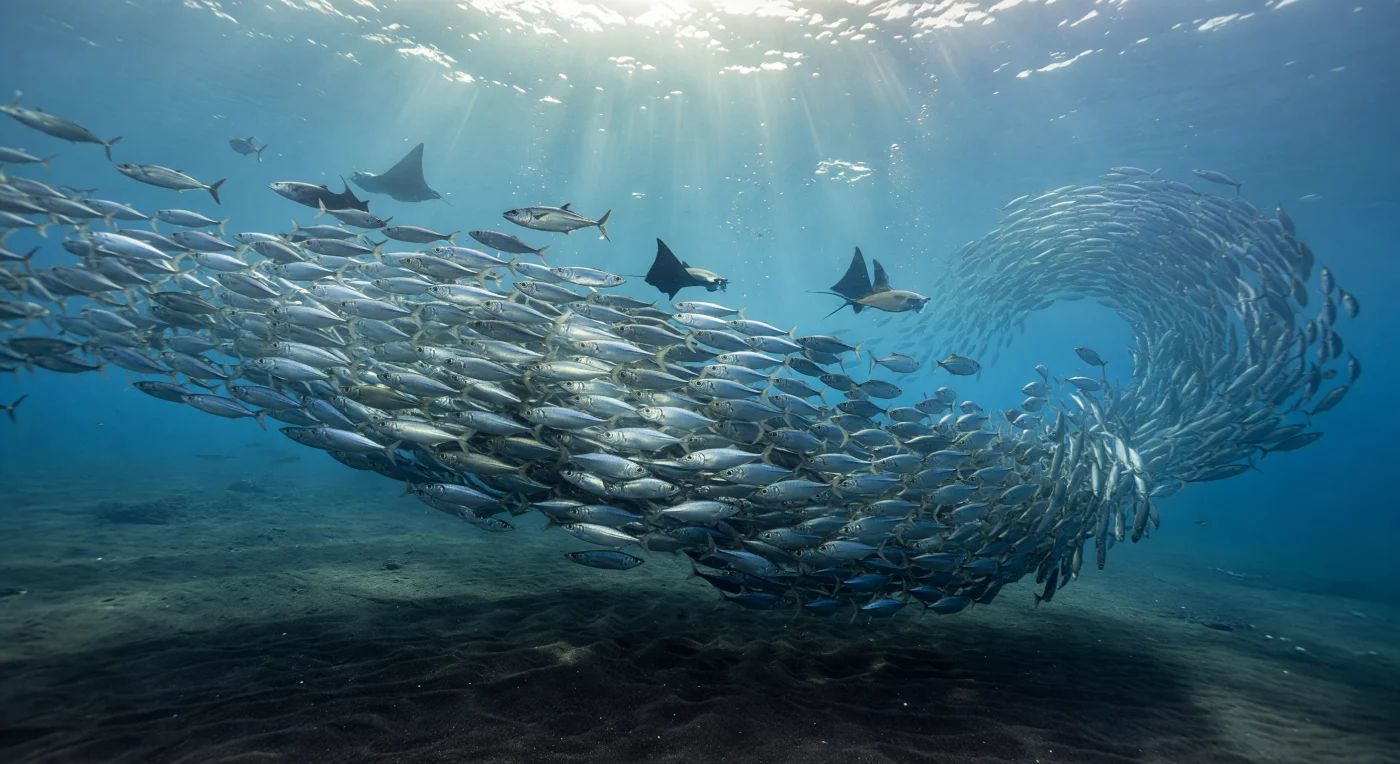
The living wall hits you before you register it — a curtain of sardines, thousands strong, sweeping past your mask in sheets of hammered silver, each scale and lateral line crisp in the slanting god rays that knife down through the blue-green column above the volcanic slope. At this depth the sun still commands the water; visibility stretches tens of meters, and the light that reaches you is warm enough to ignite the bait ball from within, each individual fish a flashing mirror against the matte black lava rubble and current-rippled basalt sand anchoring the scene below. This is open-water biology at its most theatrical: the sardines are not here by accident but are aggregating in response to upwelling nutrients and plankton-rich currents, their schooling reflex — thousands of nervous systems acting as one fluid intelligence — shaped by exactly the predation pressure now arriving from above, where mobula rays spiral and cartwheel through the column in elegant parabolas, winnowing the edges of the mass. Yellowfin tuna punch in from the open blue in short, brutal accelerations, and every impact compresses the school into a tightening vortex, the formation bending and folding like liquid metal as it attempts to absorb the strike, a phenomenon ecologists call the *vacuole response*. Suspended plankton glitters in the god rays around you, the pressure at this depth still shallow enough that your ears barely register the dive, yet the sheer biological density of the water — predators above, volcanic geology below, a million silver bodies churning the column between — carries its own quiet, immersive weight.
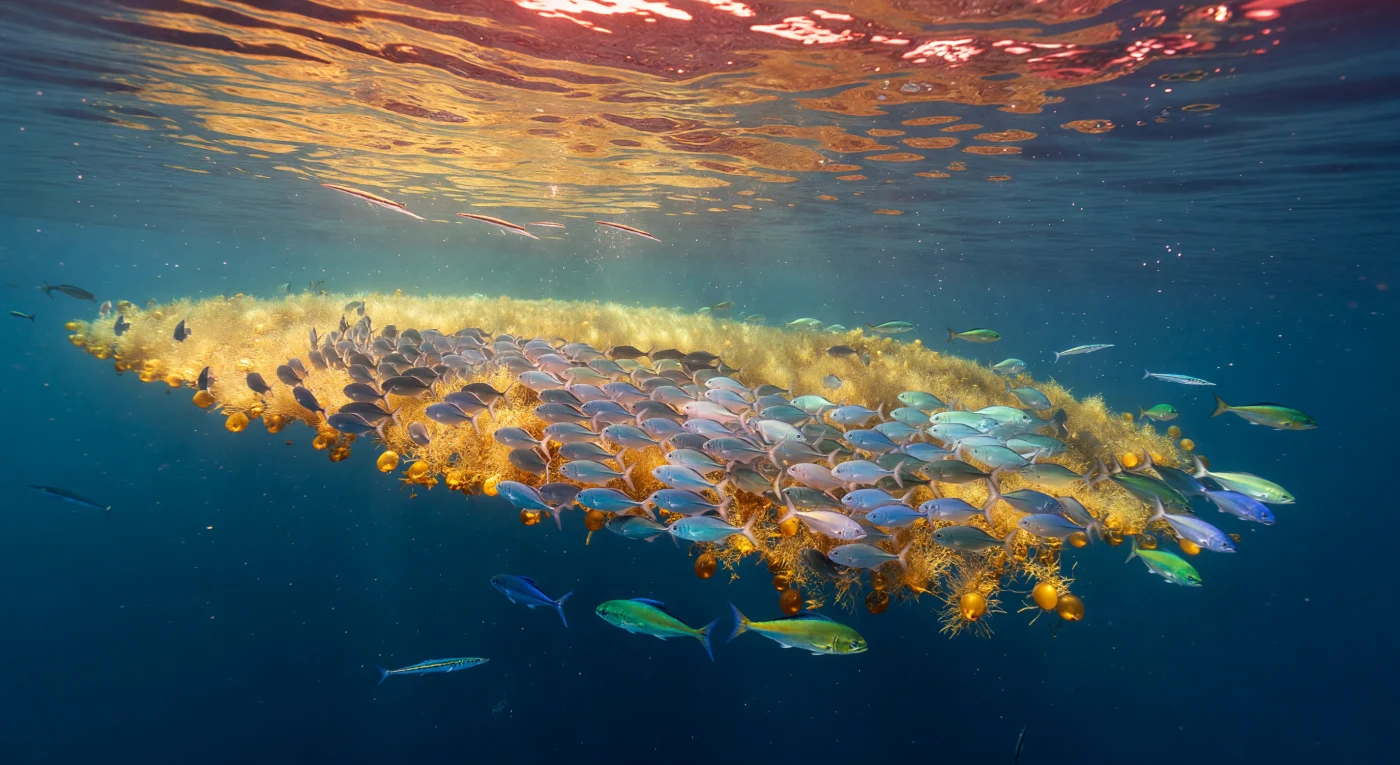
Suspended just beneath the rippled surface, the snorkeler hangs motionless beside the ragged golden-brown curtain of Sargassum, a mat of free-floating brown macroalgae whose gas-filled pneumatocysts keep it locked at the air-sea interface, where sunlight still carries enough energy to sustain a miniature ecosystem of extraordinary density. In the last oblique light of sunset, refracted into shifting caustic bands across the fronds, thousands of juvenile jacks resolve into a single animate wall — a true school in the strictest hydrodynamic sense, each fish maintaining precise inter-individual spacing through pressure-sensitive lateral-line organs, the collective body pivoting and compressing as one nervous system, flashing chrome and rose-gold as their scales catch the dying light. The Sargassum edge functions as a pelagic nursery, a cryptic refuge in an otherwise featureless open-ocean environment where juvenile epipelagic fishes exploit the structural complexity of the weed for cover against exactly the predators now patrolling the margin: mahi-mahi — Coryphaena hippurus — accelerate past with iridescent flanks that shift from electric blue to burnished green with each muscular stroke, while needlefish, their elongated rostra lined with needle teeth, slice along the mirror-bright surface film hunting silhouetted prey against the last sky glow. Below the warm amber wash of the uppermost meter, the water column opens into clear lucid blue with no bottom in sight, a reminder that this entire spectacle unfolds at the mercy of ocean circulation — the shoal, the mat, and its hunters all drifting together on the surface mixed layer, a self-contained living raft island in the open sea.
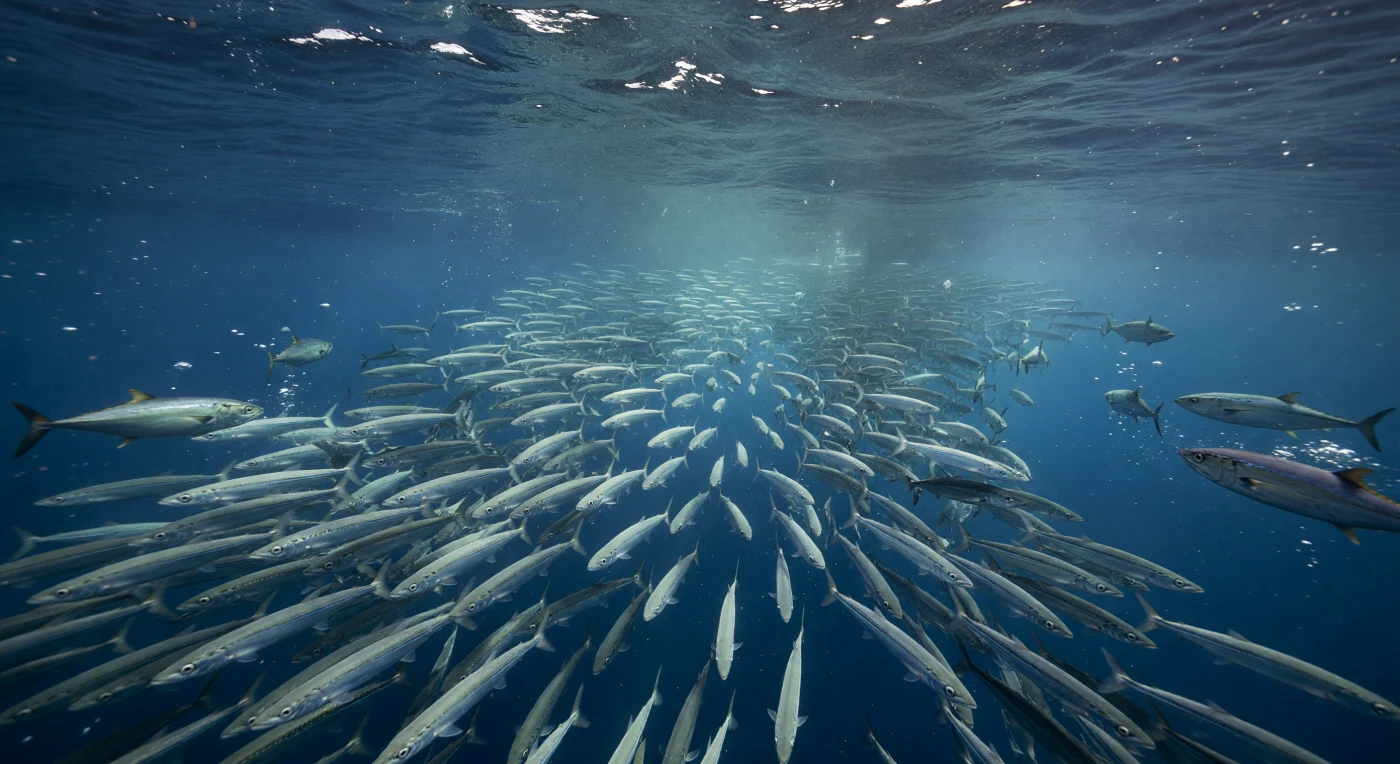
The AUV pushes into the living mass head-on, surrounded on all sides by saury — thousands of needle-bodied fish whose silver flanks catch the storm-filtered daylight in rolling, synchronized flashes, each scale a wet blade momentarily lit before the shoal folds and shifts around the intrusion. Above, the surface is a dark, wind-torn ceiling of chop through which narrow god rays descend in cool silver-blue bands, attenuating rapidly into open cobalt as depth swallows the light, while fine particulate and micro-bubbles from the squall still drift through the shafts like suspended static. This is the epipelagic open ocean at its most kinetic: a mobile biological structure numbering in the tens of thousands, the individual saury responding to neighbors and to predator pressure through hydrodynamic coupling and lateral-line sensing, the school itself functioning as a distributed organism capable of reorganizing in milliseconds. From both flanks, skipjack tuna carve sudden lanes through the formation — compact, warm-blooded, ram-ventilating hunters whose burst speed can exceed ten body lengths per second, each pass scattering a corridor of saury that immediately closes behind them. There is no seafloor reference here, no substrate, only the immense three-dimensional openness of the upper water column pressing in from every direction, the pressure still gentle at this depth but the silence and scale of the event absolute.