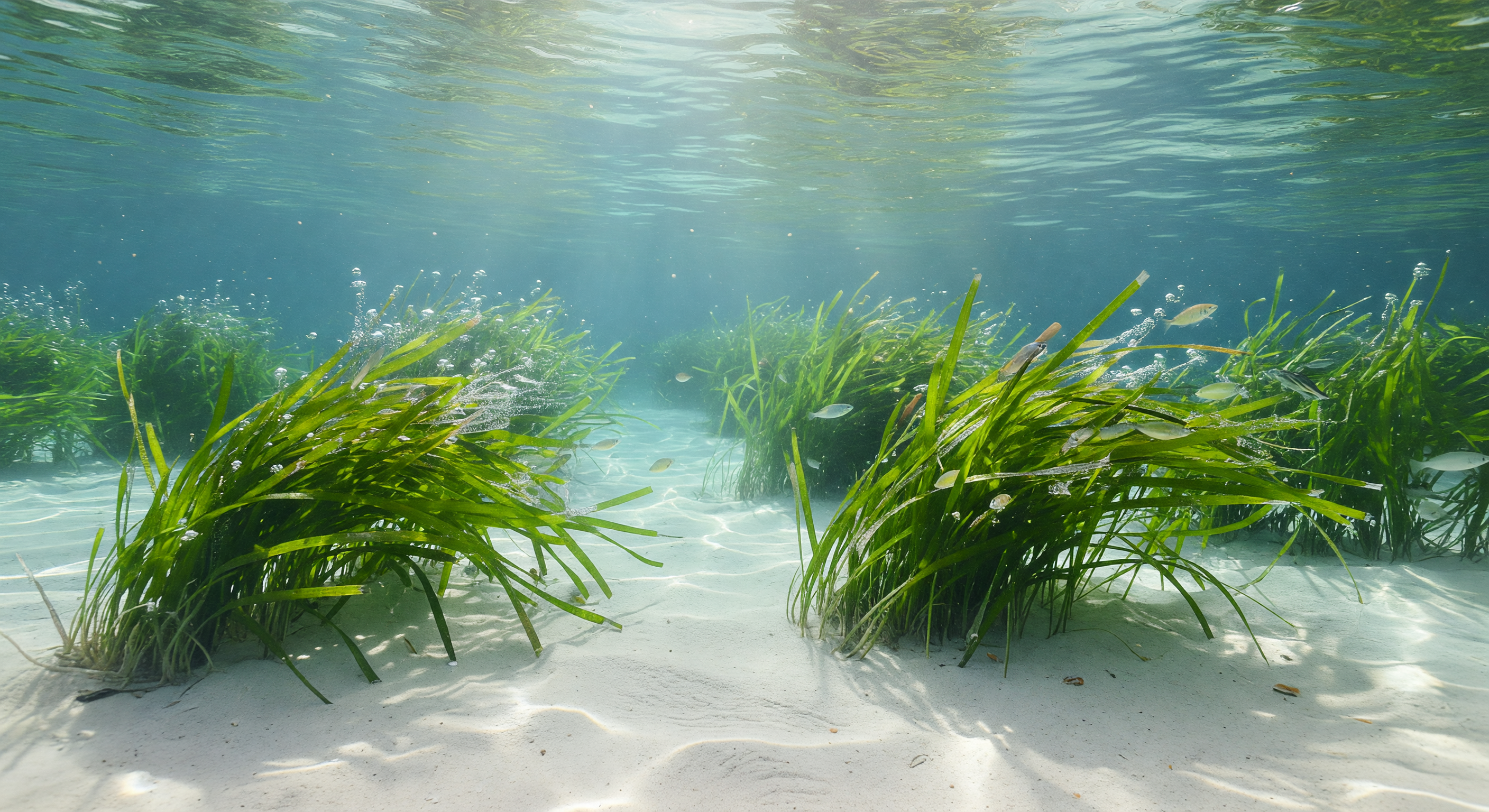
At just two meters below the sunlit surface, this coastal lagoon is one of the most productive ecosystems on Earth — a submerged prairie of *Zostera marina* whose strap-like leaves, anchored by rhizomes in pale sandy sediment, sway in slow unison with each passing ripple. Brilliant caustic patterns race continuously across the seafloor as the calm surface above refracts midday sunlight into shifting nets of gold and white, while softer god rays descend through the shallow water column in long, diffuse shafts. Every leaf blade is actively photosynthesizing, releasing oxygen directly into the water as tiny silvery bubbles that cling to the green surface before rising free — a visible signature of primary production that makes seagrass meadows among the most carbon-efficient habitats in the marine world, sequestering organic carbon in their sediments at rates rivaling tropical forests. Clouds of juvenile fish — likely sparids, atherinids, or small gobies depending on the bioregion — use the dense canopy as refuge and feeding ground, their translucent bodies flickering with refracted light as they navigate the vertical architecture of the blades. This shallow, pressure-gentle world, barely 1.2 atmospheres at its floor, hums with biological activity entirely indifferent to any observer: a self-sustaining nursery and carbon sink that has existed in coastal seas for tens of millions of years.
Seagrass meadows