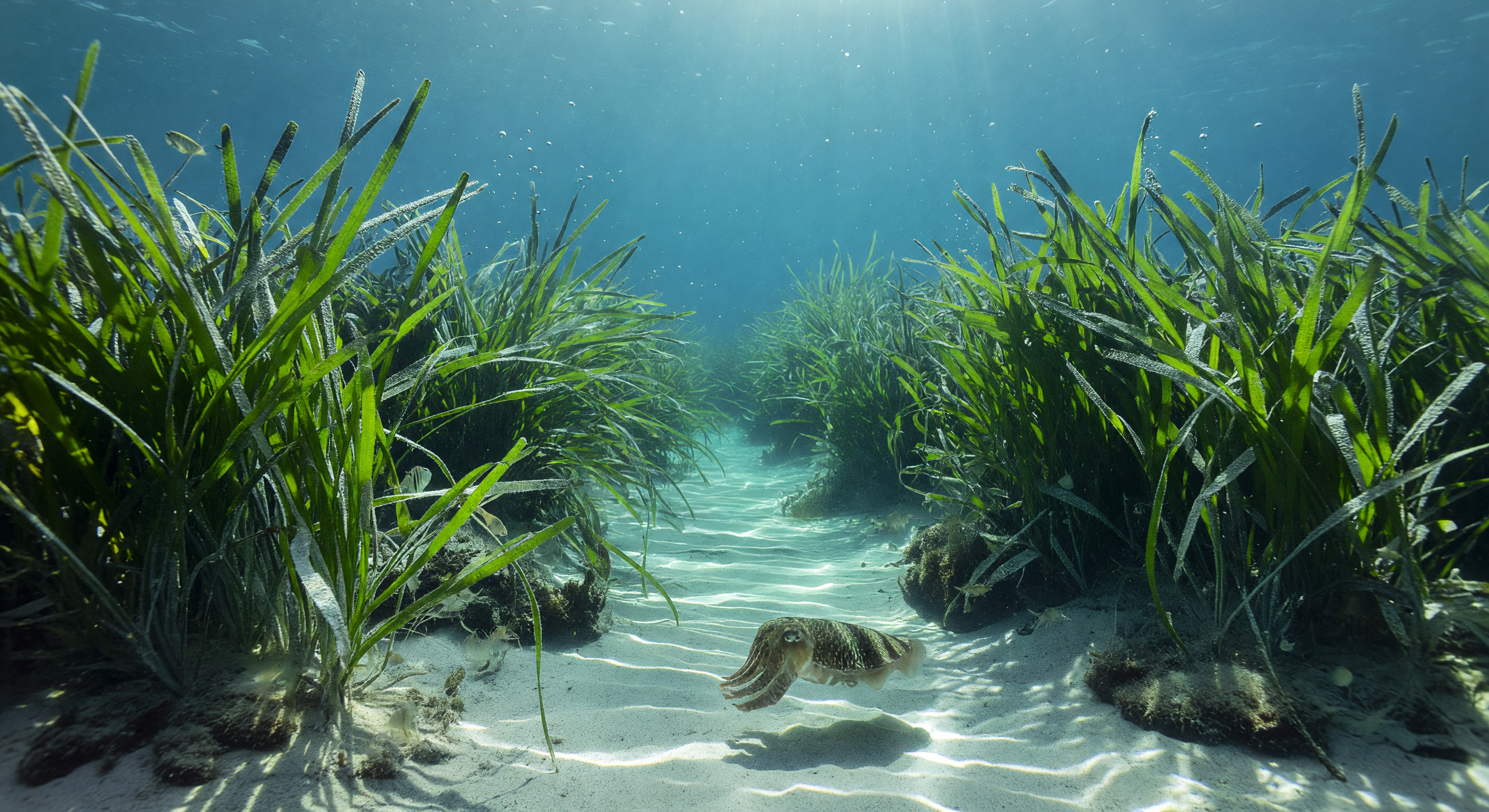
In the shallows of the Mediterranean coast, where sunlight still commands the seafloor, a narrow corridor of pale sand threads between towering stands of *Posidonia oceanica* — one of Earth's oldest and most productive marine flowering plants, whose continuous meadows have carpeted these shelves for millennia. At scarcely two atmospheres of pressure, the water column glows a luminous blue-green, and solar caustics race across the rippled sand in shifting ribbons, lighting the lower leaves from below and catching the fine suspended particles that drift freely between the blades. A common cuttlefish (*Sepia officinalis*) holds its position centimetres above the substrate in near-perfect stillness, its lateral fin frill oscillating in micro-pulses that betray extraordinary muscular control, while chromatophores and iridophores collaborate across its mantle in a real-time imitation of the striped, mottled bottom — a predatory disguise refined over hundreds of millions of years of cephalopod evolution. Translucent shrimp dart from the organic-rich mat of roots and sediment at the bases of the seagrass shoots, exploiting the structural complexity that makes these meadows among the most biodiverse coastal habitats on Earth, rivalling coral reefs in the density of species they shelter at each life stage. Here, at a depth where photosynthesis still drives the entire food web and light itself is the architecture, the meadow breathes, bends, and hunts in a self-contained world of perfect, unhurried purpose.
Seagrass meadows