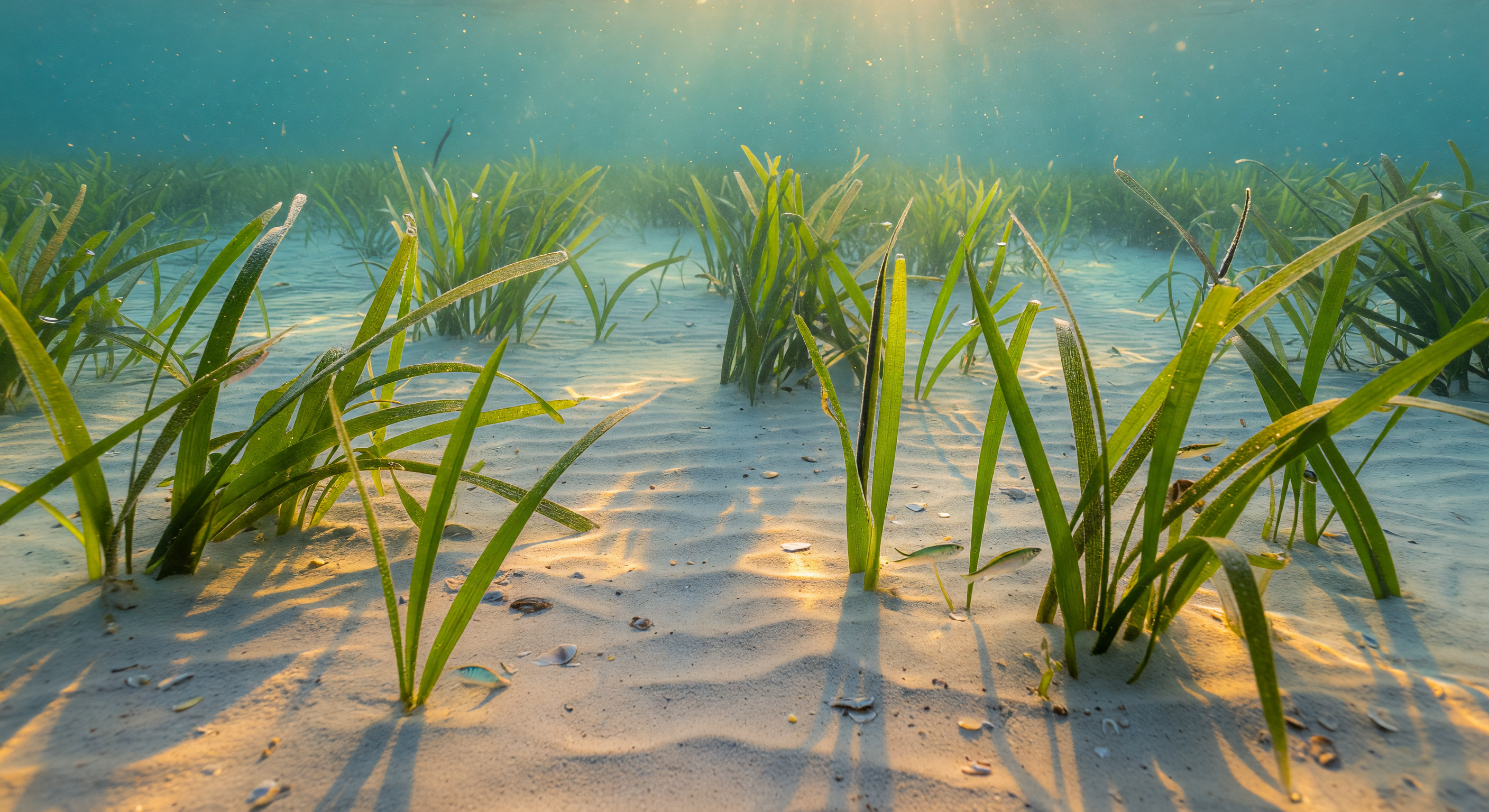
In the last hours of the afternoon, low Atlantic or Mediterranean sunlight angles through a few meters of clear water, painting the seabed in warm amber-gold caustics that shift and ripple as each swell passes overhead. This is a seagrass meadow in full vitality — a rooted, flowering-plant ecosystem, not an alga, anchored by rhizomes into pale rippled sand where fine sediment collects in organic-dark troughs between blade clusters. Eelgrass leaves (*Zostera marina*) bend in long arcs as a slow tidal pulse moves through the canopy, then recover, then bend again, the entire prairie breathing in unison under roughly 1.5 to 2 atmospheres of gentle coastal pressure. Between the grass patches, shell fragments and sediment mounds mark where rooted shoots slow the current, and among the leaves a slender pipefish holds itself rigid against a blade while juvenile fish and translucent shrimp exploit the structural shelter that makes these meadows among the most productive nursery habitats on the temperate shelf. Oxygen bubbles, photosynthesized by the grass itself in the last bright light of the day, cling sparkling to sunlit blades — a quiet chemical record of a living ecosystem converting sunlight into carbon and oxygen with no witness and no interruption.
Seagrass meadows