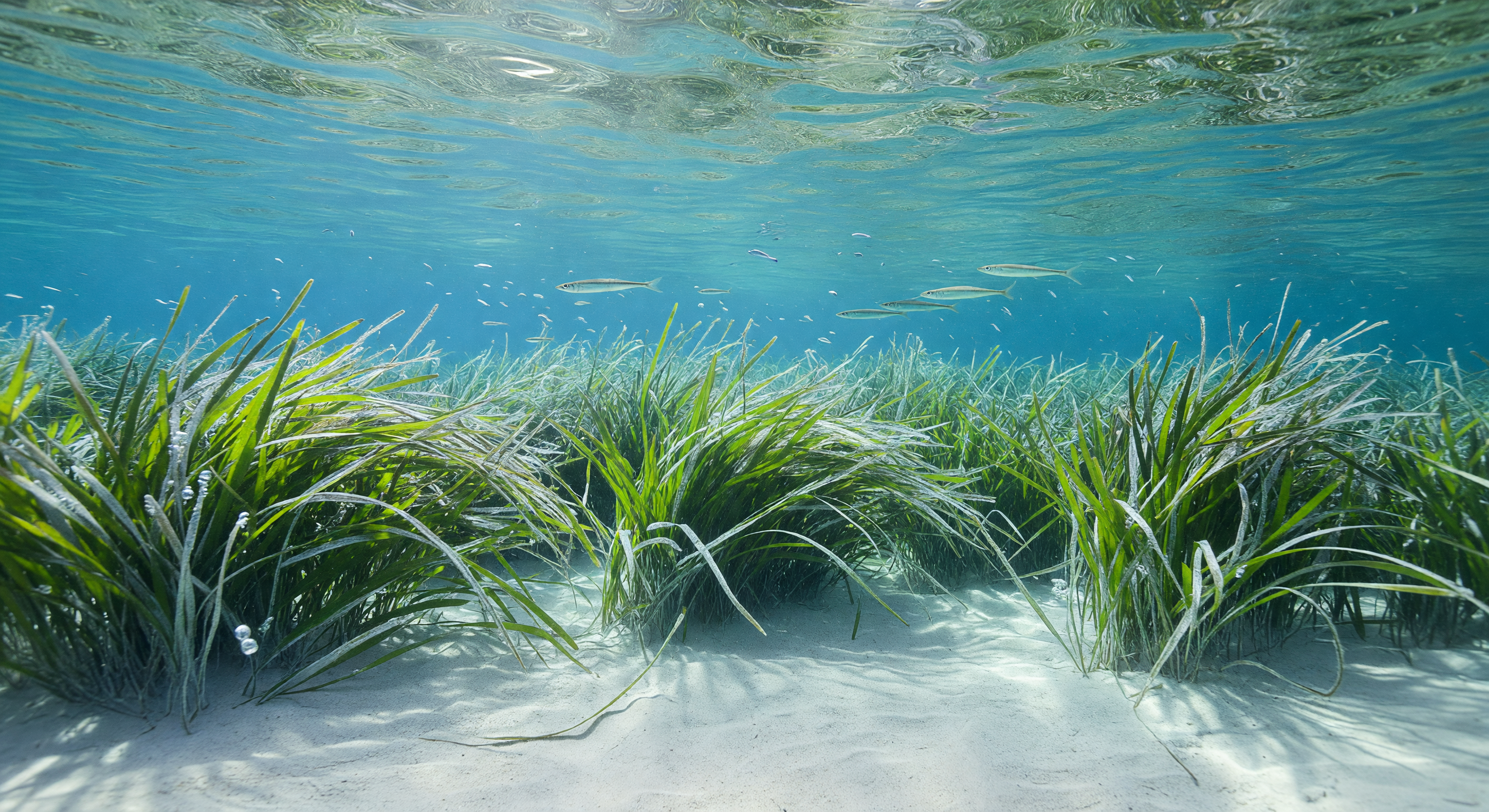
Beneath a mirror of liquid silver, a dense prairie of *Posidonia oceanica* ribbons rolls in slow synchrony with the passing swell, each blade a vivid green lance rooted in pale carbonate sand that has accumulated over centuries of leaf-fall and sediment binding — a geological process as much as a biological one. Here, barely a few metres below the air-sea interface, pressure is negligible and sunlight penetrates with full force, fracturing into shifting god rays and dancing caustics that trace ceaselessly moving patterns across the meadow canopy. Slender needlefish — *Belone belone* — cruise just beneath the surface in loose formation, their elongated silver bodies evolved to exploit exactly this liminal zone where sky and sea blur together, while clouds of translucent juvenile fish, the recruits of sea bream, wrasse, and mullet species, flicker above the blades in pulses of refracted light, sheltered by the meadow's structural complexity. *Posidonia* meadows are among the most productive ecosystems in the Mediterranean, generating oxygen through photosynthesis, locking blue carbon in their deep matte accumulations, and providing nursery architecture for dozens of species that will disperse into open water as adults. This sunlit world turns entirely on its own axis — regulated by tides, temperature, and the angle of the sun — indifferent to and entirely independent of any gaze from beyond its surface.
Other languages
- Français: Patrouille d'orphies en surface
- Español: Patrulla de agujetas superficial
- Português: Patrulha de agulhões na superfície
- Deutsch: Hornhechte an der Oberfläche
- العربية: دوريات سمك الإبرة السطحية
- हिन्दी: सतह पर सुई मछली गश्त
- 日本語: 水面のダツの巡回
- 한국어: 수면 학꽁치 순찰
- Italiano: Pattuglia di aguglie in superficie
- Nederlands: Geeppatrouille aan het oppervlak