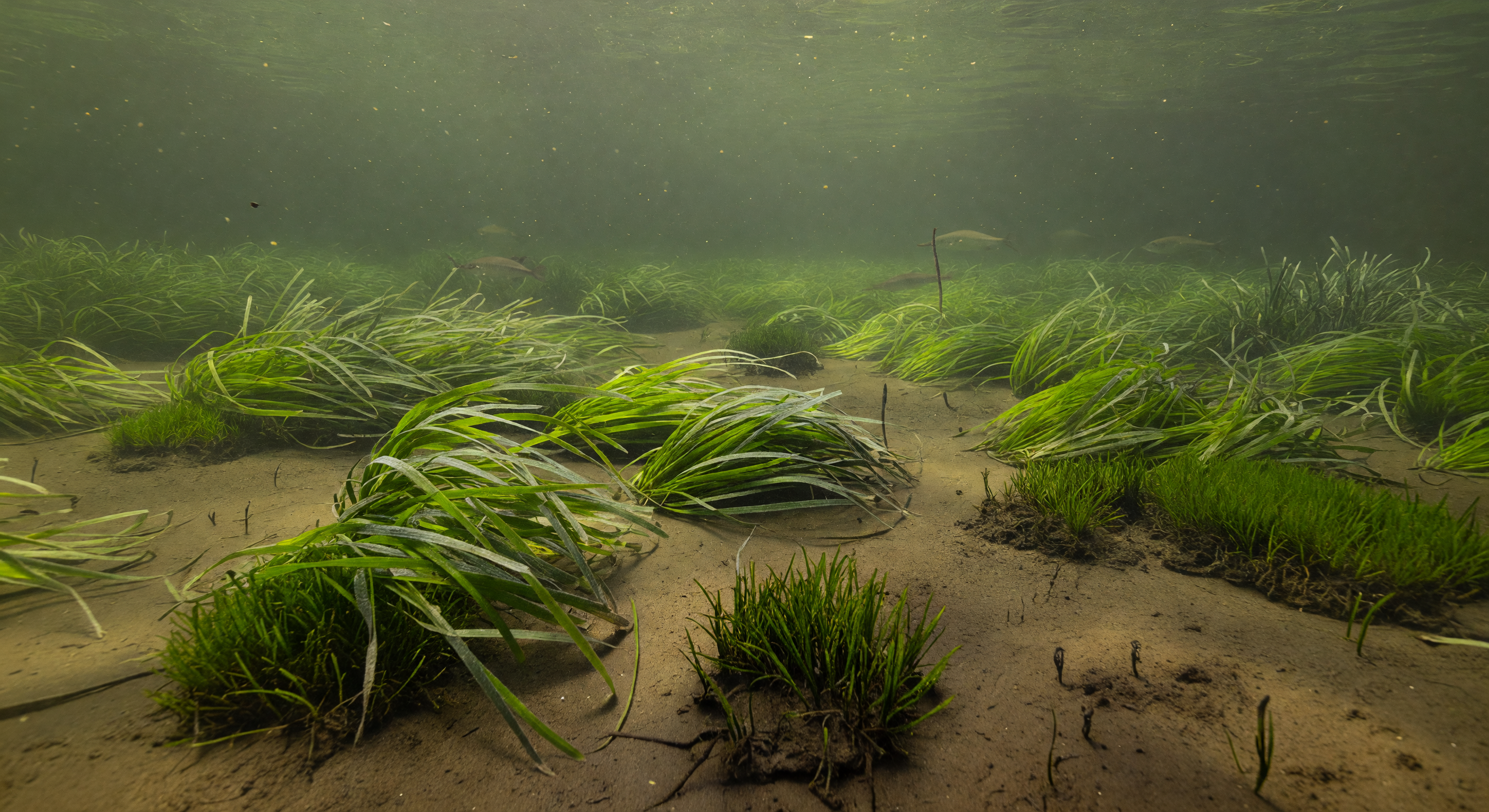
Where a river softens its grip on the land, the estuary holds a world of its own — brackish, turbid, and tender. Here, in just a few metres of water where sunlight still reaches the seafloor but is strained through tannins and suspended silt into tones of olive and amber, a patchy bed of *Zostera marina* takes root in dark, organic-rich sediment. The eelgrass blades, ribbon-thin and flexible, bend and recover in rhythmic unison with each tidal pulse, their surfaces faintly filmed with epiphytic microalgae and dotted with tiny oxygen bubbles produced by the quiet work of photosynthesis — a process that makes seagrass meadows among the most productive and carbon-dense ecosystems on Earth, sequestering organic matter in anoxic sediments below. Grey mullet — opportunistic omnivores tolerant of the wide salinity swings and low dissolved oxygen that define estuarine life — drift as soft silver silhouettes through the green-brown midwater, while a pipefish, a member of the family Syngnathidae, hangs nearly motionless among the leaves, its elongated body so precisely matched in colour and posture to the surrounding blades that it exists, effectively, as a living piece of the meadow. Fine particulate matter — sediment, organic detritus, planktonic fragments — drifts freely through the water column, softening contrast and distance, a reminder that this is a place of constant flux, where freshwater and saltwater negotiate at the edge of the land, and where life has learned, without witness or audience, to thrive in the in-between.
Other languages
- Français: Dérive d'Estuaire Olive
- Español: Deriva del Estuario Oliva
- Português: Deriva do Estuário Olive
- Deutsch: Olivfarbene Ästuardrift
- العربية: انجراف مصب الزيتون
- हिन्दी: जैतून मुहाना प्रवाह
- 日本語: オリーブ河口の漂流
- 한국어: 올리브 하구의 표류
- Italiano: Deriva dell'Estuario Oliva
- Nederlands: Olijfgroene Estuarium Drift