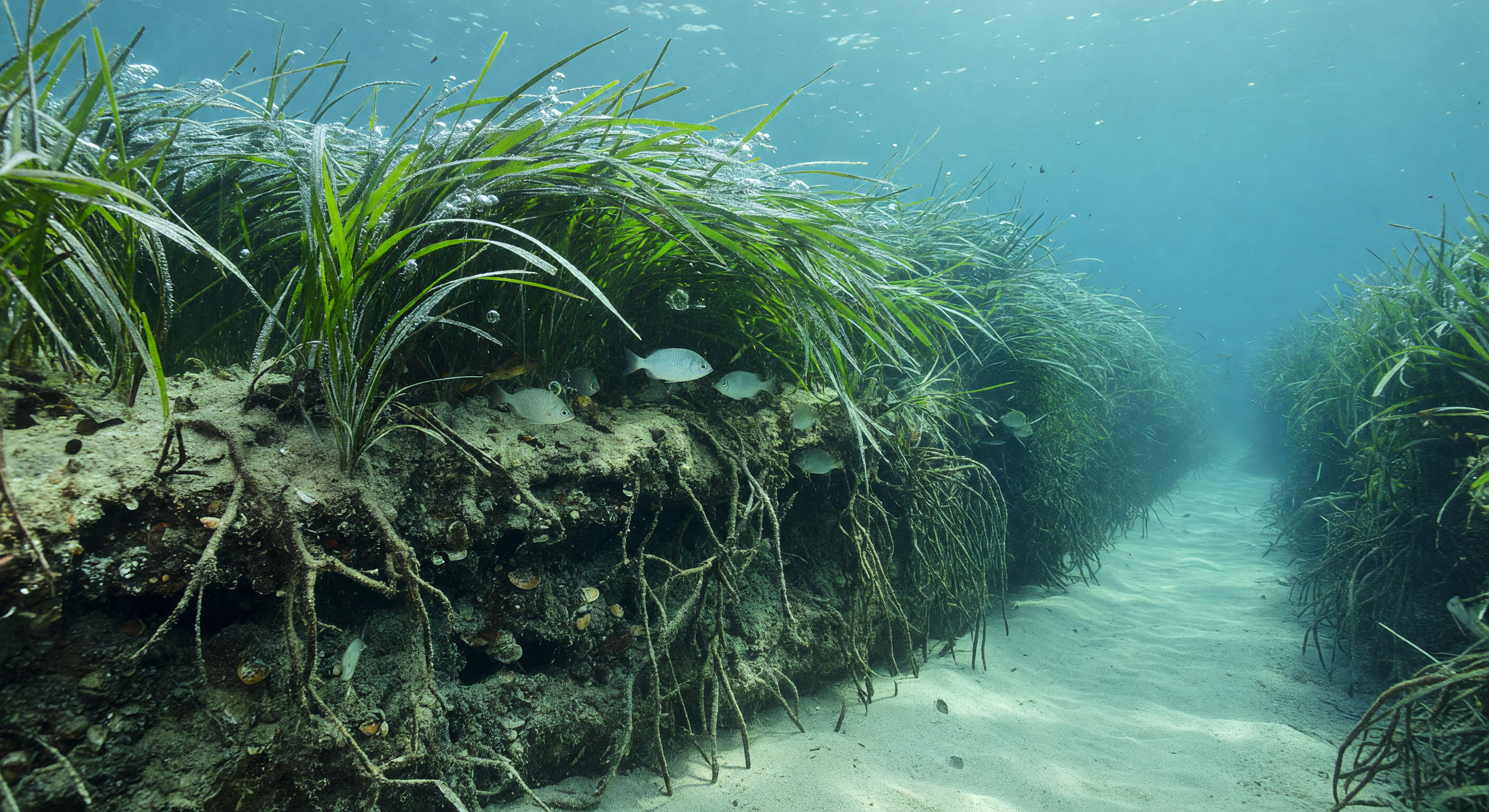
At roughly 8 to 12 meters depth along the Mediterranean coast, where pressure barely exceeds two atmospheres, a dense *Posidonia oceanica* meadow has spent centuries building its own geology: the matte, a compacted wall of dead rhizomes, trapped sediment, shell debris, and accumulated organic matter that can rise a meter or more from the seafloor like a living cliff face, its eroded surface riddled with small cavities that shelter invertebrates and juvenile fish seeking refuge from open water. Sunlight descending through the calm surface above fractures into soft caustic patterns that skitter across the pale rippled sand channel beside the scarp, filling the water column with a vivid blue-green luminance while the matte face itself sits in cooler shade, its root-tangled mass absorbing rather than reflecting the light. Above the scarp's edge, long ribbon-like leaves bend and recover in slow coherent pulses driven by the current, some blades studded with tiny silver bubbles of photosynthetically produced oxygen — a reminder that *Posidonia* meadows are among the most productive ecosystems in the Mediterranean, sequestering carbon and oxygenating coastal waters at rates comparable to terrestrial forests. A small group of silver seabream holds position at the boundary between open sand and the meadow's shelter, that ecotone edge where prey availability and escape cover balance perfectly, while finer suspended organic particles drift freely through the clear water, carrying the chemical signatures of a habitat that has existed here, entirely on its own terms, for thousands of years.
Other languages
- Français: Traversée de l'Escarpement Matte
- Español: Travesía del Escarpe Matte
- Português: Travessia da Escarpa Matte
- Deutsch: Matte Steilhang Querung
- العربية: عبور جرف الماتي
- हिन्दी: मैट कगार पार
- 日本語: マット崖壁横断
- 한국어: 매트 절벽 횡단
- Italiano: Traversata dello Scarpato Matte
- Nederlands: Matte Steilwand Doortocht