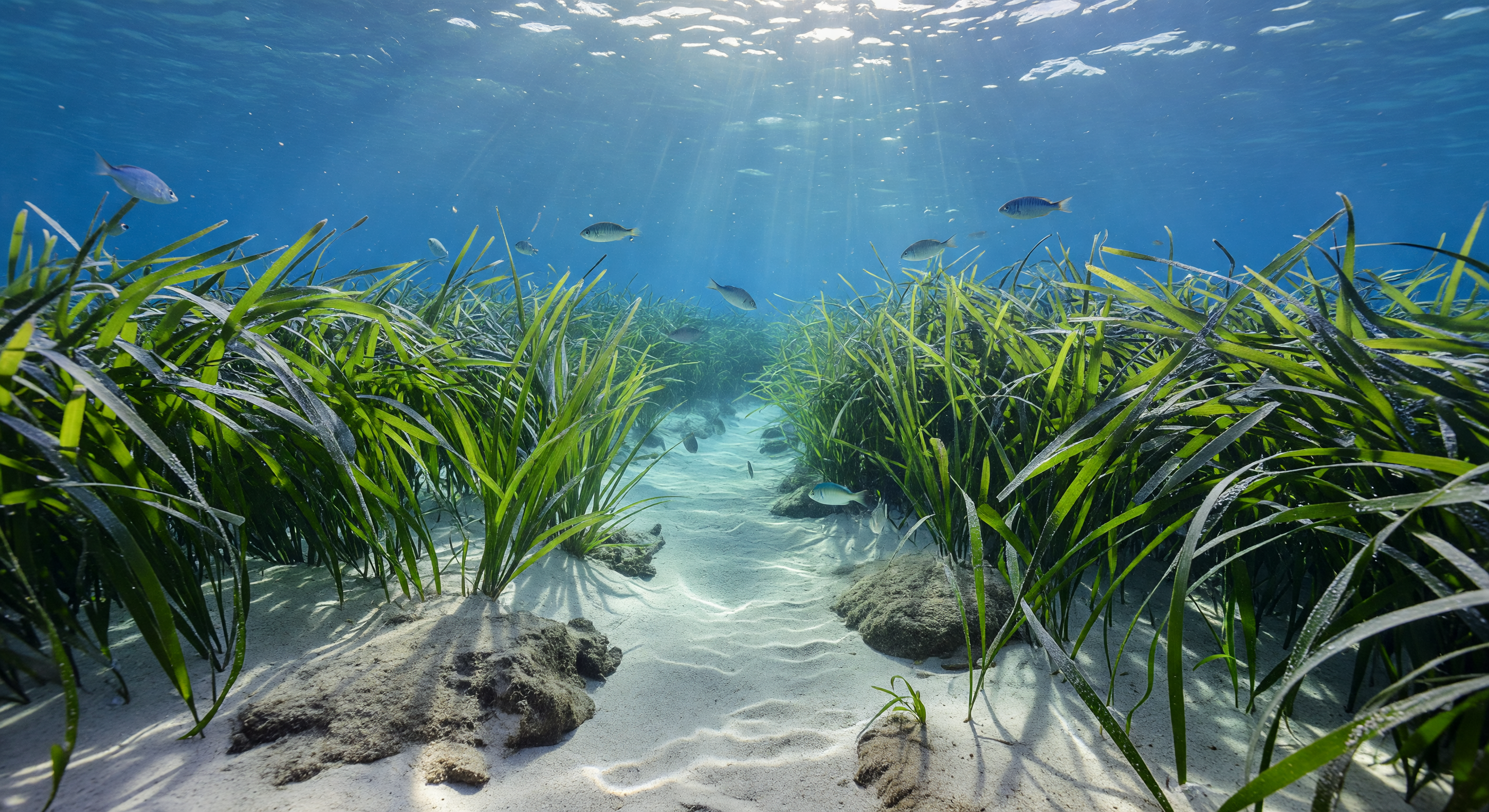
Beneath the sun-drenched surface of the Mediterranean, ribbons of *Posidonia oceanica* rise from pale sand and ancient matte in a dense, swaying prairie, each blade catching the vivid god rays that spear downward through just twelve metres of crystalline blue water — barely more than two atmospheres of pressure, yet a world of extraordinary biological richness. The salinity hovers near 38 PSU, the water temperature warm and stable with the season, and the light here is still so abundant that the uppermost leaf tips glisten with tiny oxygen bubbles, the quiet signatures of active photosynthesis converting Mediterranean sunlight into living tissue. Fine plankton and suspended particles drift through the water column, lit from above by soft caustic shimmer that ripples across the sand lane winding between the meadow beds, while epiphytic algae and microorganisms encrust the older leaf blades, building the complex micro-habitat that makes *Posidonia* one of the most biodiverse ecosystems in the European sea. Wrasse and juvenile bream move through the canopy and across open sand, exploiting the nursery shelter the meadow provides, their scales catching refracted light for an instant before the slow, rhythmic pulse of the current returns the leaves to their quiet, collective sway — a world of deep biological consequence unfolding in the bright, shallow margin of the sea, wholly indifferent to any witness.
Other languages
- Français: Rayons Divins sur Posidonies
- Español: Rayos de Luz en Posidonia
- Português: Raios Divinos na Posidônia
- Deutsch: Gottesstrahlen über Posidonia
- العربية: أشعة إلهية في البوسيدونيا
- हिन्दी: पोसीडोनिया में दिव्य किरणें
- 日本語: ポシドニアに降る光芒
- 한국어: 포시도니아의 신성한 빛줄기
- Italiano: Raggi Divini sulla Posidonia
- Nederlands: Godstralen in Posidonia