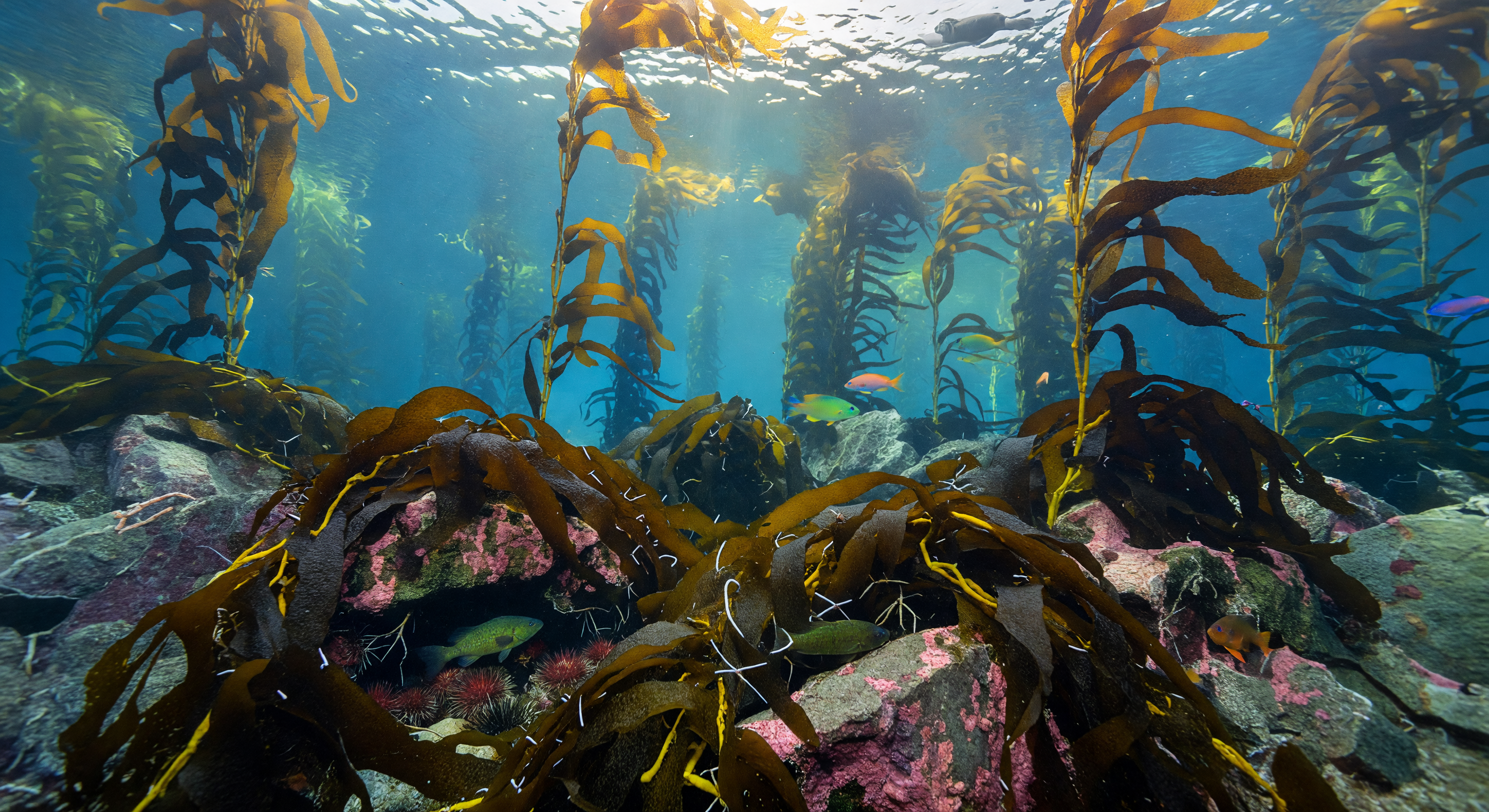
At the base of the giant-kelp forest, where sunlit stipes give way to the reef floor, massive Macrocystis pyrifera holdfasts grip fractured stone with haptera spread like bronze-brown crowns — root-analogue structures that anchor individual kelp blades against surge and current, though the alga draws no nutrients from the rock itself. Pressure here is modest, barely two to four atmospheres, yet the ecological architecture is extraordinary: pink coralline algae crust every exposed surface between the holdfasts, while red sea urchins (Mesocentrotus franciscanus) wedge themselves into crevices, their rasping mouthparts slowly grazing encrusting algae and drifting kelp fragments. Brittle stars thread their five delicate arms through the tangled haptera in perpetual, low-energy scavenging, exploiting the shelter that the holdfast labyrinth provides against predators and flow; a kelp bass (Paralabrax clathratus) hovers half-concealed in olive shadow, its countershaded flanks dissolving into the dim patchwork of filtered sunlight and holdfast geometry. Overhead, stipes rise toward a distant canopy of pneumatocyst-buoyed blades that intercept most incoming solar energy, so only narrow god rays and caustic flickers penetrate to this lowest stratum, creating a perpetual blue-green twilight even in the shallows — a cathedral of living architecture rooted in stone, shaped by cold upwelled water, and sustained entirely by light arriving from above.
Kelp forests