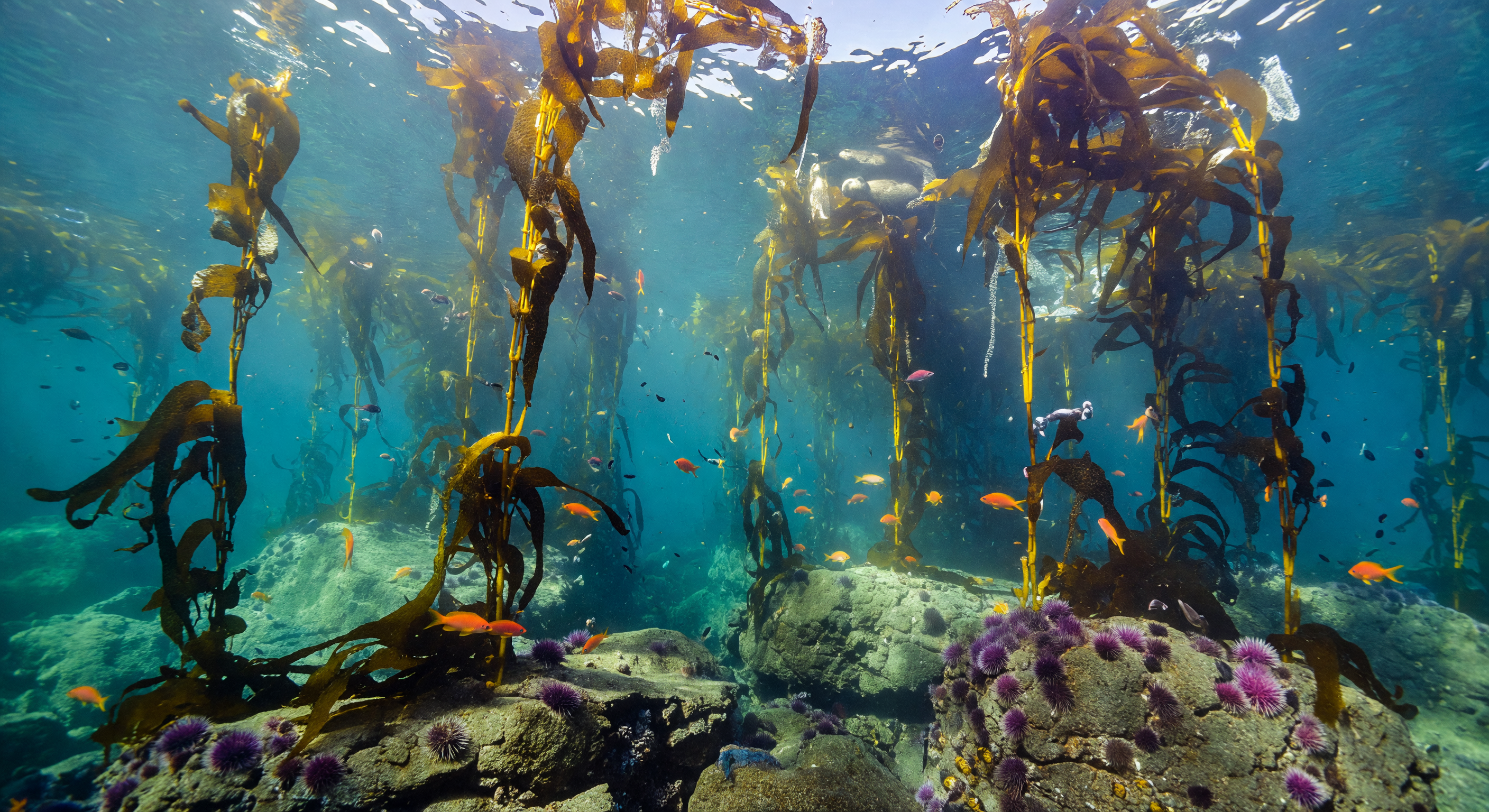
In the aftermath of a powerful Pacific swell, the giant kelp forest reassembles itself in slow motion: snapped stipes and torn pneumatocyst chains drift through vertical corridors of water where the canopy has been ripped open, tumbling in soft arcs as the surge dissipates and surface energy finally releases its grip on the reef. Natural sunlight descends through those newly opened gaps in fractured shafts of blue-green light, casting mobile caustic patterns across freshly scoured bedrock — boulder faces stripped clean of softer encrusting organisms by hours of violent surge, their exposed surfaces now cool and bare, the kind of geological reset that happens on shallow rocky reefs when swells generated hundreds of kilometers offshore finally arrive with full force at the coast. Purple sea urchins, *Strongylocentrotus purpuratus*, have packed themselves into every available crevice and crack in the exposed rock, their dense violet spines precisely oriented, exploiting the shelter that the newly abraded substrate provides while fine particles of silt, plankton, and organic debris — the suspended signature of the storm — drift freely through the water column in the ambient light. Bright orange garibaldis, *Hypsypops rubicundus*, the territorial damselfish emblematic of this ecosystem, move deliberately among the remaining *Macrocystis pyrifera* stipes, their color intensified against the jade and cobalt of the recovering water column, while far above, near the torn canopy, a sea otter floats in a returning patch of surface sunlight, small and unhurried against the vast, still-breathing architecture of kelp.
Kelp forests