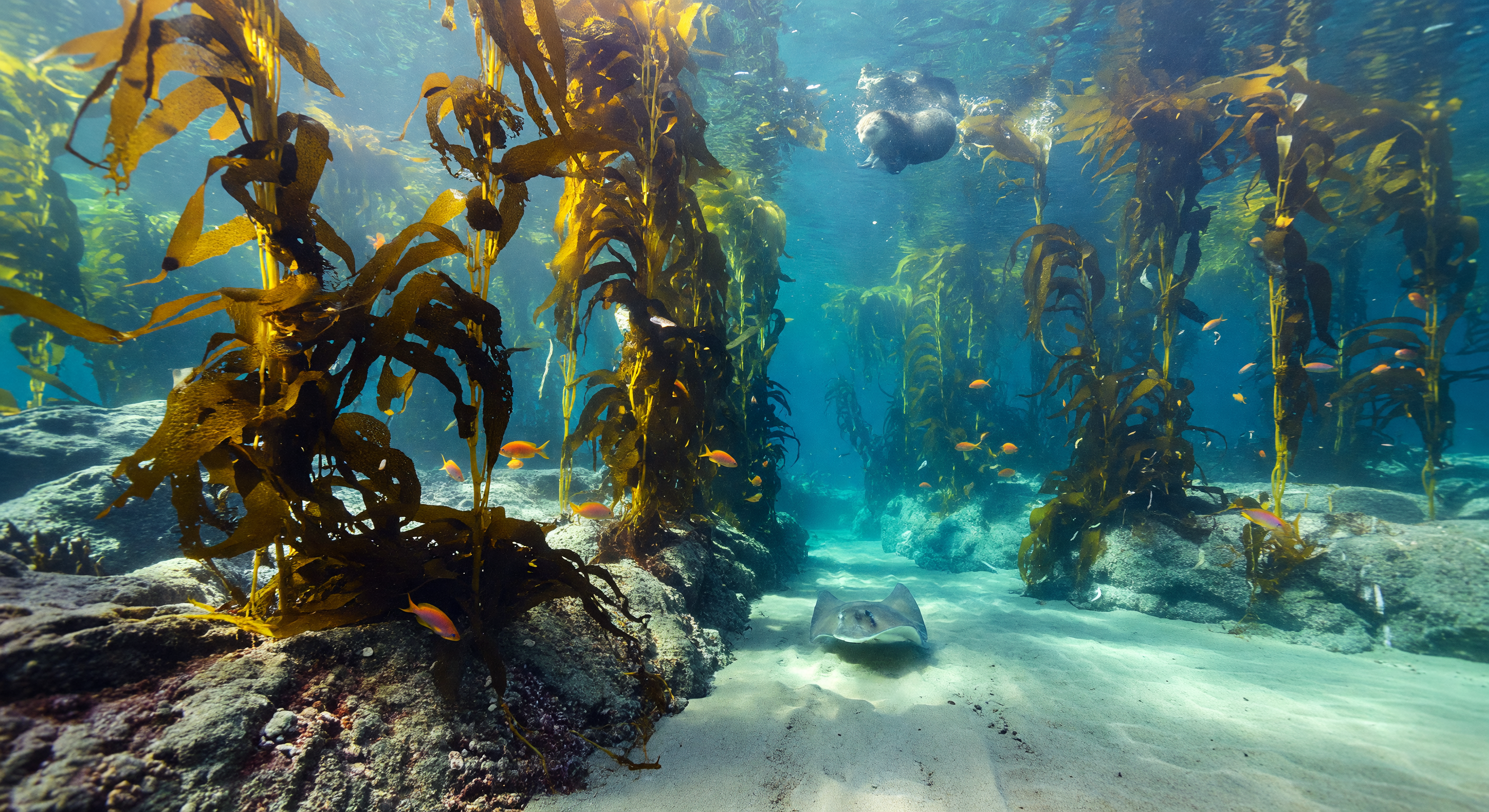
Along the sun-drenched shallows of the California coast, a cathedral of giant kelp — Macrocystis pyrifera — rises from a rocky reef where holdfasts grip encrusted stone, the long bronze-gold stipes ascending through cool, nutrient-rich water toward a shimmering canopy that fractures sunlight into cascading god rays and dancing caustic patterns across the seafloor below. Here, at depths between roughly six and twenty-five meters, the water temperatures hover near twelve to sixteen degrees Celsius, sustained by coastal upwelling that delivers the cold, nitrate-laden currents on which the kelp depends for its extraordinary growth. At the forest's abrupt edge, the reef yields entirely to pale rippled sand, and a round bat ray — Myliobatis californica — glides in effortless silence just above the bottom, its passage leaving a soft, fading inscription in the sediment along this bright open margin where structural complexity collapses into spacious clarity. Orange garibaldis, Hypsypops rubicundus, burn like embers among the kelp columns, while high in the surface canopy a sea otter rests entwined in fronds, anchored against the gentle surge in water that is rich with dissolved oxygen and threaded with drifting organic particles suspended in the ambient blue-green light. This boundary between rock and sand, between dense living architecture and open water, is one of the most ecologically charged transitions in temperate seas — a place of quiet, unwitnessed abundance that has existed, in this form, long before anything named it.
Kelp forests