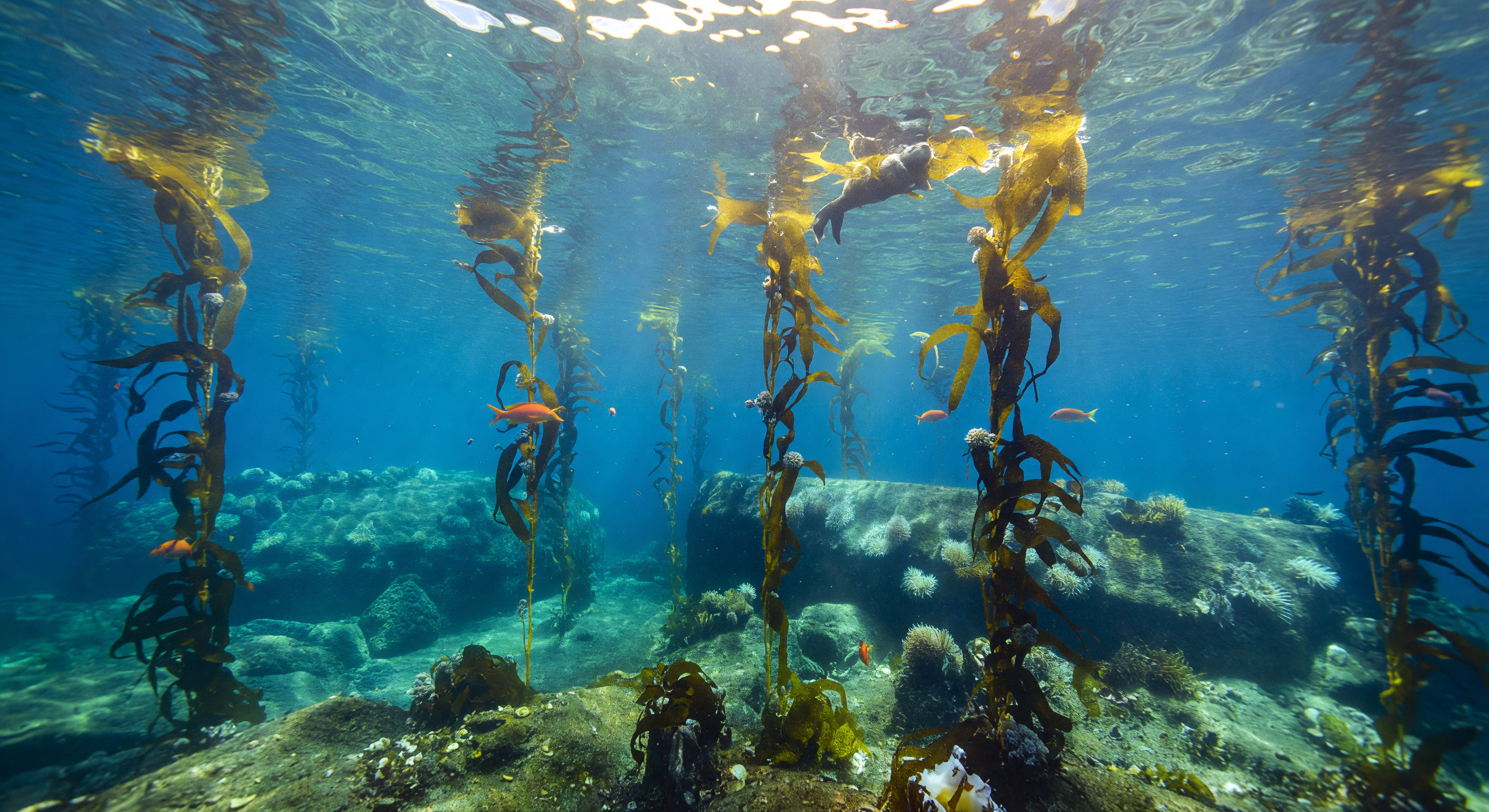
Cold, nutrient-laden water surges upward from depth along the California coast, sharpening the sea to a vivid blue-green clarity that makes every structure within the forest legible with unusual precision — the giant kelp *Macrocystis pyrifera*, rooted to bedrock at twelve to eighteen meters, stretches its stipes taut toward the surface like columns in a submerged cathedral, each pneumatocyst pearled and buoyant, lifting bronze-gold blades into the flickering canopy where broken sunlight refracts into shifting caustics and god rays. Upwelling delivers cold water near ten to twelve degrees Celsius along with dissolved nitrates that fuel kelp growth rates of up to thirty centimeters per day, sustaining one of the ocean's most productive benthic foundation ecosystems at pressures only two to three atmospheres above the surface world. Across the water column, bright orange garibaldis — *Hypsypops rubicundus*, the only reef fish with protected status in California — hover among the stipe shafts, their vivid coloration evolved in a world already flooded with natural light, while fine marine snow drifts slowly downward through the clarified water column, carrying particulate organic matter toward the reef below. On the seafloor, bedrock and boulders bear a dense understory of coralline algae and shell fragments, their shadows broken by the rhythmic surge that gently sways each frond overhead, and the distant reef ledges dissolve into clean blue-green haze dotted with open white plumose anemones, *Metridium senile*, filtering the oxygen-rich current with hundreds of feathered tentacles. Near the surface canopy, a sea otter rests unwrapped in fronds, part of a predator guild whose presence or absence reshapes the entire forest by controlling the urchin populations that, unchecked, can reduce this cathedral of living algae to bare rock.
Other languages
- Français: Pulse Bleu-Vert Montant
- Español: Pulso Verde-Azul Surgente
- Português: Pulso Verde-Azul Ascendente
- Deutsch: Blaugrüner Auftriebspuls
- العربية: نبضة خضراء زرقاء صاعدة
- हिन्दी: उभरती नीली-हरी लहर
- 日本語: 湧昇の青緑の脈動
- 한국어: 용승하는 청록빛 파동
- Italiano: Pulsazione Verde-Azzurra Ascendente
- Nederlands: Opstijgende Blauwgroene Puls