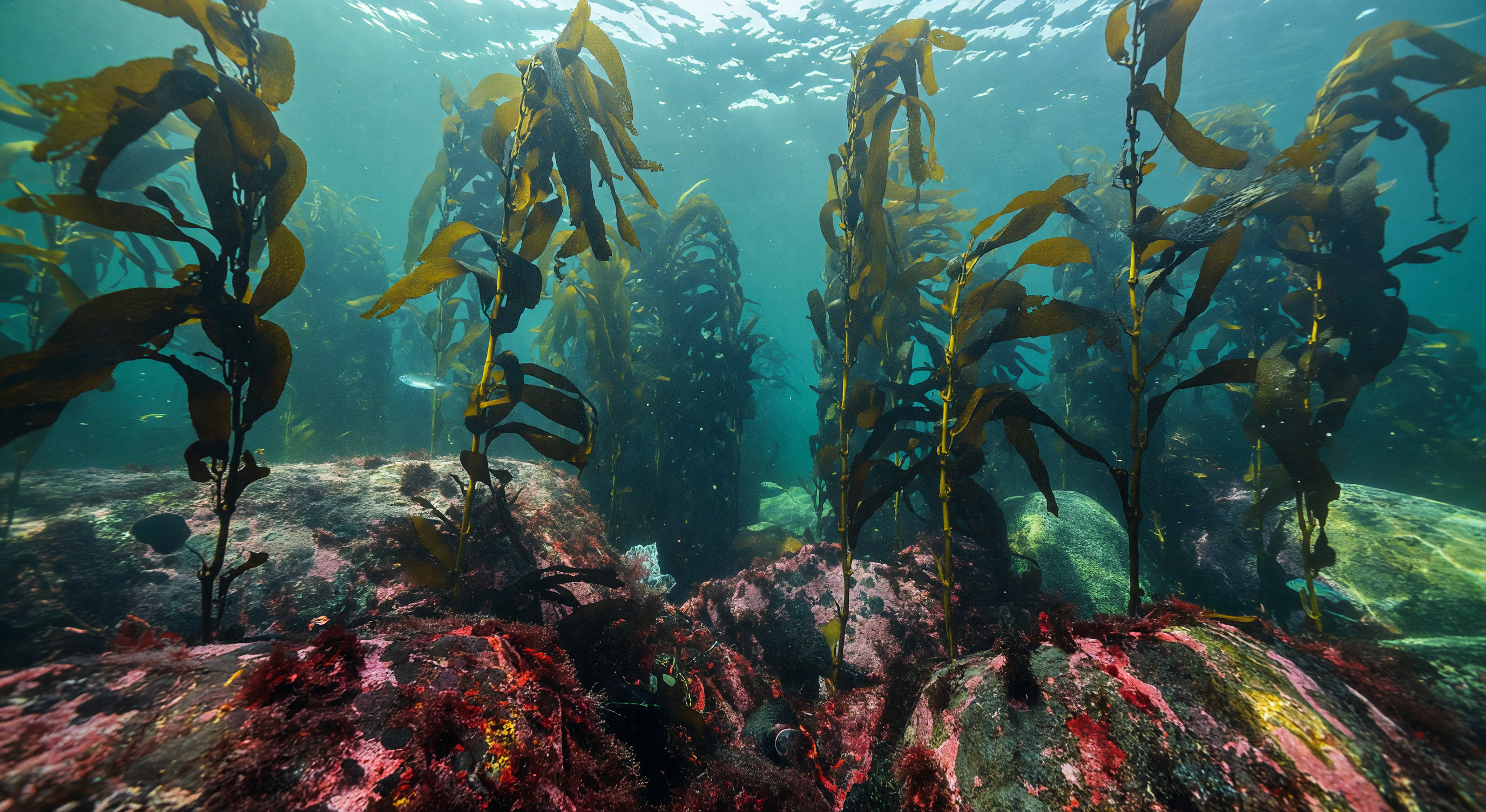
Between roughly eight and fifteen metres depth along the northeastern Atlantic coast, where wave surge still bends every frond and sunlight arrives as shifting green fire, Laminaria hyperborea anchors itself by muscular holdfasts to a boulder field encrusted with crimson red algae, pale pink corallines, and dark epilithic films that have been building for decades. The water here carries around two atmospheres of pressure — modest by oceanic standards, yet enough to give it a cool, pressing weight — and its temperature rarely climbs above twelve or thirteen degrees Celsius, conditions that suit this cold-adapted macroalga perfectly, fuelling growth rates that can exceed half a metre of new blade each year. Sunlight fractures at the surface and descends as animated caustic patterns, striping the leathery olive-brown blades and the pale undersides of small pollack drifting in loose aggregations between the stipes, their scales catching and releasing brief sparks of green light. The canopy is lower and darker than its Pacific counterparts, its broad blades overlapping to create a dimmed understory where fine marine snow drifts freely downward and red algal understory species — Delesseria, Phycodrys, dense mats of Lithothamnion — persist in the filtered illumination. This is one of the most productive coastal ecosystems on the planet, a foundation habitat that fixes carbon, oxygenates the surrounding water, and sustains food webs from sea urchins and tophknots to harbour seals patrolling the outer edges, all of it existing in complete indifference to any observer.
Other languages
- Français: Laminaire Verte Atlantique
- Español: Laminaria Verde Atlántica
- Português: Laminária Verde Atlântica
- Deutsch: Atlantischer Grüner Seetang
- العربية: عشب البحر الأطلسي الأخضر
- हिन्दी: अटलांटिक हरित लैमिनेरिया
- 日本語: 大西洋の緑のコンブ
- 한국어: 대서양 녹색 다시마
- Italiano: Laminaria Verde Atlantica
- Nederlands: Atlantisch Groen Zeewier