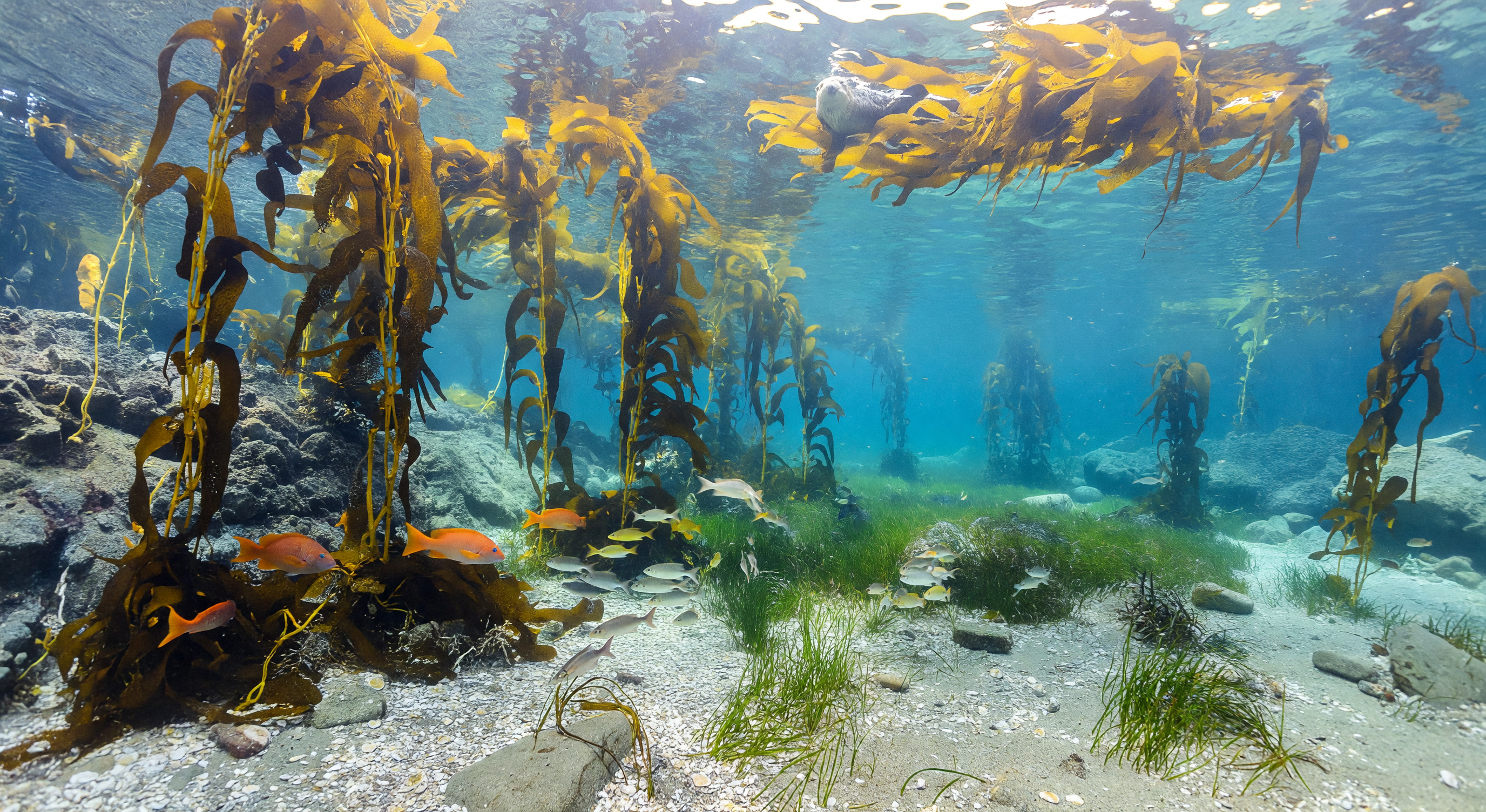
In the sheltered waters of a California cove, giant kelp — *Macrocystis pyrifera* — rises from holdfasts locked onto rocky reef in dense, cathedral-like pillars, its long stipes threaded with gas-filled pneumatocysts that buoy each frond toward a canopy shimmering at the surface, where photosynthesis proceeds with extraordinary intensity in the fully sunlit epipelagic zone. Here, at depths rarely exceeding twenty meters, pressure remains gentle — no more than three atmospheres — and the governing forces are wave surge, nutrient-rich upwelling, and the quality of light filtering down through layered fronds, shifting from vivid open-ocean turquoise to the softer, diffuse green that pools over the eelgrass meadow beyond. That meadow, woven from ribbons of *Zostera marina* anchored in pale sand and shell hash, forms a distinct transitional habitat: a nursery ecosystem where fine organic particles settle, invertebrates colonize shell fragments, and small silver juvenile fishes hover in loose aggregations, exploiting the shelter before dispersing into deeper reef communities. Bright garibaldis — *Hypsypops rubicundus*, the only truly territorial damselfish of the eastern Pacific — hold station near the rocky kelp edge, their vivid orange bodies catching the caustic light patterns that dance across stone and algal blade alike. A sea otter rests motionless among surface fronds above, its presence an ecological signature of this coast — a predator whose appetite for sea urchins keeps grazing pressure in check and the kelp forest itself intact, the entire scene existing in a continuous, self-sustaining cycle entirely indifferent to any witness.
Other languages
- Français: Transition Varech Herbiers
- Español: Transición Kelp Pastos Marinos
- Português: Transição Algas Ervas Marinhas
- Deutsch: Seetang Seegras Übergang
- العربية: انتقال عشب البحر والعشب الكلبي
- हिन्दी: समुद्री घास केल्प संक्रमण
- 日本語: ケルプと海草の移行
- 한국어: 해초 켈프 전환
- Italiano: Transizione Kelp Posidonia
- Nederlands: Zeegras Kelp Overgang