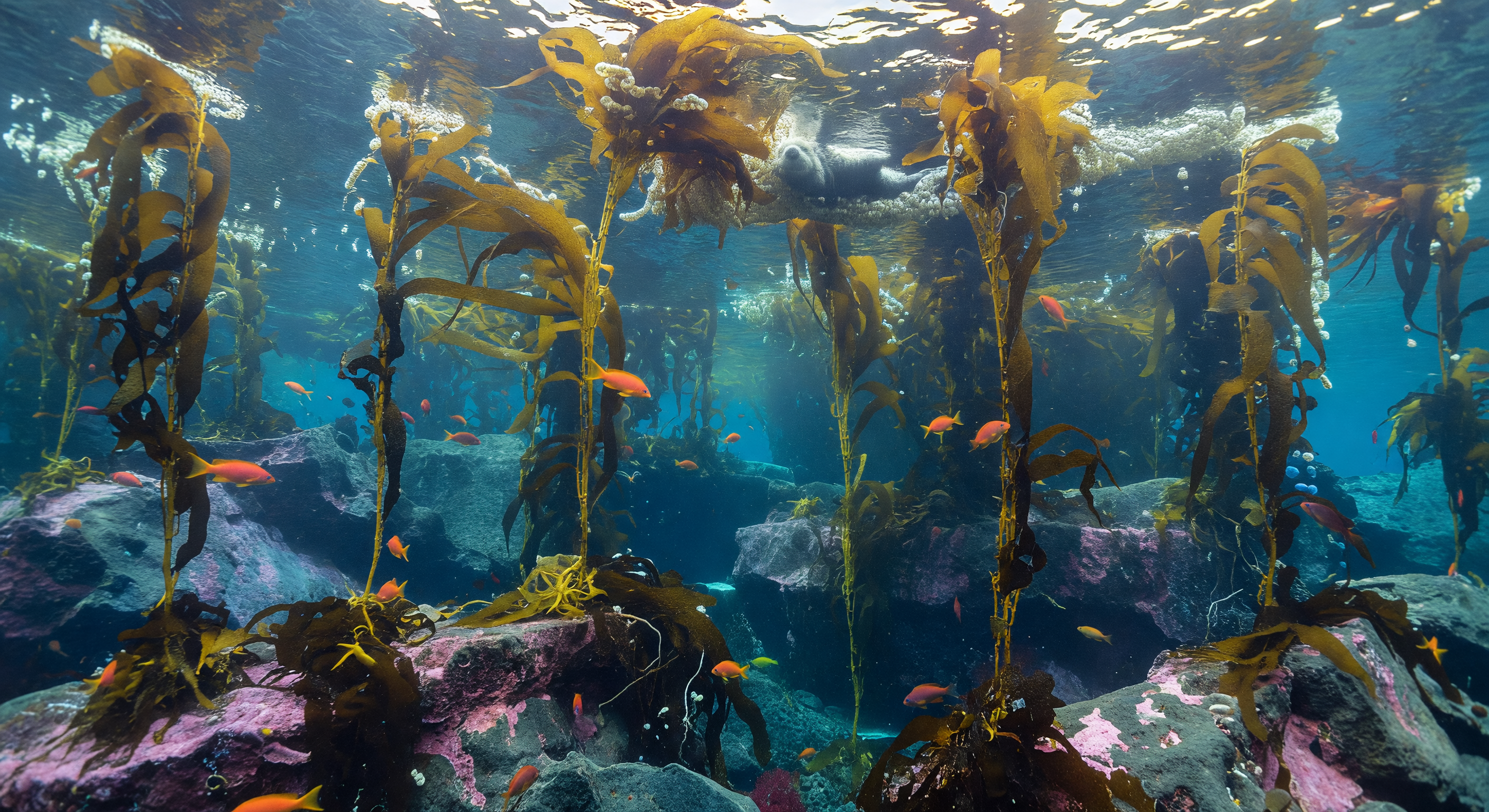
Shafts of filtered sunlight descend through the floating canopy of *Macrocystis pyrifera* in long, trembling columns of blue-green light, fracturing into dancing caustics across basalt ledges crusted with coralline pink algae — a liquid cathedral reaching from rocky seafloor to shimmering surface, rooted at depths of ten to fifteen metres where pressure is modest but biological complexity is extraordinary. Long, flexible stipes rise like living architecture from intricate holdfast tangles gripping volcanic rock, their bronze-gold blades unfurling in slow rhythmic ribbons as nutrient-rich, cool upwelled water moves gently through the forest; chains of pearl-white pneumatocysts — gas-filled floats packed with carbon monoxide — gather beneath the canopy roof, keeping the entire structure vertical and taut. Vivid orange garibaldis, *Hypsypops rubicundus*, the only federally protected marine fish in California, hover and wheel between the stipes, their pigmentation absorbing the blue-shifted light and re-emitting a saturated warmth that glows against the cobalt water column, while a sea otter rests motionless among the surface fronds overhead, backlit by rippled sunlight filtering through the canopy above. At this depth, primary production through photosynthesis is intense — giant kelp can grow up to sixty centimetres per day under optimal conditions — making these forests among the most productive ecosystems on the planet, sustaining layered communities of rockfish, invertebrates, and understory algae in a world of oxygen, light, and silent, perpetual motion.
Other languages
- Français: Cathédrale liquide de varech
- Español: Catedral líquida de kelp
- Português: Catedral líquida de algas
- Deutsch: Flüssige Kathedrale aus Kelp
- العربية: كاتدرائية سائلة من العشب البحري
- हिन्दी: केल्प की तरल गिरजाघर
- 日本語: ケルプの水中大聖堂
- 한국어: 켈프의 수중 대성당
- Italiano: Cattedrale liquida di kelp
- Nederlands: Vloeibare kathedraal van kelp