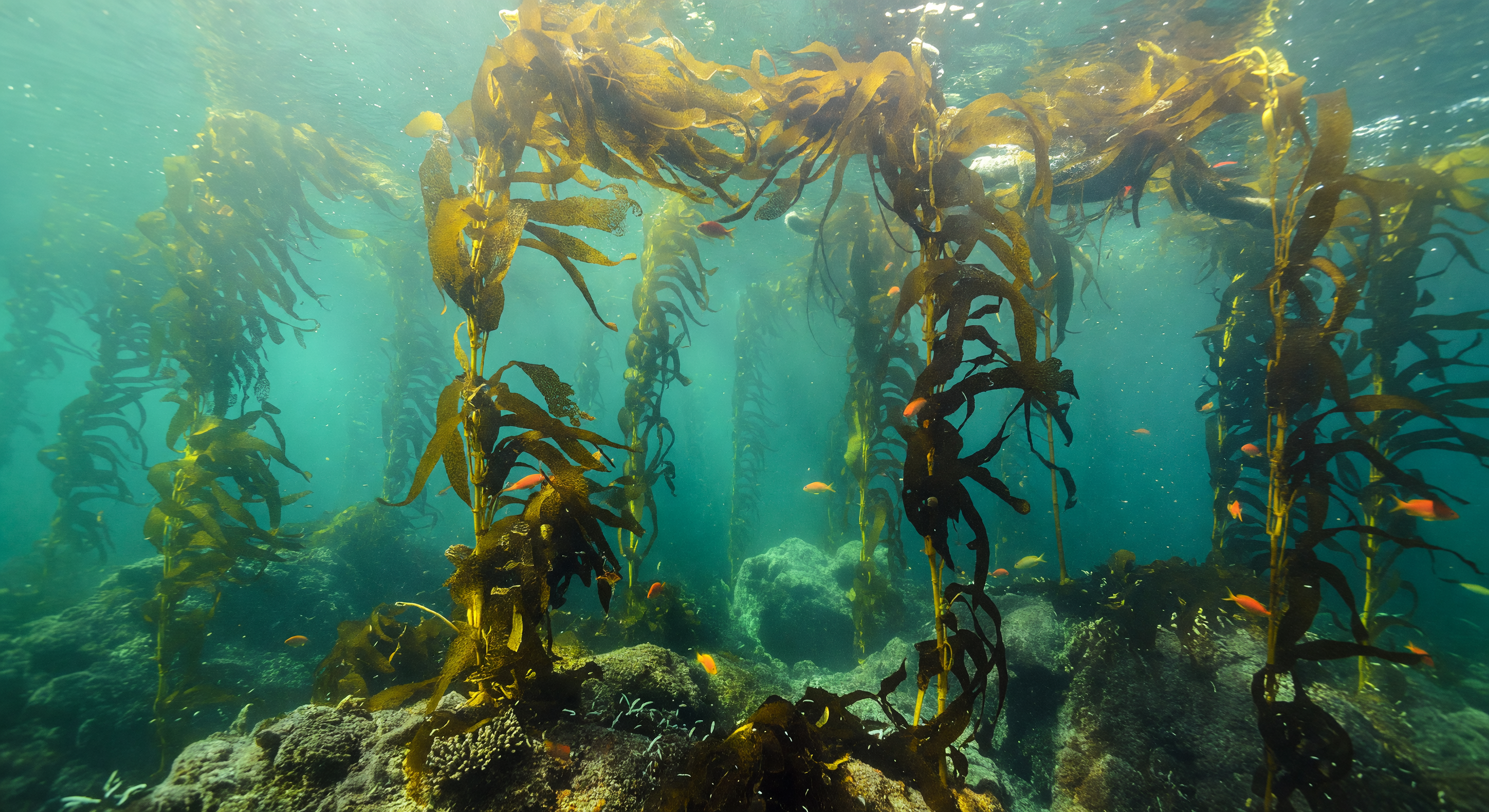
At roughly 8 to 15 meters depth along the California coast, spring upwelling floods the water column with nitrates, triggering a phytoplankton bloom that transforms the sea into a luminous jade veil — billions of microscopic diatoms and dinoflagellates suspended in the full force of unfiltered Pacific sunlight. Macrocystis pyrifera rises from holdfasts gripping coralline-encrusted boulders, stipes climbing through emerald god-rays toward a canopy where pneumatocysts keep the fronds aloft, the entire structure photosynthesizing at peak seasonal productivity in water still brisk from winter upwelling near 12°C. Dense copepod clouds, Calanus pacificus and kin, drift in slow gyres around sunlit blades, their translucent bodies catching and scattering light, part of a zooplankton biomass so thick it creates its own opaline shimmer throughout the water column. Garibaldis, Hypsypops rubicundus, hold territory among the amber stipes while small rockfish thread the vertical corridors, and near the canopy's outer edge a sea otter rests among floating fronds, wrapped in the quiet oxygen-saturated surge of a forest that has existed on this reef entirely on its own terms — rooted, breathing, and complete.
Other languages
- Français: Voile de Floraison Planctonique
- Español: Velo de Floración Planctónica
- Português: Véu de Floração Planctônica
- Deutsch: Planktonblüten Schleier
- العربية: حجاب ازدهار العوالق
- हिन्दी: प्लैंकटन खिलाव घूंघट
- 日本語: プランクトン繁殖の霞
- 한국어: 플랑크톤 번성 베일
- Italiano: Velo di Fioritura Planctonica
- Nederlands: Planktonbloei Sluier