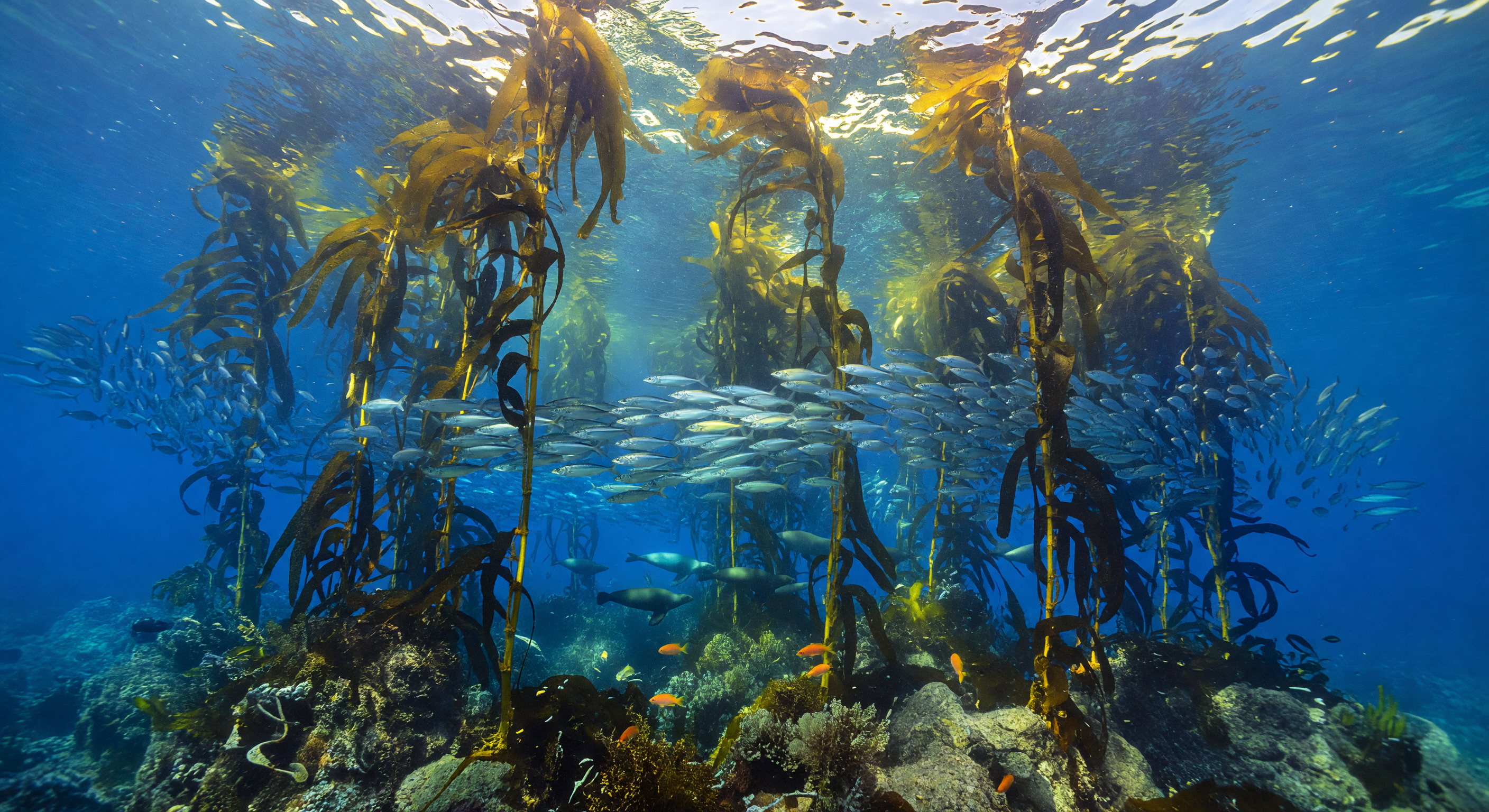
At the seaward edge of a California giant kelp forest, Macrocystis pyrifera rises from coralline-encrusted boulders in great flexible columns, their pneumatocyst-buoyed fronds gathering into a shimmering canopy just below the surface — a living architecture that can grow more than thirty centimeters in a single day under ideal conditions. Sunlight descends through this upper canopy in shifting caustic nets and blue-green shafts, fracturing into gold highlights along the bronze stipes and cooler teal shadow in the midwater, while fine suspended plankton drift through water both nutrient-rich and oxygen-saturated, fed by the cold coastal upwelling that makes this system among the most productive on Earth. Along the forest's outer face, a dense shoal of Pacific sardines — Sardinops sagax — executes a single synchronized arc, thousands of laterally flattened bodies turning in unison, their guanine-crystal scales flashing mirror-bright in a collective antipredator display that transforms individual fish into one cohesive sheet of liquid silver. California sea lions, Zalophus californianus, cut beneath the sardine mass in near-silent torpedo passes, dark fusiform bodies flickering through cold shafts of filtered light as they exploit the confusion effect at the shoal's edge, while garibaldis hover in territorial amber near the holdfast zone below. This reef fringe — where structured kelp architecture dissolves into open cobalt water — concentrates predator and prey in a dynamic boundary layer shaped entirely by sunlight, cold Pacific currents, and the patient geometry of algae rooted in stone.
Other languages
- Français: Rivière de Sardines au Bord
- Español: Río de Sardinas al Límite
- Português: Rio de Sardinhas na Beira
- Deutsch: Sardinenstrom am Rand
- العربية: نهر السردين عند الحافة
- हिन्दी: किनारे पर सार्डिन नदी
- 日本語: 端のイワシの川
- 한국어: 경계의 정어리 강
- Italiano: Fiume di Sardine al Limite
- Nederlands: Sardijnenstroom aan de Rand