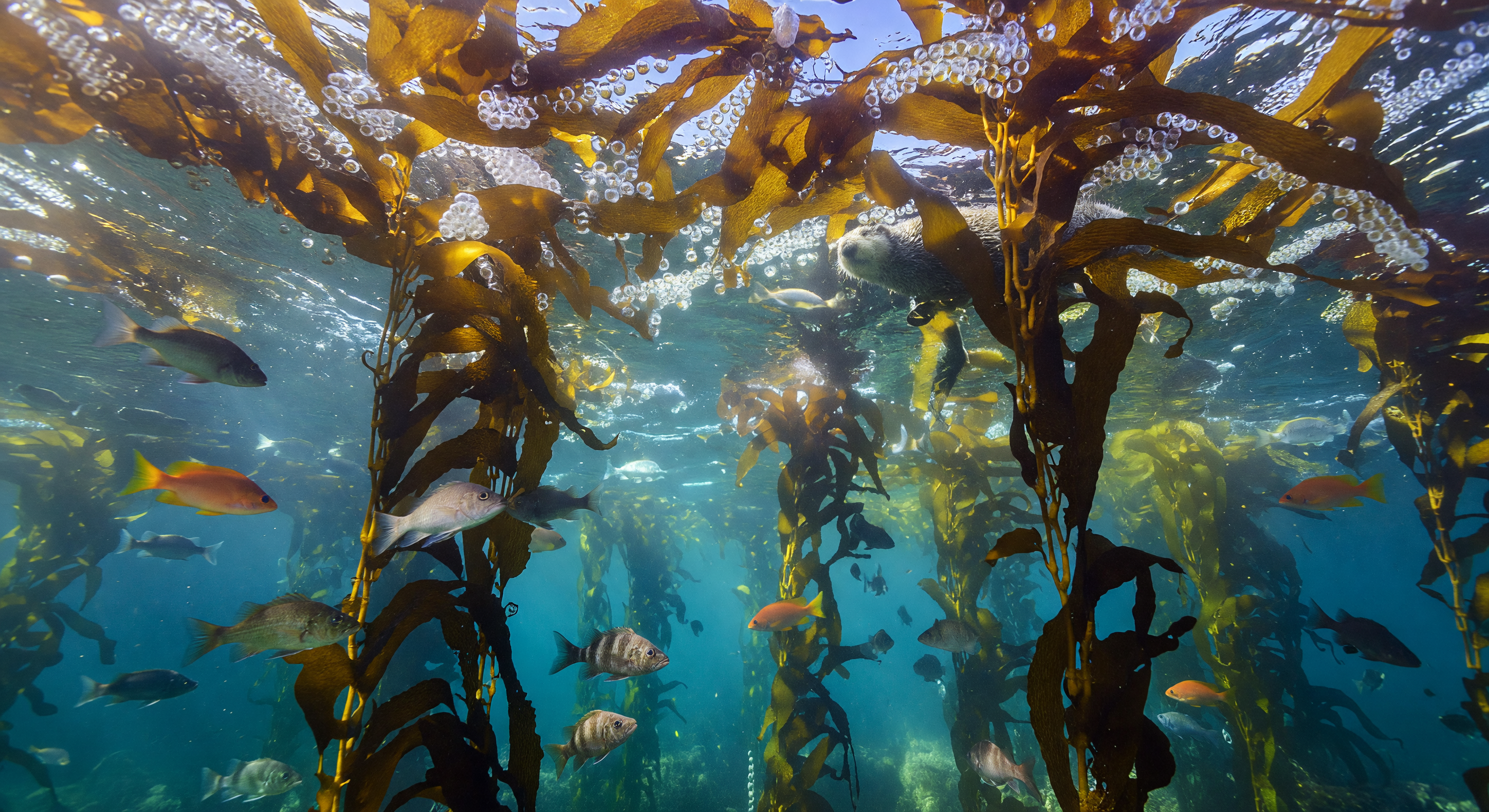
Just beneath the surface of a California coastal reef, the giant kelp *Macrocystis pyrifera* rises from rocky substrate in dense vertical stipes, its gas-filled pneumatocysts buoying fronds upward until they spread across the water's surface in an interlocking bronze-and-gold canopy, filtering the midday sun into shifting caustic patterns and god rays that ripple through the blue-green water column below. At this shallow depth — a few meters at most — pressure barely exceeds one atmosphere, oxygen saturation is high, and full-spectrum sunlight penetrates with enough intensity to drive extraordinary rates of photosynthesis, making kelp forests among the most productive ecosystems on the planet. Juvenile rockfish, their translucent fins and mottled flanks perfectly camouflaged against the dappled light, hold station among the pneumatocyst chains, exploiting the structural complexity of the canopy as refuge from predation while feeding on the dense clouds of zooplankton suspended in the illuminated water. Deeper between the stipes, garibaldi — the brilliant orange damselfish endemic to the northeastern Pacific — patrol their algal territories against olive-shadowed backgrounds, their vivid coloration a product of carotenoid-rich diets in these nutrient-upwelled nearshore waters. Above, a sea otter rests half-concealed within the canopy lanes, an ecological keystone whose predation on sea urchins protects the kelp holdfasts from the grazing pressure that, unchecked, can reduce this entire cathedral of living architecture to barren rock.
Other languages
- Français: Mosaïque de Varech Midi
- Español: Mosaico de Dosel Marino
- Português: Mosaico de Kelp ao Meio-Dia
- Deutsch: Baldachin Mosaik Mittag
- العربية: فسيفساء عشب البحر الظهيرة
- हिन्दी: केल्प छतरी दोपहर मोज़ेक
- 日本語: ケルプ林冠の昼景
- 한국어: 켈프 캐노피 한낮 모자이크
- Italiano: Mosaico di Alghe Mezzogiorno
- Nederlands: Kelp Baldakijn Middagmozaïek