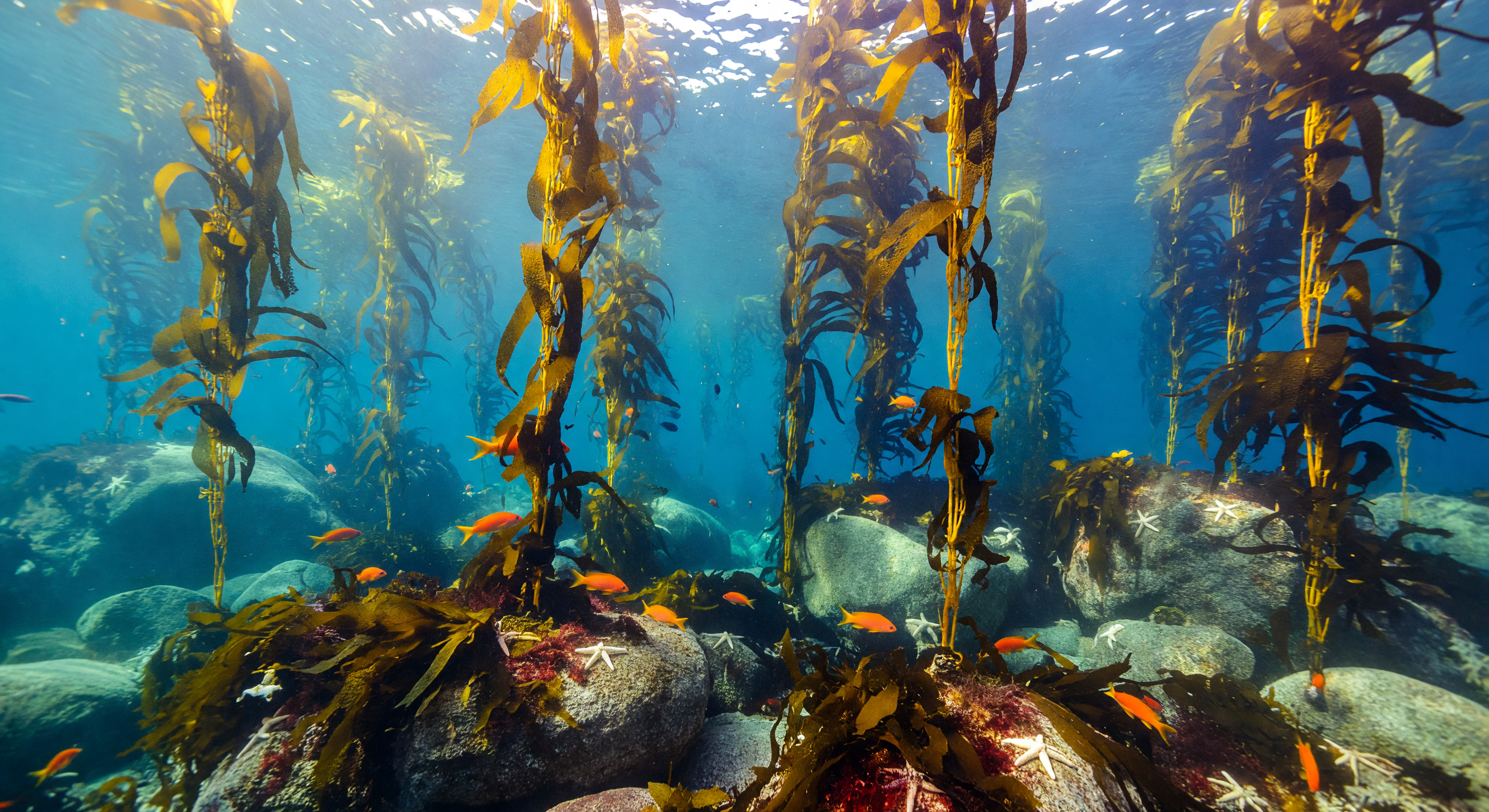
Sunlight arrives at this depth not as a distant rumor but as a living architecture — rippling caustics slide ceaselessly across rounded granite boulders, bending and fracturing with each passing swell, illuminating a world of extraordinary clarity and color. Towering columns of giant kelp, *Macrocystis pyrifera*, rise from their holdfasts like the pillars of a drowned cathedral, their pneumatocyst-studded blades backlit amber and gold where they approach the canopy, cooling through emerald and into cobalt in the shadowed intervals between them. In the bright clearing between these living columns, territorial garibaldis — *Hypsypops rubicundus*, the only damselfish of the northeastern Pacific — burn an improbable cadmium orange against the blue-green water, each individual defending its patch of reef with the quiet authority of a creature that has never needed to fear the dark. Beneath them, feather boa kelp and low understory algae carpet the reef in layered olive and red, while white sea stars cling motionless to sunlit stone, and fine suspended particles drift through the water column, catching the ambient light like slow snow in a world without winter. This is one of the most productive shallow marine ecosystems on Earth, where upwelled nutrients, oxygenated water, and relentless solar energy converge to sustain a benthic forest that shelters thousands of species and has been growing, collapsing, and regrowing along this coast for millions of years without witness.
Other languages
- Français: Clairière du Jardin Garibaldi
- Español: Claro del Jardín Garibaldi
- Português: Clareira do Jardim Garibaldi
- Deutsch: Garibaldi Garten Lichtung
- العربية: فسحة حديقة غاريبالدي
- हिन्दी: गैरीबाल्डी गार्डन की सफाई
- 日本語: ガリバルディの庭の空き地
- 한국어: 가리발디 정원 빈터
- Italiano: Radura del Giardino Garibaldi
- Nederlands: Garibaldi Tuin Open Plek