At 300 metres down the continental slope, sunlight has been stripped of every warm wavelength by the weight of water above, arriving here only as a cold, attenuating blue that bleaches to indigo against the gullied sediment face and surrenders entirely in the deeper ravines below. Pressure at this depth exceeds 30 atmospheres, and the water column is anything but empty: an internal tidal pulse — the slow, rhythmic heaving of density interfaces set in motion by the interaction of barotropic tides with the slope itself — organises marine snow and transparent copepods into diagonal streaming lanes, a quiet blizzard of organic detritus, faecal pellets, shed exoskeletons, and collapsed mucous feeding webs drifting steadily downslope to feed the benthos below. Near the sediment face, a faint nepheloid layer hovers, a whisper of resuspended silt kept aloft by bottom shear, while deep in the darker recesses of the gully walls, isolated bioluminescent pinpricks flash without witness — chemical light produced by organisms that have never known sunlight and require none. Far overhead, the deep scattering layer resolves as a broad, diffuse dark band suspended across the fading blue ceiling, a living acoustic mirror composed of myctophid fish, siphonophores, euphausiids, and gelatinous zooplankton that migrate vertically each day across hundreds of metres, coupling the sunlit surface with this cold, pressured twilight through the simple act of breathing and eating.
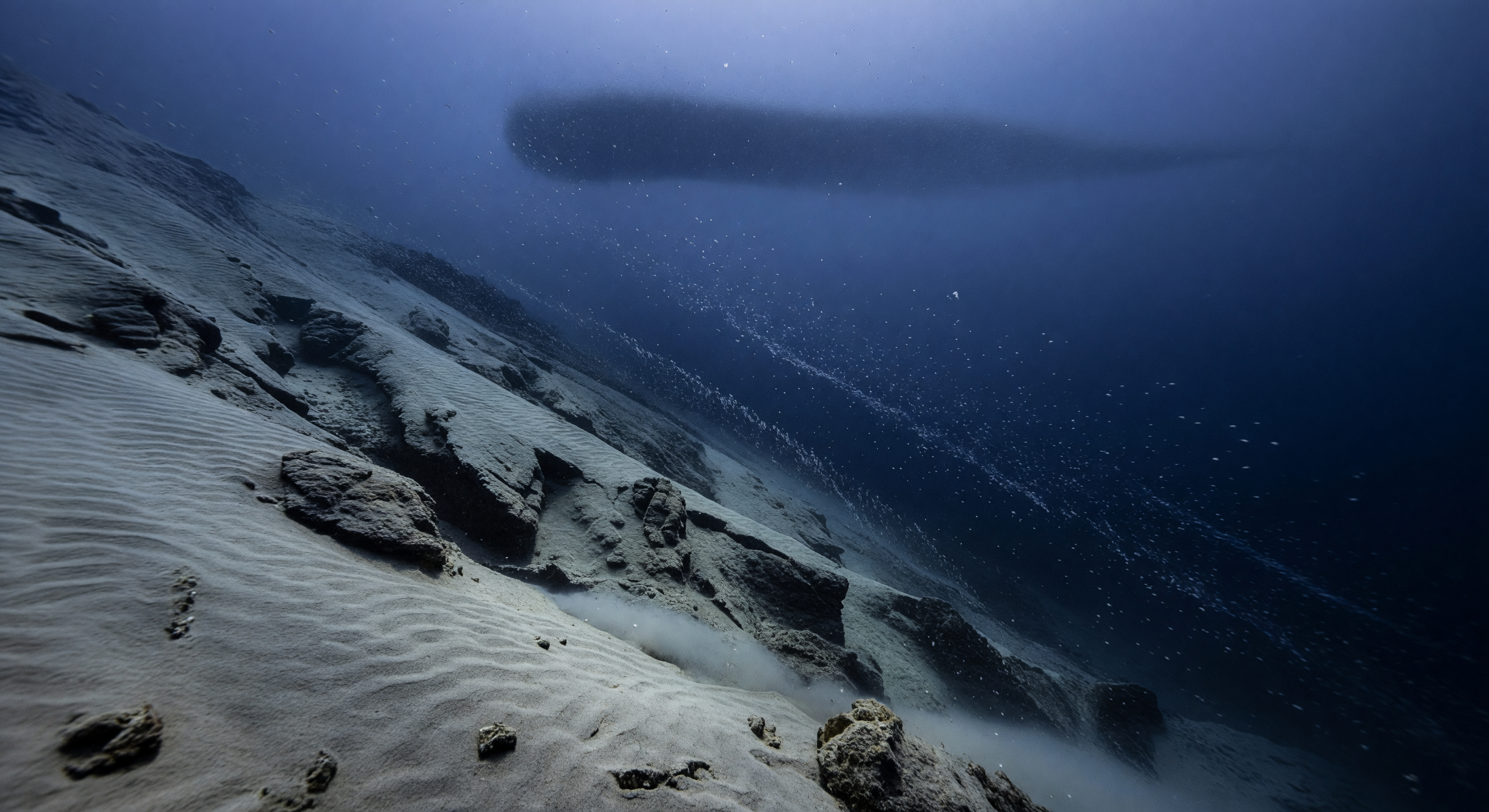
Continental slope