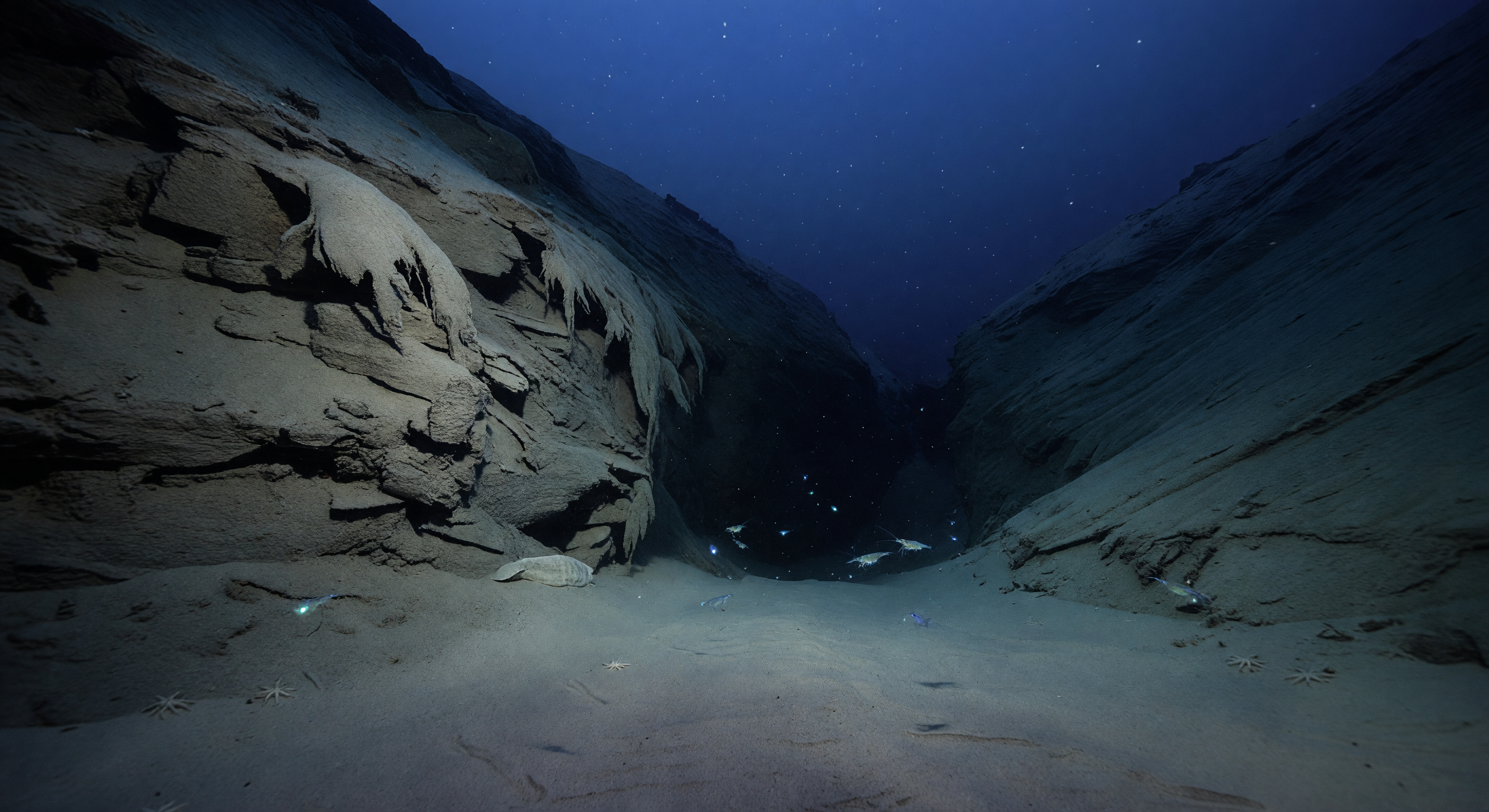
At 560 meters depth, the continental slope folds into a shadowed gully where geology tells its own violent history — a fresh slump scar exposes raw gray-beige mud in fractured plates and torn silt drapes, evidence of a recent gravitational failure along the steep margin where sediment periodically surrenders to slope and pressure. The last residual downwelling sunlight reaches this depth as little more than a dim cobalt gradient, attenuating rapidly into indigo and then absolute black within the ravine's deepest recesses, where the water column above exerts roughly 57 atmospheres of pressure against every surface. Suspended marine snow drifts in languid suspension through the cold water column, while a fragile carpet of recently displaced silt mantles the gully floor, its smooth surface still bearing the faint textural memory of its own slow movement. Against this near-darkness, transparent mesopelagic shrimp — startled into bioluminescent response — emit scattered blue-green pinpricks of light, each brief flash briefly illuminating glassy bodies, fine antennae, and silvery tapetal eyes before extinguishing back into the dark; this chemical light is not decoration but defense, a startle response evolved across millions of years in a world where the only illumination has ever been biological. Along the gully margins, brittle stars trace delicate signatures across the silt and a pale holothurian rests near the slump scar, these benthic organisms part of a transition fauna that shifts markedly with depth along the slope, living entirely within a silence and pressure that has never required our witnessing.
Other languages
- Français: Premières Lueurs dans le Ravin
- Español: Destellos en el Barranco
- Português: Primeiros Brilhos no Barranco
- Deutsch: Erste Blitze im Abgrund
- العربية: أولى الومضات في الوادي
- हिन्दी: खड्ड में पहली चमक
- 日本語: 谷間の最初の閃光
- 한국어: 협곡의 첫 섬광
- Italiano: Primi Bagliori nel Burrone
- Nederlands: Eerste Flitsen in Kloof