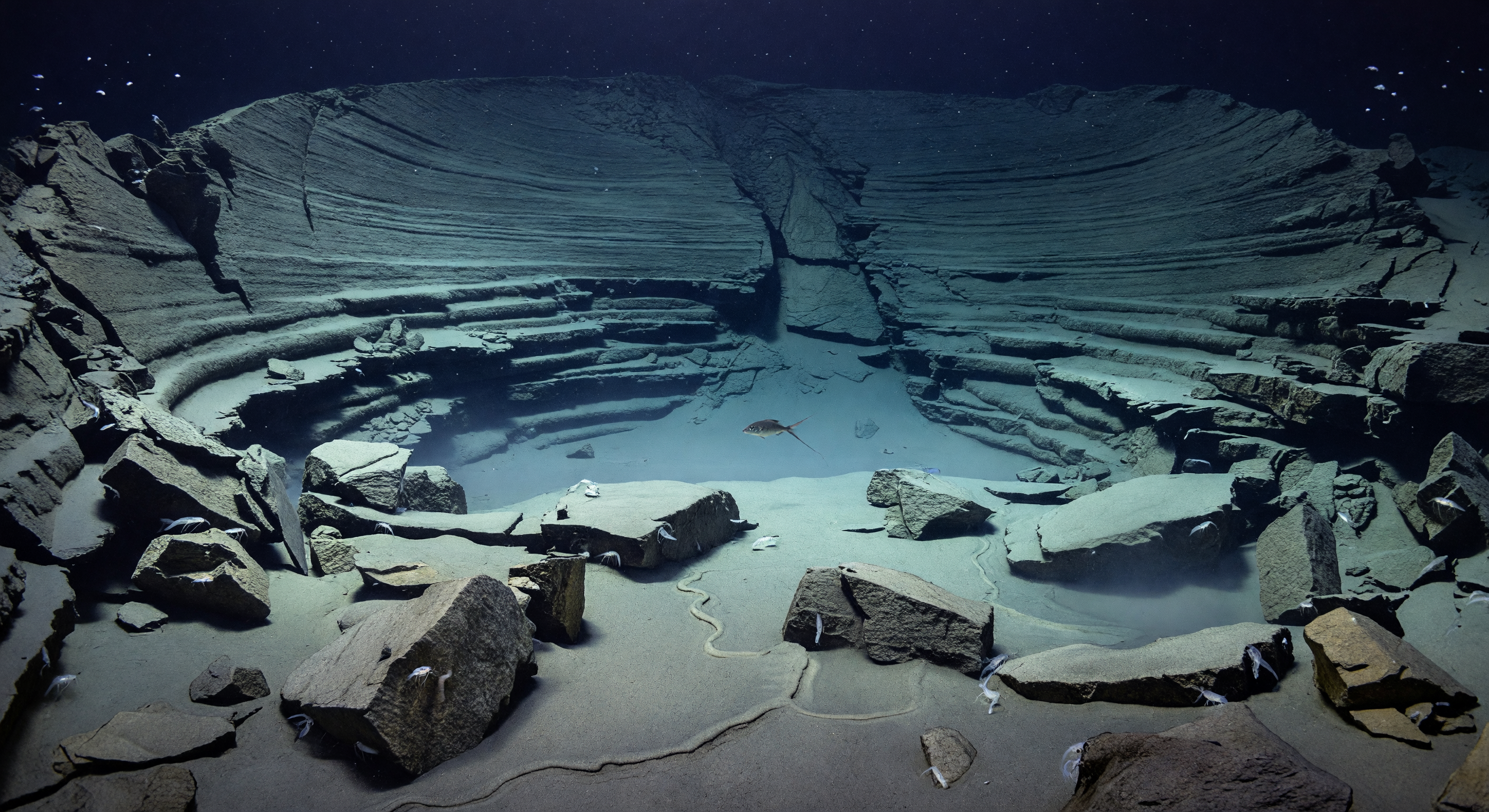
At 620 metres depth on the continental slope, the seafloor bears the exposed anatomy of a past catastrophic failure: a crescent headwall of pale compacted sediment and fractured mudstone rises in clean arcuate bands above a basin strewn with angular toppled blocks, all draped in thin silts and flanked by narrow ravines that record the geometry of ancient downslope collapse. Pressure here exceeds 60 atmospheres, the water hovers just above 4°C, and the only illumination is the last attenuated remnant of sunlight — a monochromatic deep blue that dissolves into indigo within the recesses of the amphitheater, naturally tracing every scarp and ledge without a single artificial source. A lone grenadier, Coryphaenoides or a close relative, hangs motionless over the sedimented basin floor, its long tapering tail and silvery-charcoal body characteristic of the rattail family that dominates benthic fish communities across the world's slopes at this depth; sparse transparent shrimps and small invertebrates occupy crevices in the rock edges, part of the mesopelagic–benthic transition fauna adapted to near-zero light and crushing pressure. Marine snow descends steadily through the water column, each particle a fragment of biological production from far above, while a thin nepheloid layer hazes the sediment surface and occasional pinpoints of bioluminescence flicker at the darker margins — the cold, silent, self-sufficient metabolism of a world that has never required a witness.
Other languages
- Français: Amphithéâtre d'Effondrement
- Español: Anfiteatro de Derrumbe
- Português: Anfiteatro de Deslizamento
- Deutsch: Rutschnarben Amphitheater
- العربية: مدرج ندبة الانهيار
- हिन्दी: भूस्खलन घाव रंगमंच
- 日本語: 崩落痕円形劇場
- 한국어: 함몰 흉터 원형극장
- Italiano: Anfiteatro della Frana
- Nederlands: Instorting Litteken Amfitheater